Tom Polen remembers being acquired. Before he was the executive welcoming new teams into BD, he belonged to a small company that had been bought. Years later, standing before employees arriving through another deal, he could reach for a memory considerably more useful than a slide about corporate culture: he knew what their first day felt like.
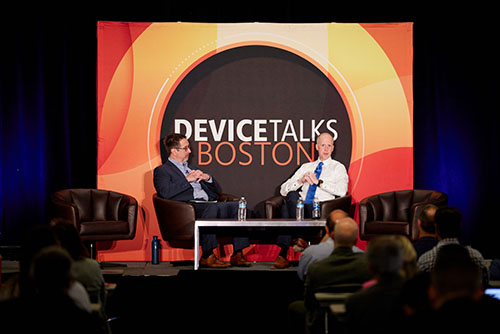
At DeviceTalks Boston in 2023, he described the pleasure of telling those teams that he had entered BD the same way. There is an appealing reversal here. The employee who once had to learn the larger organization’s rules eventually became responsible for deciding them. An acquisition can look tidy in an announcement. The people inside it still have to find their way around on Monday.
Polen’s career has repeatedly brought him back to that gap between an executive decision and somebody else’s working day. Buying a business, writing a strategy, introducing a new operating method: each requires people to change what they do. The chairman’s signature is the beginning of that work. His biography becomes more interesting when you follow what happens after the signature.
A return ticket to Franklin Lakes
His first arrival at BD came in 1999 through an acquired startup. The early roles were in sales and marketing. In 2004 he left for Baxter, where his responsibilities included manufacturing and services, strategic marketing and the management of a global business. He returned to BD in 2009. A career described as a climb turns out to have a useful detour.
Leaving gave him experience inside another organization; returning gave him a succession of larger assignments. By April 2017, he was president of BD, with oversight across its operating segments. The chief operating officer title followed in October 2018. These were jobs concerned with how the parts of a company fit together, a subject that would become central to his public account of leadership.
The scale of the assignments changed sharply. He led BD’s $12 billion CareFusion acquisition in 2015 and the strategy for its $24 billion Bard acquisition in 2017. Those figures describe transactions, rather than personal achievements measured in dollars. Their significance for Polen’s story is the responsibility that followed: different businesses, working habits and ambitions had to function inside one company.
BD announced his succession to Vince Forlenza in September 2019, setting January 28, 2020 as the effective date. Forlenza initially remained executive chairman; Polen added the chairmanship on April 28, 2021. The handover happened in stages. By then, the former arrival from a startup had become responsible for both the executive office and the boardroom.
- 1999Arrives at BD
through a startup acquisition - 2004Leaves for Baxter
a different operating environment - 2009Returns to BD
with larger assignments ahead - 2020Becomes CEO
following the succession plan
A student, then a supporter
Before those appointments came Salisbury University, where Polen graduated in 1996. He worked as a laboratory assistant for Diane Davis. He later earned an MBA at Johns Hopkins. The undergraduate connection supplies a smaller and more personal thread than the corporate chronology: a student helping a teacher, then an alumnus returning to help preserve her work.
In 2023, Salisbury recorded that Polen and fellow former student Herman Staats had come forward with $6,000 in matching gifts toward a scholarship honoring Davis. It is a specific act of remembrance. A university can occupy a single line in an executive biography; a gift tied to a named teacher tells you which part of the institution remained personal.
That detail also makes the distance between Salisbury and Franklin Lakes feel less abstract. The career eventually involved businesses purchased for billions. The relationship with a former teacher survived in an undertaking small enough to describe without an investor presentation. Both belong in the portrait, though only one tends to make the business headlines.
The chief executive takes out a pen
Polen’s answer to organizational confusion includes an unfashionably patient instrument: a written document. On taking the top job, he and his team prepared a 20-page account of the BD 2025 strategy. He described adding annual updates, selecting ten priorities for weekly discussion and reviewing progress through a regular operating schedule.
The act of writing matters because a large organization can agree with a phrase while disagreeing about its meaning. A document leaves something to examine. A colleague can return to a paragraph, object to an assumption or ask what a particular promise requires. The leader has to put the logic somewhere other people can see it.
Polen has described circulating his annual paper among the leadership team for edits and questions. Giving colleagues time to read and form a response is a practical form of listening. It makes room for the person whose useful objection arrives after the meeting has ended, rather than rewarding only whoever can speak fastest inside it.
He connects careful listening with trust and better decisions. The invitation needs a practical form. Listening takes more than leaving a pause after a presentation. A marked-up paper provides evidence that somebody has been allowed to reconsider the presentation’s premise. It leaves the discussion open after the room has emptied.
BD 2025 strategy paper
An old idea enters the AI conversation
By 2026, Polen was talking publicly about lean manufacturing alongside artificial intelligence. His teacher, Yukio Katahira, also works with GE Aerospace’s Larry Culp. The connection places Polen in a community of executives interested in a management tradition associated with Toyota, even as the corporate conversation rushes toward new software.
The order of operations is his point. Improve the process, understand how it works, then consider what technology can contribute. “You can’t apply AI to a broken process,” he says. In a business world rather fond of buying a fresh answer before inspecting the old question, that is a useful restraint.
BD’s program, called BD Excellence, extends continuous improvement across functions. Polen has described an ambition to develop people who notice problems as well as solve them. The distinction has everyday force. A familiar inconvenience can become part of the furniture. Someone still has to ask why the furniture is in the doorway.
That is also where the patient work of management becomes visible. A technology announcement has a date and a launch. An operating habit has to survive the following week, and the one after that. The question for Polen’s approach is whether repeated attention can make improvement ordinary enough to continue without a special occasion.
“You can’t apply AI to a broken process.”
Tom Polen · 2026
The audience gets a vote
There is another side to making people feel heard: deciding what the organization applauds. Polen has spoken about explaining the behavior behind a promotion, so colleagues understand why someone is advancing. The title alone tells employees who has won. The explanation tells them which actions the company wants repeated.
His 2021 Glassdoor Employees’ Choice recognition offers one dated measure of how leadership was being received. The award drew on anonymous, voluntary employee reviews collected during the preceding year. It belongs to that period, with that method. A workplace contains many experiences, and an award is one piece of the record rather than a permanent verdict.
Polen has also put an ethical expectation in writing. In his introduction to BD’s code of conduct, he asks people to raise concerns and seek help when they have questions. Formal rules and invitations to speak have to meet in ordinary exchanges: an awkward conversation, a reported concern, a manager’s response. The credibility of the invitation is built there.
A garden hose outranks the boss
Away from executive titles, Polen has described growing up in the country, spending time outdoors and enjoying trail running and obstacle-course events. He said he had played several sports without competing at an elite level. It is a pleasingly modest introduction to a hobby that subsequently acquired some rather elaborate preparation.
While training for a SEALFIT 20X event, he enlisted his three children to help him and his friends get used to cold water. The children were given a garden hose and permission to play coaches. They embraced the assignment enthusiastically. Their father recalled laughing while trying to continue the exercises. Delegation, in this instance, produced immediate results.
He had also brought his leadership group to a custom SEALFIT event. It would be too neat to turn every outdoor outing into a theory of corporate performance. The hose story is valuable because it resists the polished executive photograph: a father makes a plan, the children discover its comic possibilities, and everybody gets thoroughly involved.
His reading at the time paired Brad Thor’s thriller Blowback with Bill George’s Discover Your True North. Suspense and leadership instruction made a fairly practical combination. Sometimes the person running a large business wants to think about his purpose. Sometimes he would like to find out what happens in the next chapter.
The next first day
In February 2026, BD completed the separation of a business that combined with Waters. For Polen, whose career had been shaped by bringing companies together, the transaction added another kind of organizational change to the story. A portfolio can be reshaped through departure as well as arrival; the daily work still has to hold together.
The next quarterly figures offered an early, limited view of the resulting company. For the quarter ended June 30, 2026, BD reported revenue of $4.983 billion, up 5.4% on a reported basis. Polen called it the first full quarter of “New BD.” It was a checkpoint after the separation, with continuing operations used for comparison.
A quarter cannot settle whether a strategy will endure. Nor does a leadership method become convincing merely because its author can explain it. Polen’s approach will keep meeting the same practical examination: whether the decisions made at the center help people do their jobs across the company.
The first-day memory remains a good place to return. Polen knows what it is to join an unfamiliar organization and then build a career inside it. His task now includes creating the conditions in which somebody else can do the same. The welcome matters. So does what that person discovers when the welcome is over.