Bob Martin climbed into a truck, hitched to a Keystone Cougar fifth wheel, and put the brakes to work. At the Navistar test track, the president and CEO of THOR Industries was trying emergency stops. The attraction was a feature that car drivers had long taken for granted: antilock braking, now finding its way onto recreational trailers.
Jason Lippert, the supplier executive who described the visit in 2024, remembered Martin towing RVs around the country earlier in his career. Those trailers had lacked ABS. Here was a chance to feel the difference from the driver's seat. For a company selling escape, stopping properly is a surprisingly persuasive place to begin.
The episode offers a useful introduction to Martin. He runs a business whose products invite extravagant language about freedom and adventure. Yet the distance between a fine holiday and a miserable afternoon can be a component, a repair, or an unfamiliar maneuver. His working life has kept bringing him back to that distance.
The small company worth leaving for
Martin grew up in Elkhart, Indiana, and returned home after graduating from Purdue in 1993. Coachmen gave him his start as a sales trainee. In 1998 he moved to Keystone, then a much smaller business. He later described leaving an established employer for the startup as a consequential career decision. The safer-looking choice would have made a less interesting résumé.
THOR acquired Keystone in 2001, bringing Martin into the group. His subsequent progress was gradual enough to include several views of the same machine: sales management, operations, subsidiary leadership, then responsibility across businesses. He became Keystone's chief operating officer in 2007 and its president in 2010, before moving into THOR group leadership in 2012.
In August 2013, he took over as THOR's chief executive and joined its board. He was 43. Peter Orthwein, the co-founder he succeeded, pointed to Martin's dealer relationships when explaining the choice. That detail matters. A manufacturer's connection with the people selling and servicing its vehicles can be as consequential as the specifications on the brochure.
Sales trainee1998Keystone
A smaller bet2013THOR
Chief executive
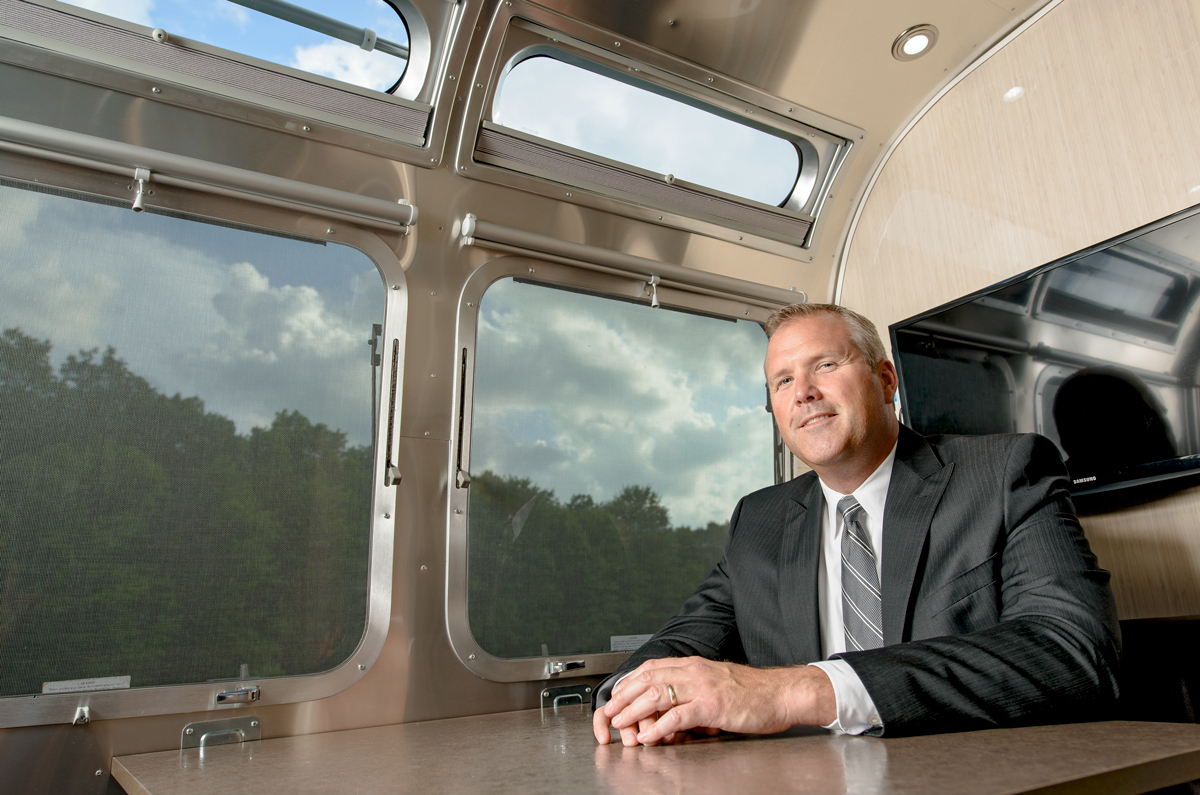
A big business with room for other people
Ask how Martin manages the scale, and the answer begins with how much he leaves to other managers. In 2019, he described a corporate office of fewer than 60 people within a company of roughly 20,000. Those are historical figures, but they convey the arrangement he was defending: subsidiaries retained responsibility for products and dealer relationships.
“I try not to think about it,” he said when asked about running a company of such size. It was a modest opening to an explanation of delegation. Airstream's managers, in his account, knew their brand and handled its business. Corporate leadership received updates without needing to make every product decision.
That approach requires a particular sort of confidence. A manager can demonstrate authority by appearing in every decision, or by choosing people whose judgment makes that unnecessary. Martin's account favors the second practice. The resulting company is easier to understand as a collection of operating businesses than as a single design studio issuing instructions from Indiana.
Buying a company, keeping its character
Martin's tenure has included substantial acquisitions. THOR announced its purchase of Jayco for approximately $576 million in July 2016. The transaction brought Jayco, Starcraft, Highland Ridge and Entegra Coach into the group. The existing senior management team was to continue leading the business. Ownership changed; the people with operating knowledge still had a job to do.
The February 2019 acquisition of Erwin Hymer Group extended that model across the Atlantic. The deal brought a European manufacturing business into THOR and excluded EHG's former North American operations. It was a geographic change as well as a financial one: Martin now had a larger reason to understand how Europeans bought, built and used RVs.
There is an obvious temptation in an acquisition to make the purchase look like its new owner. Keeping distinct brands poses a different challenge: determine what the parent can improve without flattening the differences customers came for. Martin's preference for subsidiary management makes sense in that setting. The purchase creates access to resources; it also creates a duty to listen.
The interview that took five minutes
Todd Woelfer has supplied a more personal illustration of Martin's management. Recalling his own recruitment in a 2023 podcast conversation, he described an interview lasting about five minutes. He left thinking it had gone badly. It had gone well enough for him to join the company.
Woelfer wanted to contribute beyond legal work. Over time, his responsibilities expanded into the business, and he became chief operating officer. He credited Martin with finding where people could contribute, rather than confining them to their existing titles. A short interview is hardly a recruiting manual. In this instance, the useful part was what happened afterward.
The anecdote gives delegation a human dimension. A corporate chart can assign duties neatly while missing someone's abilities. Leaving room for a colleague to grow makes the chart less tidy and may make the business more capable. Woelfer's account suggests that Martin is comfortable with that trade.
Technology has to earn its camping space
Martin played offensive line at Purdue. At six feet six, he is also an unusually literal reminder that a vehicle's occupants have to fit. His interest in product development has expanded well beyond physical space. In 2021 he discussed connected appliances, electronic controls and communications features as ways to make RVs more appealing to younger buyers.
THOR had brought in Josef Hjelmaker as its first chief innovation officer, drawing on experience that included Whirlpool and automotive technology. Martin saw room to bring more of that knowledge into recreational vehicles. A campsite may be an escape from everyday routines, but a buyer does not necessarily wish to escape a reliable connection or an appliance that works.
By September 2024, THOR and Harbinger were showing a hybrid Class A demonstration motorhome. Its electric platform combined a battery with a gasoline range extender; the announced range estimate was 500 miles. That was an estimate for the demonstrated platform, rather than a promise about every future trip or model.
The attraction went beyond propulsion. The system was designed to support power use while camping, too. For Martin, this was a practical direction for electrification: develop equipment around how RV owners travel and stay. The motorhome still has to function after it reaches the destination. Arrival merely begins the other half of the job.
“No one knows exactly where EVs are going”
Bob Martin, speaking to dealers in September 2025
A part number can spoil a holiday
At THOR's September 2025 Open House kickoff in Elkhart, Martin emphasized dealer relationships and discussed new vehicles, including Entegra's extended range hybrid Embark. The same event also devoted attention to something less photogenic: finding replacement parts.
THOR's work with RV Partfinder addressed the difficulty of identifying and sourcing components. In a survey presented there, 63 percent of respondents were dissatisfied with parts identification, and 88 percent expressed interest in a new solution. The numbers described that survey, rather than all RV owners. They nevertheless explained why a database deserved time alongside the new motorhomes.
A holiday is experienced one broken component at a time. Faster identification cannot settle every service problem, but it tackles a specific source of delay. For an executive raised in sales, there is a straightforward commercial reason to care: the customer's judgment continues long after the purchase agreement is signed.
The price of keeping the road open
The latest results make the financial test plain. For the fiscal year ended July 31, 2026, THOR reported net sales of about $9.61 billion, up 0.3 percent. Net income attributable to THOR fell 31.3 percent to about $177.5 million. Nearly steady sales and a substantial profit decline make an uncomfortable pair.
Martin described affordability pressures and rising material costs. The response included restructuring and changes to the North American operating model, aimed at protecting attainable consumer prices despite pressure on margins. These are choices with costs attached. The wish to take a family away for the weekend does not settle the question of what that family can afford.
The business also depends on places worth reaching. THOR's partnership with the National Forest Foundation, dating to 2019, supports conservation and campground infrastructure. That connection puts the landscape into the business picture. Building a more convenient vehicle has limited value if the destinations become harder to enjoy.
Martin has described taking short family trips to the Smoky Mountains and using a black-and-gold Tuscany motorhome for football tailgates. Purdue colors, of course. The details are pleasingly ordinary for someone responsible for so many brands: a manageable trip, familiar company, a game to attend.
His career has grown from those local beginnings into a business spanning North America and Europe. The questions keep returning to the scale of a single trip. Can the buyer afford it? Can the dealer fix it? Does it behave properly on the road? Back at the test track, at least one of those questions could be put directly to the pedal.
Keep the conversation going
- THOR Industries ↗
- Martin’s THOR leadership biography ↗
- 2013 CEO appointment ↗
- Jayco acquisition announcement ↗
- Erwin Hymer Group transaction closing ↗
- Jason Lippert on Martin’s trailer braking test ↗
- Bob Martin on LinkedIn ↗
- 2019 conversation: career, RV trips and Europe ↗
- RV Podcast: Martin on running THOR ↗
- Todd Woelfer’s conversation about leadership ↗
- 2021 interview: technology and younger buyers ↗
- 2024 hybrid motorhome announcement ↗
- 2025 Elkhart Open House coverage ↗
- THOR fiscal 2026 results ↗
- Listen: 2026 Chief Travel Leader interview ↗
- THOR and the National Forest Foundation ↗
- THOR Industries on YouTube (company channel) ↗
- THOR on Instagram (company account) ↗
- THOR on Facebook (company account) ↗