Mark Millett wanted to become a mechanical engineer. There was a snag. “But I hated math,” he later recalled. He studied metallurgy instead. It is a pleasingly awkward beginning for a career spent making an exacting industrial process work: a young Englishman takes his second choice, crosses the Atlantic, and eventually helps establish a steel company in Indiana.
The route included a winter in Aspen in 1981, washing dishes and skiing. Before the furnaces came the washing-up. His early American adventure makes a useful corrective to the polished executive biography, in which every appointment appears to have been arranged at birth. Millett’s path had room for an experiment.
Today, he is Steel Dynamics’ co-founder, chairman and chief executive. In August 2026, the company announced that Theresa Wagler would succeed him as president and CEO on January 1, 2027, with Millett becoming executive chairman. That impending handover gives his story a question more interesting than how much steel a company can make: how do you pass along the habits that made it worth building?
A Plymouth education, with a detour
Millett came from Plymouth, in southwest England, and earned his bachelor’s degree in metallurgy at the University of Surrey. A placement year in New Zealand helped shape his outlook. At Surrey he also met Abby, who became his wife. His life in America followed an education that already included the experience of leaving familiar surroundings.
There is a temptation to turn travel into a tidy explanation for everything that follows. The more interesting point is smaller. A placement takes knowledge out of the classroom and puts it somewhere unfamiliar. A technical degree gives you a vocabulary; working elsewhere asks whether you can use it. Millett would spend much of his career in that gap between knowing a process and getting it to run.
In July 2025, Surrey included him among its honorary graduands. His work had brought together employee empowerment and the use of recycled metal. The young graduate who had gone abroad returned to the university’s story with a company, a family and several decades of practical metallurgy behind him.
The furnace comes before the corner office
Before Steel Dynamics, Millett spent 12 years at Nucor. At the Crawfordsville project in Indiana, he managed the melt shop during the company’s work on thin-slab casting. Keith Busse and Richard “Dick” Teets, his future fellow founders, were part of that technical world. Their association began around the difficult business of making steel, years before it became a founding-team biography.
Electric arc furnaces use electricity to melt metallic feedstock, including recycled steel scrap. Thin-slab casting makes a thinner starting slab for the rolling process. These technologies belong together in Millett’s career: one changes how metal is melted, the other how it proceeds toward a finished flat product. The customer ultimately buys material with the right properties and finish. The route through the plant still determines much of the cost.
That gives the engineer a particular kind of business education. A design must survive contact with equipment, raw materials, production schedules and people. A promising machine has to become a repeatable operation. There are few opportunities to argue a furnace into better performance. It is an unusually literal school of management.
Steel scrap can re-enter the cycle. Simplified process illustration.
Three founders, then a mill
In 1993, Millett co-founded Steel Dynamics with Busse and Teets. The first greenfield electric arc furnace flat-roll mill began producing steel in Butler, Indiana, in 1996. The company also went public that year. Three years separate the founding date from steel production, a useful interval to remember whenever a company’s origin gets compressed into a single triumphant sentence.
Millett’s responsibilities included the design, construction and startup of the company’s steel mills. At Butler, that included melting and casting. His career was rooted in the machinery that makes the revenue possible: before a mill can acquire a reputation, somebody has to make it work.
From 1998 to 2008, he oversaw flat-roll mill operations. In August 2008, he took responsibility for metals recycling and ferrous resources, alongside the presidency and chief operating role at OmniSource. Those appointments put him on both sides of a steelmaker’s material equation, dealing with the finished product and the scrap that helps feed the furnace.
Steel Dynamics had acquired OmniSource in 2007. The logic is visible without a management diagram. A steelmaker using recycled scrap has an interest in the quality and availability of that scrap. Bringing recycling into the business creates another connection to manage, but also a way to understand the input rather than simply receive an invoice for it.
What happens after the founders?
Millett became CEO in January 2012, succeeding Busse. He became board chairman in May 2021. The titles mark a change in scale and responsibility, though they can obscure the daily work. Running a growing collection of operations requires decisions about what belongs together, what deserves investment and what authority stays close to the plant.
His own description of his approach was plain: “I tend to be a little more structured and intentional.” He treated the preservation of the company’s culture as a central responsibility. A larger organization needs coordination; the challenge is keeping that coordination from swallowing the initiative that made expansion possible.
“Sustaining our culture is sacrosanct.”
Mark Millett, 2018
The practical expression includes production incentives. Teams can receive a conversion bonus linked to production costs and efficiency. There are also family picnics and divisional holiday parties. The arrangement combines a financial interest in how the plant performs with repeated opportunities to know the people beside you. The picnic and the pay calculation do different jobs.
Product choices carry the same attention to practical consequences. Steel Dynamics can weld rail into lengths of 1,600 feet. Longer rail means fewer welds for the railroad to manage. It is an example of competitiveness living in an unglamorous detail: make a customer’s installation and maintenance work easier, and the product becomes more useful.
The reward, and the work behind it
The industry has recognized Millett across several decades. He received the Electric Metal Makers Guild’s Billy Wallis Award in 2000. AIST named him Steelmaker of the Year in 2014 and again in 2022. In 2024, he received the Willy Korf/Ken Iverson Steel Vision Award. The following year brought the Bessemer Gold Medal from the Institute of Materials, Minerals & Mining.
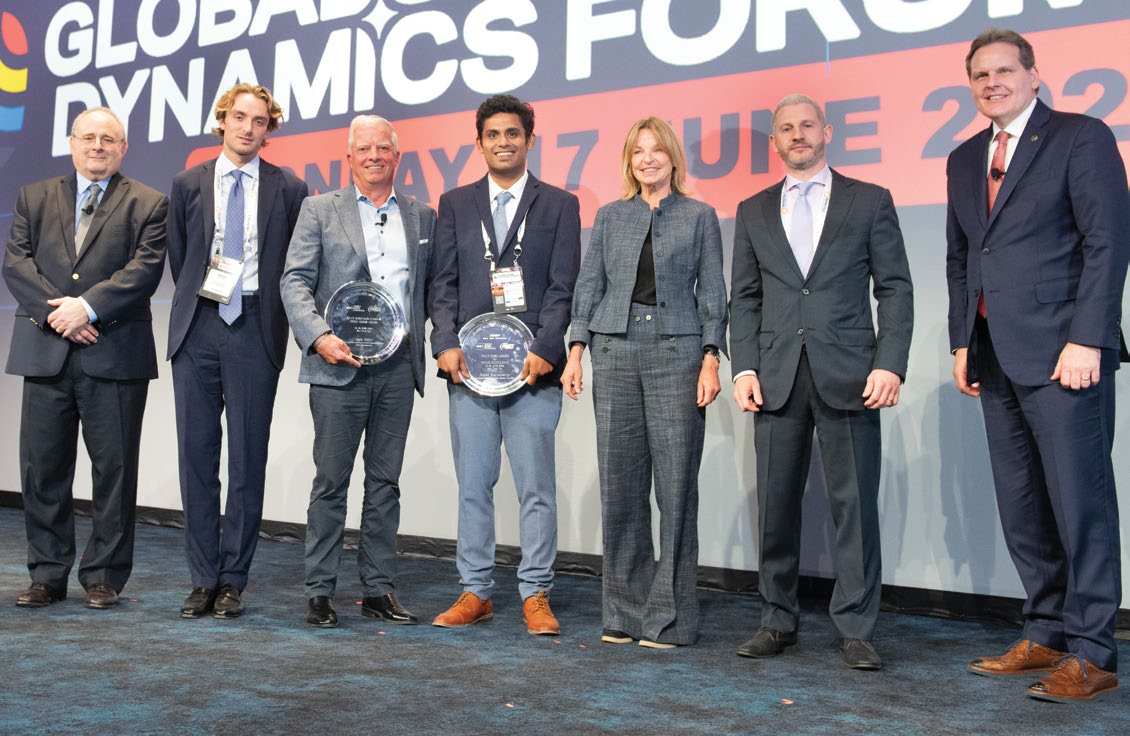
Iverson’s name makes the 2024 award especially apt. The Nucor leader’s example connected technical innovation with a workplace capable of using it. Millett’s career has repeatedly brought those subjects together. New equipment offers possibilities; an operating team turns those possibilities into something a customer can order again.
The financial record supplies scale. In 2022, Steel Dynamics reported $22.3 billion in net sales and $3.9 billion in net income, with steel shipments of 12.2 million tons. Its fabrication business helped drive the year’s gains. Those are company results, produced by many people, and their breadth matters to understanding the executive’s job.
Expansion also arrives with problems. The Sinton, Texas, mill was fully commissioned in the first half of 2022, then faced unexpected power and equipment challenges as production increased. Its geographic appeal included access to customers in the southwestern United States and Mexico. An attractive location and a difficult startup can occupy the same project. Industrial strategy has to accommodate both.
A steelmaker tries another metal
In July 2022, Steel Dynamics announced plans for a recycled aluminum flat-rolled mill with annual capacity of 650,000 metric tons, supported by two satellite slab centers. The original capital estimate was $2.2 billion. Customers already buying steel also consumed aluminum; the recycling operation provided another point of connection. The move extended existing relationships into a different material.
It also created another startup to manage. In the third quarter of 2026, the aluminum operation shipped 55,000 metric tons of flat-rolled sheet and recorded a $26 million operating loss. Quality problems at higher speeds had been traced to the hot-strip mill’s rolling coolant composition. The company changed it and reported improved performance in October. A large strategic ambition had reached a very specific chemical problem.
The wider company reported third-quarter net sales of $6.5 billion and net income of $756 million. Those figures sit alongside the aluminum loss, rather than erase it. For Millett, the final months before the planned CEO transition contain the familiar mixture: established operations producing earnings while a newer process requires attention.
Leaving room for the next decision
Wagler joined Steel Dynamics in 1998 and has been CFO since 2007. Her appointment puts a longtime colleague in the chief executive’s chair. Millett will remain involved as executive chairman. The announced transition preserves a connection to the founding generation while changing who holds the operating leadership role.
A handover makes culture unusually concrete. People must know whose decision counts. The successor needs enough room to make choices, including choices a founder might have made differently. A company built on initiative eventually has to extend that principle to the person taking over.
Millett began with a course change and made a career out of turning technical possibilities into working operations. The next transition asks for a different kind of construction. After helping build the furnaces, mills and relationships, he has another responsibility: making room for the people who will decide what to build next.
Continue the conversation
- Official biography
- SteelCast interview with Tim Rutter
- Watch SteelCast on Tata Steel UK’s YouTube channel
- Mark Millett on LinkedIn
- The 2018 conversation about culture
- The planned 2027 leadership transition
- October 2026 results and operating update
- Surrey’s July 2025 graduation programme
- The 2024 awards ceremony