Before Andrew Silvernail had a performance system to explain, he had a silver Subaru and friends willing to puncture his dignity. In 2012, after Forbes placed him fourth on its list of powerful CEOs aged 40 and under, the response from home was suitably economical: “No. 4? That’s it?” A person can acquire a considerable title and still have trouble impressing the people who remember his car.
Those people knew him from Bucksport, Maine, where he graduated from high school in 1989 and played football. He later married his high school sweetheart, Shelby. His route into business would take him through Dartmouth, Harvard, industrial research, and factory management. Yet the early part of the story keeps returning to particular people who noticed him before there was much of a résumé to notice.
The Subaru before the spreadsheet
His former football coach, Tom Sullivan, helped open the route to Phillips Exeter and then Dartmouth. Silvernail has also credited the Cianchette family, whose construction business gave him an early view of commercial leadership. A student job or an introduction can look small beside a chief executive’s appointment. At the time, it can change the entire set of choices available.
At Dartmouth, he studied government, graduating with the class of 1994. Work as an equity research analyst at Fidelity put industrial companies under his microscope. One executive suggested that he belonged on the operating side of the table. He went to Harvard Business School, completing his MBA in 1999. Studying a business and being responsible for one would turn out to be different occupations.
His interest in business had also taken shape during an internship at McLean-Fogg, a family-owned manufacturer in Illinois. In his own account, the attraction was the human part of the enterprise. He had grown up as the youngest of four boys, with a father who worked as a social worker. Factories offered a different setting for questions about what people could accomplish together.
“I realized I liked business because it was about people.”
Andrew Silvernail, 2018 interview
That explanation is useful because the next part of his career could otherwise read like a procession of company names. Danaher, Newell Rubbermaid, and Rexnord gave him operating responsibilities before he joined IDEX. The work involved businesses with products to make, customers to retain, and teams whose decisions determined whether the numbers would follow the plan.
An operator learns to choose
Silvernail joined IDEX in January 2009. By the time the company chose him as CEO, he was overseeing three business segments that together represented more than half its annual revenue. His promotion took effect on August 10, 2011. He became chairman the following January. The appointment put someone who already knew substantial parts of the operation in charge of the whole.
IDEX’s products occupied specialized corners of industrial life: fluid-handling components, dispensing equipment, and fire and safety products. A company of that kind requires attention to small markets and particular customer requirements. Its corporate scale comes from many businesses doing specific jobs. Running the group means deciding what belongs with local managers and what the larger organization can help them do.
Silvernail’s IDEX tenure lasted until 2020. International Paper’s current biography credits that period with total shareholder return exceeding 500 percent. In 2017, Institutional Investor included him in its ranking of leading American executives, based on investment analysts’ votes. Those are measures of a completed assignment. They help explain his appeal to another board; they cannot complete the next assignment for him.
Total shareholder return during his IDEX CEO tenure, as reported in International Paper’s leadership biography. A historical result, across 2011-2020.
His connections extended beyond the companies he ran. He joined the Aspen Institute’s 2012 class of Henry Crown Fellows and served on Dartmouth Engineering’s board from 2016 to 2021. He also serves on Stryker’s board. Those roles place him in conversations about leadership and institutions as well as the daily work of production and selling.
After IDEX came the chairmanship and chief executive role at Madison Industries in 2021, followed by private investment and advisory work. He founded 5 Nails, LLC, and served as an executive advisor at KKR. By the time International Paper called, he had worked inside public companies, a privately held industrial group, and the investment world. The next job would put him back among paper mills.
A very large box of decisions
International Paper announced his selection in March 2024. He succeeded Mark Sutton as CEO on May 1 and became chairman on October 1. For someone whose childhood understanding of business had included a Maine paper mill, there was a neat geographical loop in the appointment. The operating problem awaiting him was considerably less neat.
He brought an 80/20 performance system to the company. In an August 2024 presentation, he laid out four steps: simplify, segment, resource, and grow. The underlying question is where customers, products, and activities create enough value to deserve additional attention and investment. A long list of things to do is easy to produce. A defensible order of importance takes more work.
- 01SimplifyExpose complexity
- 02SegmentSeparate distinct needs
- 03ResourceDirect the investment
- 04GrowBuild on the choices
The presentation used a gardening analogy, separating crops and watering according to need. It also described IDEX’s initial trials: three businesses, two successes, and one difficult result. Even in his own teaching material, implementation had a learning period. The arithmetic may fit neatly into a label. The organization still has to work through what it means.
By November 2025, he was telling investors that change required focus, energy, and a catalyst. He spoke about the force of established explanations for keeping assets, and the need to examine their economics. That is where an operating philosophy becomes uncomfortable. A familiar facility or practice can have plenty of defenders even when the case for the next dollar of investment is weak.
When geography changes the answer
International Paper completed its acquisition of DS Smith in January 2025. A year later, the company announced plans to separate its North American and EMEA packaging operations into two publicly traded businesses. Each would contain assets from both legacy companies. Silvernail was expected to remain chairman and CEO of International Paper; Tim Nicholls was designated to lead the proposed EMEA company.
The rationale centered on the differences between the regions and their investment needs. At a February 2026 investor conference, Silvernail acknowledged that the company had overestimated customers’ appetite for making deals globally. That admission gives the proposed split a more interesting explanation than a diagram of two companies. Customer behavior was complicating the original logic of scale.
A box has a destination, and the customer waiting for it has particular requirements. A corporate structure must eventually prove useful to that transaction. The proposed separation asks whether regional management and capital allocation can serve those requirements better. It remains an execution task, with the intended benefits still to be earned.
In September 2026, Silvernail described investments across 80 facilities, including projects already undertaken and others ahead. He also discussed reducing the variability generated by the company’s own changes as the period of major asset sales and closures winds down. The ambition was to make the operation steadier, even while demand and input costs remained outside his control.
The numbers do not applaud
The quarterly accounts give that ambition a practical test. For the second quarter of 2026, International Paper reported $6.00 billion in net sales, a $12 million loss from continuing operations, and $587 million in adjusted EBITDA, a non-GAAP measure. Those figures describe different things. Revenue shows the volume of business in dollars; the loss and adjusted measure require their own attention.
Silvernail highlighted the completed Riverdale machine conversion, improved mill performance in North America, and continuing work ahead of the separation. He also identified reliability, rising input costs, and commercial execution as priorities. An upgraded machine is a concrete milestone. Consistently translating such work into earnings is a longer examination.
Accountability has been part of his public language. On the first-quarter 2026 call, he began an answer about holding people responsible by putting himself first. He acknowledged disappointment over missed numbers while defending the transformation plan. That combination leaves investors with something to evaluate: both an explanation of the difficulties and an executive who has attached his judgment to the response.
Back to the people who opened doors
There is another allocation decision in Silvernail’s life, far from quarterly earnings calls. He and Shelby, together with their children, established Silvernail Scholars with an initial $2 million commitment. Both came through Bucksport High School. The program supports students in Hancock County, Maine, returning family resources to a place that supplied early encouragement.
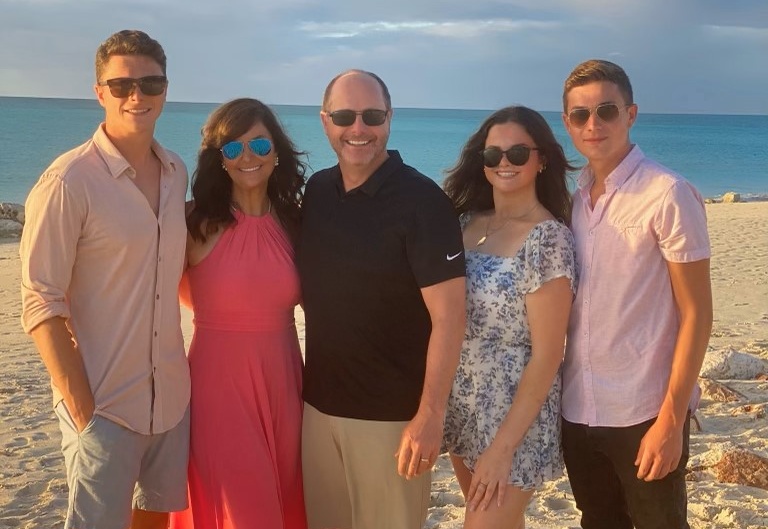
The program describes awards of up to $20,000, paid over a student’s course of study, alongside year-round support and a cohort model. An annual symposium brings scholars together to build connections and discuss leadership. The recipient lists include students pursuing university, maritime, and community-college education. The design gives practical form to the idea that opportunity requires both money and people.
His explanation for supporting it returns to the adults who helped him when he had little direction. The family’s program makes that memory useful to someone else. A scholarship cannot reproduce another person’s life, nor should it try. It can make the next step more accessible and put helpful people within reach.
The scale is different from International Paper, but the question has a familiar shape. Where can an investment make a difference? In one setting, Silvernail is choosing among industrial assets and regional structures. In the other, his family is backing students whose careers have barely started. The teenager in the Subaru once needed somebody to see a possibility. Now he gets to help pay for a few.
Continue the conversation
- International Paper · leadership biography
- Andrew Silvernail on LinkedIn
- Silvernail Scholars · the program
- Listen · his conversation with Knowledge at Wharton
- Watch or listen · a CEO’s perspective on intelligence
- Read · his 80/20 presentation
- The proposed split · a closer look
- International Paper · second-quarter 2026 results