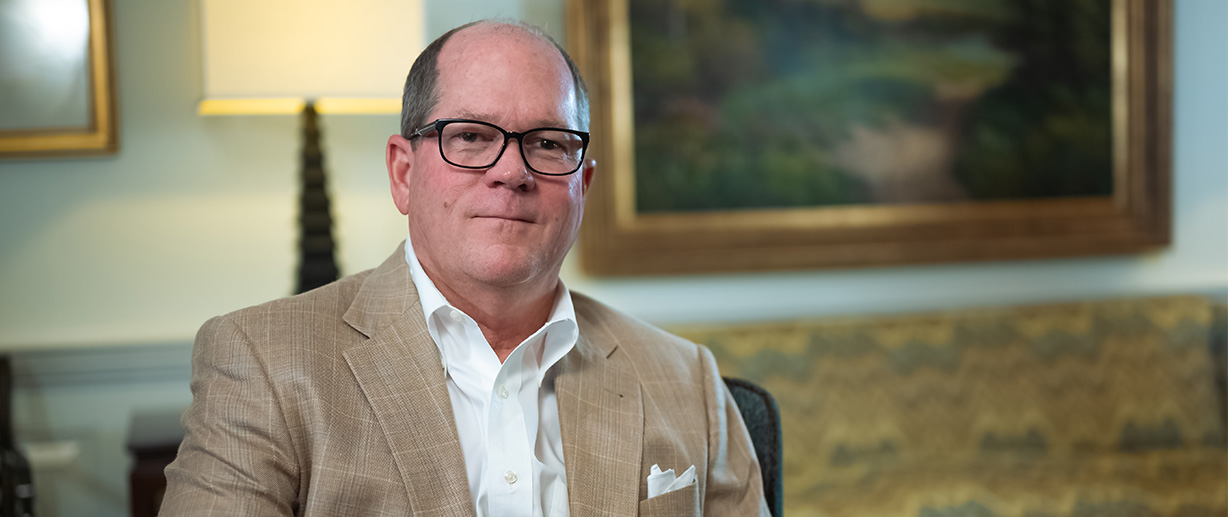
Howard Coker’s preparation for a life abroad included a trip to the public library. It was the 1990s. He was managing a Sonoco factory in Ohio when a call arrived about an assignment in Singapore. He went to find out about the place where he would be working. For a future chief executive of a global packaging company, it was a pleasantly unglamorous departure lounge.
Coker had graduated from Wofford College in 1985 without studying overseas. He later described his student outlook as narrow, concentrated on college and the beginning of a business career. The Singapore assignment took that comfortable frame and enlarged it. Years afterward, he supported a matching fund for student experiences at Wofford, hoping younger people would encounter other countries earlier than he had.
That episode offers a way into a career otherwise crowded with titles, territories and types of container. Coker joined Sonoco in 1985. He became president and chief executive in February 2020, after 35 years inside the business. His surname belongs to its founding family. His working life, however, also includes the education that comes from being responsible for a factory far from home.
A family name, followed by a long apprenticeship
Sonoco began in Hartsville, South Carolina, in 1899 as the Southern Novelty Company. Major James Lide Coker, Howard’s great-great-grandfather, and the Major’s son James Jr. are central to its origin. Their experiments with local pine and paper encountered expensive setbacks, including resin that interfered with production. Paper cones for textile mills gave the enterprise a workable direction. The company’s family history contains plenty of machinery and very little inevitability.
For Howard, inheriting a connection to that history did not mean arriving directly in the chief executive’s chair. His assignments covered sales, manufacturing and management. He became general manager for Asia/Pacific in the rigid paper and plastics division, and later director of sales for that business in North America. The geography changed; so did the problems he had to solve.
One promotion makes that range especially clear. Announced in December 2005 and effective the following January, it put him in charge of Sonoco Phoenix, the metal and plastic ends and closures business. Its operations included North America and Brazil. He had previously been division vice president for sales and marketing in rigid paper and plastics in North America. The new assignment brought commercial experience into broader operating responsibility. It also connected him to a business Fuller had been overseeing. Long before either held his later title, the two executives were part of the same reshuffling of responsibilities across products and regions.
His academic preparation included a business administration degree at Wofford and an MBA from Wake Forest, completed in 1990. The practical curriculum kept expanding. He held responsibility for rigid paper containers, closures, industrial paper, tubes and cores. These are modest-sounding nouns with substantial consequences for the people who need a production line to keep running.
Before the CEO appointment, his remit included industrial businesses across multiple regions, recycling and reels. By then, he had spent decades learning different pieces of the company. A family tree can explain a connection. A list of operating assignments explains the work.
Joins Sonoco
Wake Forest
President & CEO
Wofford trustees
The same handshake, another hemisphere
Singapore made the world larger without making everyone in it seem unfamiliar. Coker recognized an approach to relationships that reminded him of South Carolina. He has described that continuity in plain terms: “People are people wherever you go.” It is a useful sentence from an executive whose responsibilities have crossed so many borders. There is no need to translate it into management dialect.
He has also talked about culture as something demonstrated through conduct and treatment of colleagues. This gives his international experience a particular shape. Learning about another country did not require abandoning every lesson from home. It required finding out which habits travelled well and being open to what the new setting could teach him.
His later responsibilities made that question practical. A North American sales operation, an Asia/Pacific business and a global industrial portfolio offer different views of the same organization. The person leading them has to work with colleagues whose experience may be far removed from his own. Familiarity with headquarters is only one part of the job.
“People are people wherever you go.”
Howard Coker
Growing by deciding what to keep
Coker’s tenure as CEO has involved changing the collection of businesses he spent so long getting to know. Sonoco completed its purchase of Ball Metalpack in January 2022 for an aggregate cash purchase price of $1.35 billion, subject to adjustments. That brought food and household metal packaging further into the company’s portfolio. In December 2024, it completed the acquisition of Eviosys, the European food-can, ends and closures manufacturer.
The Eviosys purchase involved about $3.8 billion in net cash consideration. It brought approximately 6,500 employees and 44 manufacturing facilities across 17 countries. Those figures describe the operational assignment as much as the transaction. Buying a business creates a new group of colleagues, plants and customer commitments that somebody must make work together.
Then came the other side of the exercise. In April 2025, Sonoco completed the roughly $1.8 billion sale of its Thermoformed and Flexibles Packaging business to TOPPAN. The company said approximately $1.5 billion in after-tax proceeds would go toward reducing leverage. Coker’s explanation emphasized a focused portfolio and further investment in metal and fiber packaging.
The sequence is revealing. An executive closely connected to the company’s past has been willing to alter its boundaries. Sonoco’s 2026 proxy described a move from 20 highly diversified businesses to two core segments. Maintaining a connection to a company does not oblige its leader to keep every business it has accumulated. Sometimes continuity requires a rather extensive clear-out.
The factory floor reaches the executive table
There is a smaller, telling personnel decision alongside the large transactions. Andrea White became Sonoco’s chief human resources officer in March 2025 after a career grounded in manufacturing. Her experience included process engineering and leadership of the Sonoco Performance System, a program concerned with standardization and efficient processes across facilities.
White’s explanation of Coker’s interest in her emphasized experience across manufacturing levels and functional groups. She pointed out that roughly 80 percent of the company’s people work on the manufacturing floor. Her description suggests that he wanted the personnel function to understand the places where most employees actually worked. That is a concrete connection between his operating background and a senior appointment.
In January 2026, Sonoco announced that chief operating officer Rodger Fuller would retire after a 40-year career. It also said it would not appoint a successor: the business-unit presidents would report directly to Coker. Fuller’s departure removed a layer between the CEO and the operating businesses. The arrangement makes the attention Coker gives those businesses still more consequential.
His own long service and Fuller’s career underline another feature of this company’s leadership: people can accumulate substantial institutional memory. The useful test of that memory is what it helps a team notice today. Knowing how something used to work is helpful only if someone remains willing to ask whether it should work differently tomorrow.
A company smaller in scope, still tested at scale
By February 2026, Coker was describing the portfolio transformation as complete. Sonoco’s investor presentation turned toward a three-year growth strategy. The proposed next chapter included innovation, operating improvements and additional cost savings. Finishing the rearrangement of businesses left the ordinary, demanding work of improving their performance.
The second-quarter results, released in July, supplied a measured view of that assignment. Sales were $1.885 billion, down 1.3 percent from the comparable quarter. Adjusted net income rose 10.6 percent to $151 million. Reported net income was $105 million, compared with $493 million a year earlier; the earlier period included a $425 million gain from the TFP sale. The distinction matters when reading a business in the middle of such substantial changes.
Coker attributed the quarter’s performance to productivity and cost control helping offset inflation. The industrial business benefited from demand for North American recycled paperboard, while paper-can volume increased in EMEA and Asia/Pacific. His optimism came with a manufacturing vocabulary: output, demand, capacity and cost. The promised benefits of a new portfolio still have to appear in the work of its plants.
An earlier departure for the next generation
Coker’s responsibilities outside Sonoco include Manufacturers Alliance and Wofford. In June 2026, the college named him vice chair of its board of trustees. South Carolina’s Chamber of Commerce had recognized him as its 2021 Business Leader of the Year. These connections place him in conversations about manufacturing, education and the state where he lives and works.
Wofford provides a particularly personal connection. The graduate who once moved straight toward a business career has returned as a trustee and donor. His support for student experiences gives an institutional form to something he learned later: meeting people elsewhere can change the limits of what feels familiar.
That brings the story back to the public library. A work assignment sent Coker looking for information about Singapore; living and working there gave him an education a book could only begin. Decades of responsibility followed, through factories, regions and the chief executive’s office. Now he can help students make their own departures sooner. There is a quiet pleasure in that possibility: somebody else might get a head start on the lesson.