A kitchen cupboard is a peculiar atlas. French’s mustard can sit beside Cholula hot sauce; a tin of OLD BAY can keep company with a jar of McCormick spice. Geography gets compressed into a few shelves, and dinner proceeds without a shareholder presentation. Brendan Foley’s working life has increasingly involved the machinery behind that apparently casual arrangement: the brands, factories, distribution routes, and people that put familiar flavors within reach.
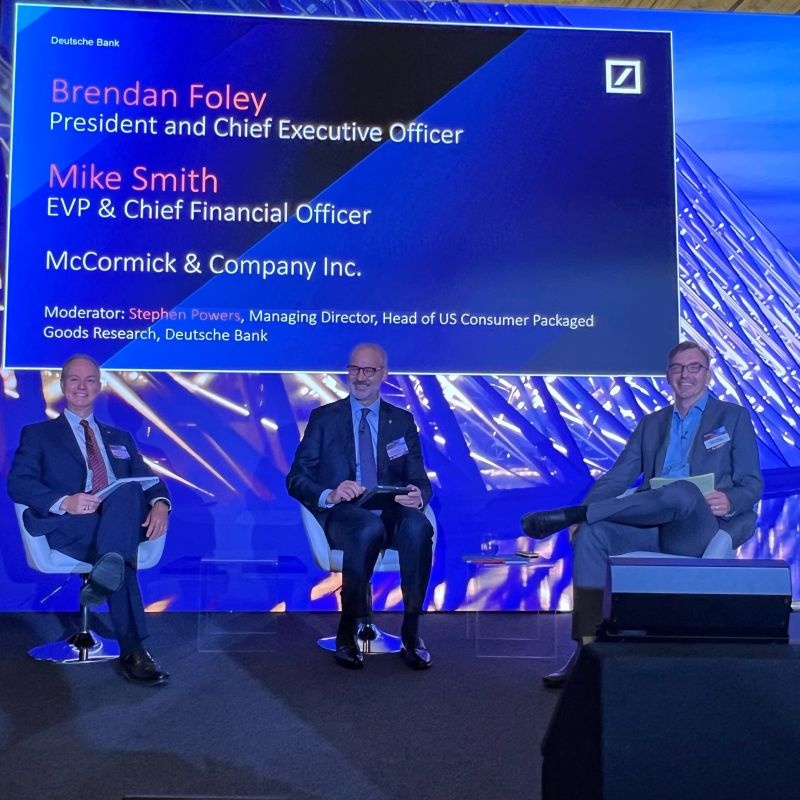
Foley is McCormick’s chairman, president, and chief executive officer, the eleventh CEO in a business founded in 1889. His route there began in advertising and passed through General Mills and H.J. Heinz. By the time he became CEO in September 2023, he had spent nine years inside McCormick. The progression matters. He arrived as a consumer business leader and accumulated responsibility until the map on his desk included the whole company.
In 2026, that map acquired a much larger outline. McCormick agreed to combine with Unilever’s Foods business, with certain exclusions, in a transaction expected to close by mid-2027, subject to approvals and other conditions. Foley is due to lead the combined business. The scale attracts attention. The more revealing question is what this long apprenticeship in brands has prepared him to do with it.
Dayton, by way of Argentina and Brazil
Foley calls Dayton, Ohio, his hometown. His childhood also included Argentina and Brazil. Those are useful coordinates in a career that would later stretch across the Americas and Asia, although they do not supply a tidy explanation for every decision that followed. A childhood abroad is a biographical fact, not a management qualification. What makes it interesting here is the eventual return of those countries to his commercial conversation.
At Miami University in Ohio, he studied business, graduating in 1987. His earliest professional experience included Ketchum Advertising, followed by General Mills. The sequence put him on both sides of the brand-building relationship: the business of communicating a proposition and the business of making that proposition worth buying. A packet on a shelf has little patience for an elaborate explanation. Its owner has to understand what a customer wants before somebody else does.
His advice about leadership, shared through Miami, is unusually useful when read beside that background: “You’ve got to be willing to take risks.” Curiosity and openness to other points of view also feature in his advice. These are his stated principles, rather than a license to invent a private personality. They describe a practical tension in his work: a leader has to choose a direction while remaining willing to learn something inconvenient.
- 1987Miami University
- 2014U.S. consumer
- 2022Global operations
- 2023Chief executive
- 2025Chairman
Fifteen years in the condiment business
At Heinz, Foley spent about fifteen years in marketing and general management. The roles became progressively broader: U.S. foodservice president from 2008 to 2012, U.S. consumer products president from 2012 to 2013, and North America Zone president from 2013 to 2014. The job titles trace a move from particular customers and channels toward responsibility for a region. Selling to restaurants and selling to households belong to the same industry, but they demand different conversations.
That distinction would become relevant at McCormick, whose work reaches both the supermarket shopper and the businesses making or serving food. The consumer encounters a label. A commercial customer may be looking for a seasoning solution that works consistently in a product or kitchen. Understanding the two audiences helps explain the breadth of Foley’s preparation. His career ran through both before he took charge of a company organized around serving them.
There is an unglamorous advantage to spending years with everyday products. Familiarity gives a brand a place at the table, but familiarity alone cannot manufacture another purchase. A business still has to make its product available, make the economics work, and give the buyer a reason to return. Foley’s résumé is full of responsibilities for those ordinary requirements. The spectacular part, when it arrives, depends on them.
The job grew a continent at a time
Foley joined McCormick in 2014 to lead its U.S. consumer business. North America followed in 2015. In 2016 his remit included global consumer operations and North America; later assignments encompassed the Americas and then Asia. Read quickly, this can sound like a procession of similar corporate titles. Read geographically, each promotion adds another set of customers, colleagues, and operating problems to the previous assignment.
June 2022 brought a more decisive change. McCormick created the president and chief operating officer role for him, putting all business units and the worldwide supply chain within his responsibility. A marketer’s field of view now formally included the system that had to deliver the promise. It is one thing to understand why a product appeals to someone. It is another to take responsibility for its passage through a global business.
The company credited him with integrating recent acquisitions and reorganizing the Americas when it announced his promotion to CEO the following year. These are telling assignments for a successor. Buying a brand creates an announcement; integration requires the new operation to function alongside the old one. Foley’s preparation included the work that happens after the congratulations, when responsibilities have to be settled and commercial plans made usable.
A succession with room for a mentor
Lawrence Kurzius handed over the CEO position on September 1, 2023, and remained executive chairman. The arrangement allowed the operating succession and the chairmanship to happen in stages. Foley subsequently became chairman on January 1, 2025. By then, the incoming CEO and his predecessor had worked together at McCormick for a decade. This was a succession built through shared assignments and an extended handover.
Foley publicly credited Kurzius with mentorship as well as leadership. That acknowledgment gives a human dimension to the formal transition. Executives generally inherit businesses with someone else’s decisions already embedded in them. Knowing the person who made those decisions can be useful. So can having time to learn which practices should continue and which new responsibilities now belong to the successor.
His commitments on taking the CEO job included preserving performance continuity and keeping McCormick a place where employees could work and grow. His earlier responsibilities also included support for its Multiple Management Board leadership development program. The emphasis connects succession at the top with development elsewhere in the organization. A company that promotes from within needs people ready for a larger job before the vacancy appears.
“Lawrence has been a transformational leader and a great mentor.”
Brendan Foley, November 2024
The cupboard gets a larger map
The proposed Unilever Foods combination puts that experience under a different kind of scrutiny. The announced structure would leave existing McCormick shareholders with 35% of the combined company, Unilever shareholders with 55.1%, and Unilever with 9.9%. Foley would remain chairman, president, and CEO. McCormick would retain its Hunt Valley global headquarters, with an international headquarters in the Netherlands. These are plans for the combined business, not a description of a completed merger.
The geographical opportunity becomes clearer in Foley’s discussion of Brazil. Speaking with interviewer Brian Sozzi, he identified the country as a market where McCormick lacked a presence and Unilever had strength. He also pointed toward the possibilities for brands such as Amora and Maille. Here, a country from his childhood reappears in the business case. There is no need to turn that coincidence into destiny. It is interesting enough as geography.
His ambition for another brand came with a welcome flash of salesmanship: “There aren’t enough people who love Cholula yet.” A hot sauce does give a corporate executive rather more conversational latitude than a balance-sheet adjustment. Beneath the line is a recognizable brand manager’s concern. Ownership does not mean a brand has reached everyone who might buy it. Distribution and attention still have work to do.
The practical test will be whether the proposed combination can make those opportunities real while keeping the existing businesses working. In October 2026, McCormick said integration planning remained on track and that a future leadership team and operating model had been established. Planning is an achievement with a specific boundary. It prepares the organization for a transaction whose completion and subsequent performance still lie ahead.
- 55.1% Unilever shareholders
- 35.0% McCormick shareholders
- 9.9% Unilever
A ballpark, a boardroom, and the next dinner
There are smaller scenes in Foley’s public working life. At McCormick’s Family Day at Camden Yards, he celebrated employees and their families watching the Orioles play the Tampa Bay Rays, with OLD BAY and McCormick products contributing to the food. It is an appealingly literal meeting of company culture and local culture: colleagues together at a baseball game, and a Maryland seasoning already quite at home in the occasion.
His community work has included chairing the Maryland Food Bank’s board. He also joined the Fortune Brands Innovations board in July 2025, taking his consumer-brand and operating experience into a different product business. The commitments widen the picture beyond the spice aisle. They place him among people dealing with food distribution in one setting and the stewardship of household brands in another.
McCormick’s 2025 results give his responsibilities a useful sense of proportion: $6.84 billion in sales and $962 million in operating cash flow. In his shareholder letter, Foley linked performance to investments in marketing, innovation, and distribution, alongside cost management. That is the familiar combination running through his career. Customers need reasons to buy; the organization needs the means to serve them; the enterprise has to pay for both.
The cupboard is still a useful place to return at the end. It contains the outcome of decisions most shoppers will never see, made by people they will never meet. Foley’s career has carried him from explaining brands to overseeing the operations behind them. His next assignment asks whether that experience can travel further. Dinner, meanwhile, remains an exacting little referendum. Somebody reaches for the bottle, or they leave it on the shelf.