At a roomful of consumer-goods analysts in February 2026, Noel Wallace found room in the presentation for Cooper. Cooper was four months old, newly arrived in the Wallace household, and a dog. There were strategic plans to explain and financial results to review. There was also, apparently, a puppy to introduce. A company with a pet-food business could hardly object.
It was a small interruption in the working life of Colgate-Palmolive’s chairman, president and chief executive. It also provided a useful way into a career that can look, on paper, almost excessively orderly. Wallace joined the company in 1987. He became CEO in 2019 and chairman in 2020. One employer, nearly four decades, an expanding collection of responsibilities. The interesting part is how much movement sits inside that continuity.
A long tenure, with plenty of departures
Wallace graduated from Texas A&M University with a business administration degree in finance. His entry point at Colgate was its Global Marketing Development Program. Finance supplied one vocabulary; marketing supplied another. Over time, general management would require him to translate between both.
His work took him through Turkey, Russia, Poland, Mexico, South Africa, Puerto Rico and Uruguay. The geography matters. Selling familiar household products across markets means dealing with different shops, incomes, expectations and competitors. A recognizable label does some work for you. It cannot do all of it.
Staying with a multinational can therefore involve a peculiar kind of career change: the name on the payslip remains constant while almost everything around it changes. Wallace’s route offers a more interesting picture of company loyalty than the usual image of someone patiently occupying the same desk. His education continued well beyond Texas, with considerably more luggage.
In 2002, he took charge of the global toothbrush business. Mexico followed, then the United States. In 2010 he became president of North America, with responsibility for global sustainability. By 2013 he was running Latin America. These were different views of the same enterprise: a product category, individual countries, a region, and an obligation that crossed regional borders.
- 1987Joins Colgate
- 2010North America + sustainability
- 2013Latin America
- 2019President + CEO
- 2020Chairman
He moved into the global innovation and growth role, including Hill’s Pet Nutrition, in 2016. In July 2018 he became president and chief operating officer, overseeing operating units worldwide. When the board selected him to succeed Ian Cook, the transition had a precise date: April 2, 2019. Cook stayed as executive chairman to help with the handover. Wallace inherited both a business and a set of relationships built over decades.
The useful discomfort of a question
Long experience can make a leader very sure of the answer. Wallace has publicly argued for keeping the questions alive. “CEOs have to be insatiably curious to broadly understand the many external forces around us right now,” he said.
His explanation was practical. The chief executive needs to understand outside developments, ask specialists about their implications, and turn that understanding into something colleagues can use. Otherwise, an organization can acquire an impressive collection of observations without knowing what to do on Monday morning.
He used generative AI as an example, acknowledging that he did not consider himself an expert. There is something refreshing about a senior executive leaving a little room between his title and his technical knowledge. Expertise can be hired. A willingness to ask the expert a sensible question requires a different kind of confidence.
“Leaders have to be highly self aware of their impact on others.”
Noel Wallace, in a 2021 leadership conversation
Speaking with Prep for Prep’s Ruth Jurgensen and fellow Colgate leaders in 2021, Wallace emphasized self-awareness. The observation draws attention to a less visible part of management. People experience a leader through the effect of a meeting, a response, a decision, or an invitation to speak. The title tells them who has authority. The encounter tells them how that authority feels.
His public account of meeting high-school interns at the New York headquarters offers a modest example. He went to lunch to share reflections from his career and came away praising what they had taught him about AI and lifelong learning. An intern lunch is an ordinary corporate appointment. Being willing to describe yourself as its student gives the appointment a little more purpose.
What happens between the plan and the shelf
Wallace’s public visits also reach the less photogenic parts of the business. He has described meeting manufacturing teams in Morristown, Tennessee, and Greenwood and Orangeburg, South Carolina. His comments singled out quality, digital tools, training and the ability to deliver products to consumers and retail partners.
The subjects are revealing precisely because they lack glamour. A household brand has to turn a promise into a repeatable physical object, then get it to the right place. A good campaign can win attention. The production line has to keep the appointment.
He has also met new researchers at the company’s Piscataway, New Jersey technology campus through its peer-to-peer “Adapt for the Future” program. Their discussion covered learning, curiosity, challenges and leadership. Put the factory visits beside the researcher meeting and a working portrait begins to form: someone whose stated interest in learning extends across different kinds of expertise.
The interpretation has limits. A visit or a public post cannot tell you everything about a manager. But these are concrete choices about what Wallace chooses to notice and praise. The machinery, the training and the people who make a product possible receive some of the attention normally reserved for the finished package.
A tube worth sharing
One of the more distinctive decisions during Wallace’s first year as CEO concerned the package itself. Colgate began shipping its recyclable toothpaste tube under Tom’s of Maine in 2019 and shared the technology with other companies, including competitors.
For a business built around brands, giving away a technical solution is an interesting choice. Packaging travels through a system of manufacturers, sorting facilities and reprocessors. A single company can change its design; wider adoption requires other people to change their habits and equipment too. Keeping the knowledge to yourself can limit the usefulness of the invention.
Wallace linked sharing the technology to the company’s sustainability goals. The decision makes those goals unusually tangible. A tube is a humble object. It receives little admiration and a firm squeeze. Yet the material choices inside it connect product development to waste systems far beyond the bathroom shelf.
By the end of 2024, approximately 75 percent of Colgate-Palmolive’s toothpaste stock-keeping units worldwide had moved to the recyclable design. The qualification matters: a recyclable package still needs a local system that accepts it. The company advises consumers to check locally. Progress in materials and progress in collection have to meet somewhere.
of global toothpaste SKUs transitioned to the recyclable tube design by the end of 2024.A packaging measure, not a recycling collection rate.
Three generations at the bell
In June 2026, Wallace stood at the New York Stock Exchange with Cook, former CEO Reuben Mark and employee award honorees. The occasion brought a long management lineage into one photograph. The company was marking 220 years; its You Can Make a Difference awards program was marking 40.
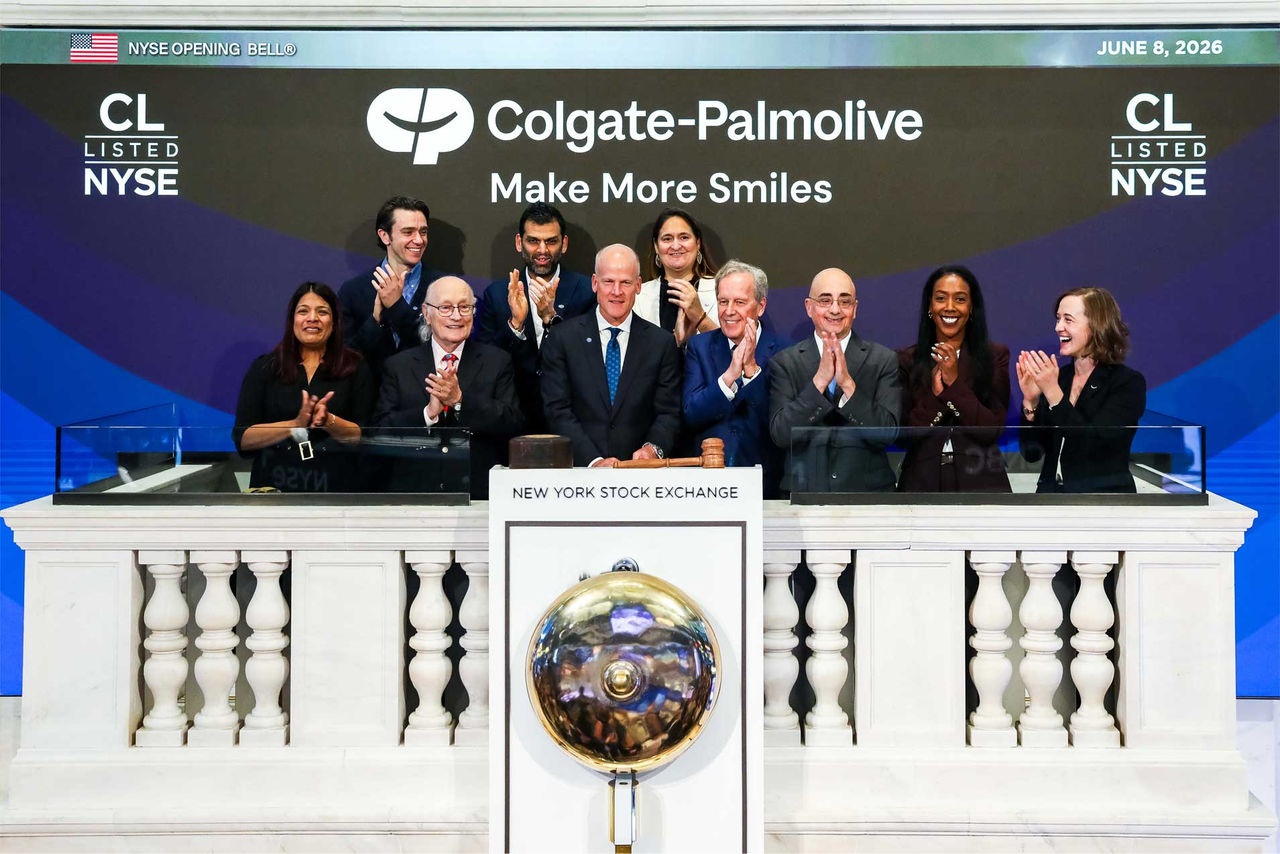
Mark created the peer-nominated awards in 1986, the year before Wallace arrived. Their premise was that an employee anywhere in the company might produce an idea worth spreading everywhere. The anniversary celebration included 41 global winners across six teams and five continents.
The scene puts Wallace’s tenure in perspective. He has spent most of his adult working life inside an organization older than any of its current leaders. Preserving useful habits while changing unhelpful ones is an awkward assignment. The photograph gives that assignment faces: predecessors, a successor, and employees whose contributions have earned a place beside them.
The next plan still has to earn its place
Wallace’s responsibilities now extend beyond Colgate’s boardroom. American Express elected him a director in July 2025, assigning him to its audit and compliance and compensation and benefits committees. He previously served on Kellogg’s board from 2015 to 2018 and also serves on the Consumer Goods Forum’s board. These connections place his experience with global brands in conversations beyond the household-products aisle.
Inside Colgate, the current horizon is 2030. At the September 2026 Barclays conference, he described the task as improving and scaling capabilities developed during the previous strategic plan, including analytics and AI. He also said the growth plan did not depend on major acquisitions. Smaller additions could supply useful capabilities; a large deal was no prerequisite for the ambition.
That distinction leaves considerable work with the business he already leads. Second-quarter 2026 net sales rose 4.9 percent to $5.361 billion, while organic sales grew 2.4 percent. The earnings measures moved in different directions: reported diluted earnings per share fell 5 percent, while the company’s adjusted Base Business measure rose 8 percent. A proper account of the quarter needs both figures.
The next scheduled earnings call is October 30. Until then, the dates and percentages remain provisional markers in a much longer working life. Wallace’s career began with learning the business from inside. His remarks suggest he still regards learning as part of the job. After nearly forty years, leaving room for another question may be one of the more demanding forms of continuity.