Simon Meester built his route to the corner office through Genie, a business whose machines lift other people into the air. By October 2025, less than two years into his tenure as Terex chief executive, the company was preparing to let that business go. Terex announced plans to explore an exit from its Aerials segment, including a possible sale or spin-off. A career built partly on blue boom lifts had arrived at a decision about whether they still belonged in the company.
There is something revealing in that sequence. Executives often inherit a collection of businesses and spend years explaining why the collection makes sense. Meester has been changing the collection. First came a $2 billion purchase of Environmental Solutions Group from Dover in October 2024. Then came a merger agreement with REV Group, completed in February 2026. Waste collection vehicles and fire apparatus acquired a larger place in the Terex story. The familiar outline of the company began to change.
The useful question is how a person learns to make that kind of choice. Meester’s public career offers an answer in installments: moving between countries, working through production constraints, and asking whether a new technology actually earns its place on a customer’s jobsite. The machinery is large. The questions are often quite small. Can someone service it? Can someone charge it? Will it turn up when promised?
An education in moving heavy things
Before Terex, there was a long apprenticeship in industrial businesses. Meester spent 14 years in progressively senior roles at Caterpillar, then became president of Sandvik Mining and Construction in India. At Eaton, he eventually led the Industrial Control Division as vice president and general manager. These are businesses where selling a product also means understanding the operation that must keep it working.
His career took him through the Netherlands, the United States, Dubai, India and China. At Caterpillar, a move to the United States in 2006 put him in global excavator product management; a later assignment took him to Dubai with responsibility for the Middle East and Africa. He joined Eaton in 2012 in a mining and metals role based in Shanghai. The geography matters because equipment markets do not all want the same thing at the same moment.
His formal education brought together automotive engineering and business. He earned a Bachelor of Science in automotive engineering in the Netherlands and an MBA from the University of Surrey in England. That combination is useful in a company selling machines whose appeal depends on both what they can do and what they cost to own. A clever mechanism still has to survive a purchasing meeting.
In 2018, he joined Terex as vice president of global sales and marketing administration for its aerial work platforms business. He became Genie’s chief operating officer in June 2020, its president in August 2021, and president of Aerial Work Platforms in May 2023. It was a succession of expanding responsibilities inside the business before the responsibility became the whole company.
The missing component has a vote
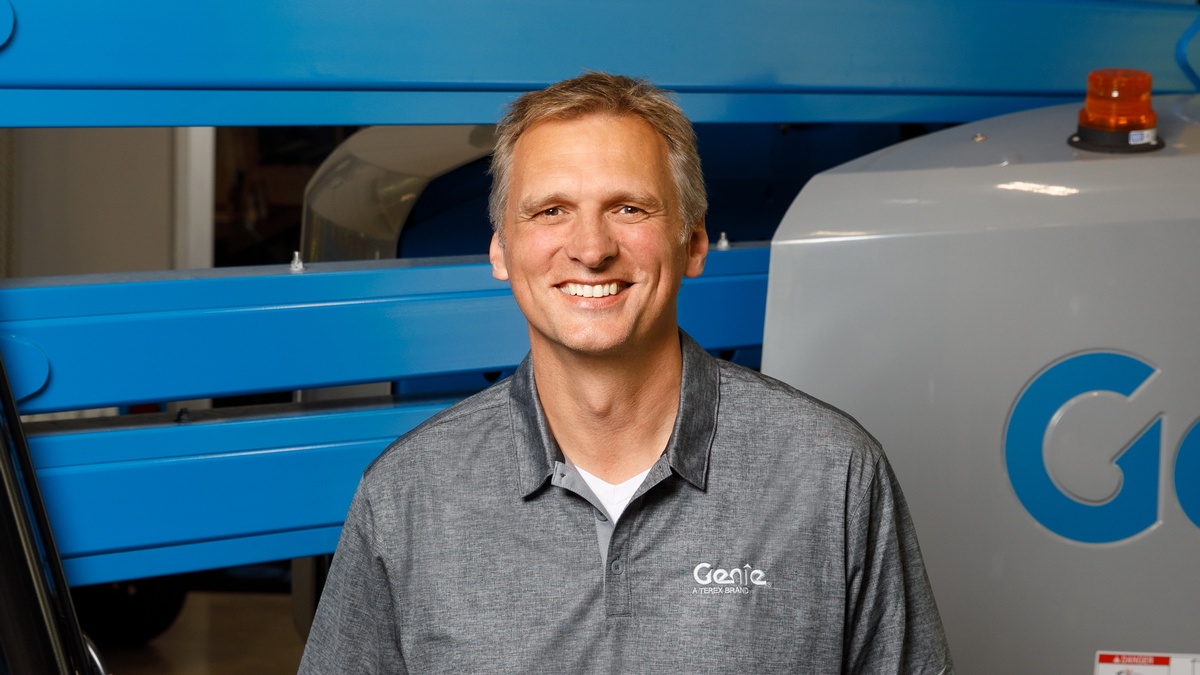
At Genie, the relationship between a promise and a finished machine was particularly visible. Customers could want equipment, and factories could want to build it, yet a missing component could hold up the entire transaction. Discussing supply constraints in 2022, Meester described work across suppliers, alternative sources and engineering redesigns to accommodate components that were actually available. The drawing board had to negotiate with the loading dock.
That detail is a better introduction to his working world than a list of leadership adjectives. A production schedule can look perfectly reasonable until a part fails to arrive. Changing a design to use an available component requires cooperation between engineering, procurement and manufacturing. It also requires an answer to the customer waiting at the other end. The work is specific enough to resist grand speeches.
The same interview returned repeatedly to maintenance. Meester discussed simpler boom designs, fewer service items and sealed electric drive motors. These details belong to the unglamorous arithmetic of equipment ownership: time in service, time in the workshop, parts to replace, money to spend. For the rental customer, a machine’s purchase price is merely the opening entry in a much longer ledger.
“Just because we can, doesn’t mean we should.”
Simon Meester, discussing equipment electrification, April 2023
A battery needs somewhere to plug in
Electrification gave Meester another occasion to distinguish technical possibility from practical usefulness. In April 2023, he argued for matching the power system to the work, even when engineers could technically do more. He was discussing the choice between electric and hybrid equipment. His test was what made economic sense for the customer, a useful restraint in an industry whose product names can resemble passwords.
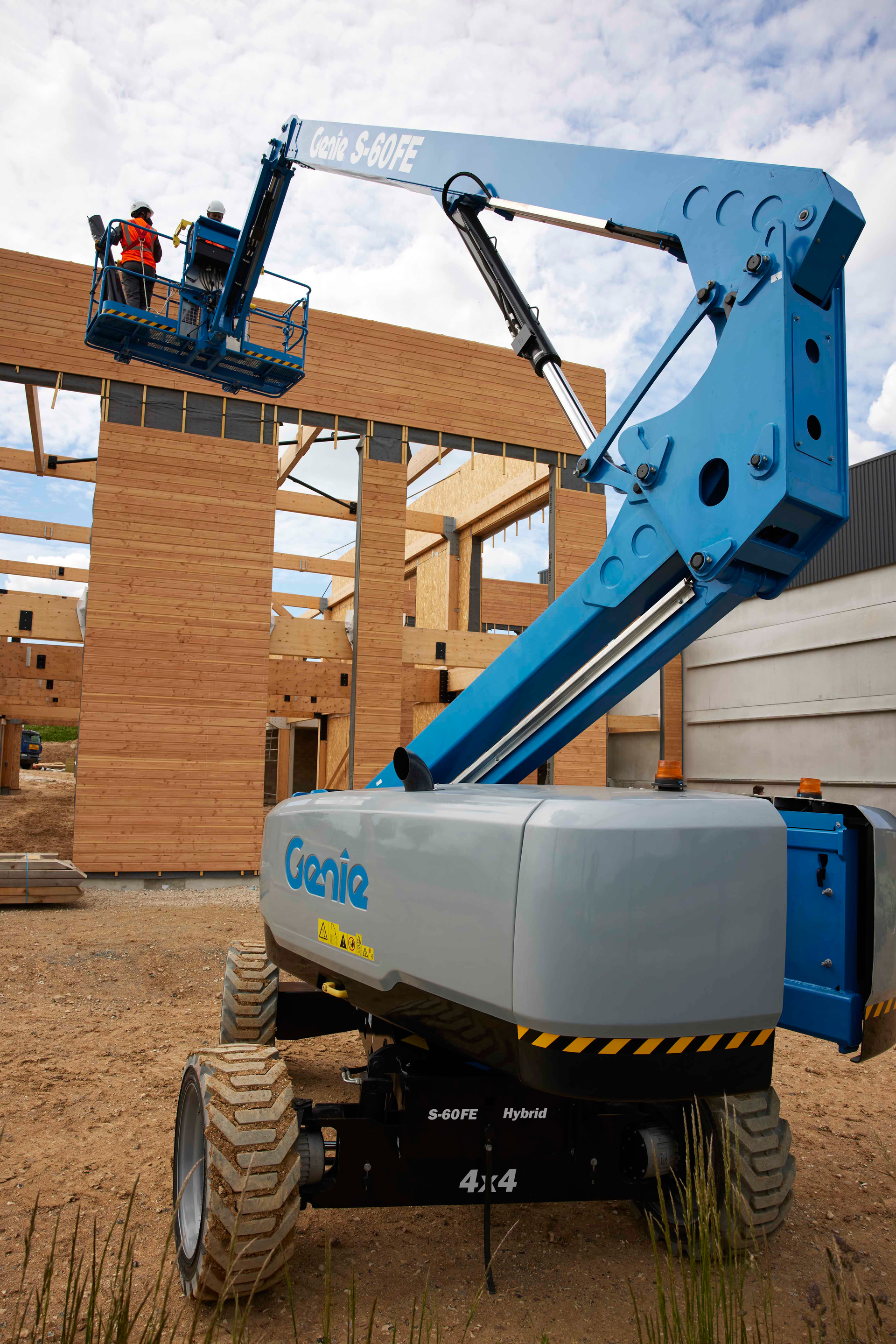
Later that year, he explained the argument through charging infrastructure. Genie’s hybrid booms could operate electrically while retaining the flexibility of an engine. He described their ability to recharge batteries in hybrid operation and keep working when a charge had been depleted. Full electrification, meanwhile, still faced the practical obstacle of getting power to the jobsite. The customer needed a working shift, whatever technology made that possible.
Environmental ambitions also reached the factory itself. Genie’s new Monterrey manufacturing facility received LEED Gold certification in October 2023. Meester spoke about reducing the footprint of products, processes and facilities together. That is a broader set of decisions than changing what powers a boom lift. The building making the machine has an energy story of its own.
Read together, those choices suggest a practical test for innovation: can the customer use it under the conditions that actually exist? An idea can be sound while its timing is wrong for a particular application. Accepting that distinction leaves room for several technologies to coexist. It also means the person making the decision has to keep listening after the product presentation ends.
The handover had two directions
When Terex announced its succession plan in October 2023, Meester was due to take over from John L. Garrison Jr. on January 1, 2024. The appointment also brought a seat on the board. Garrison would work with him through the transition and remain available as a consultant until June 30. David Sachs would become non-executive chairman, keeping that role separate from the chief executive’s job.
Meester was simultaneously handing Genie to Joshua Gross. The two had worked on the brand positioning behind “Quality by Design,” and Gross had held responsibilities spanning strategy, product management and commercial operations. Meester’s next role therefore depended on two transitions succeeding: taking responsibility for Terex while allowing another leader to take responsibility for the operation he knew closely.
That is a quieter milestone than an appointment announcement makes it sound. A promotion creates a vacancy as well as a title. The ability to leave a business in someone else’s hands becomes part of the work. In Meester’s case, the question would soon grow larger, as Terex began reconsidering which businesses it intended to own at all.
- 2018Sales & marketing
- 2020Genie COO
- 2021Genie president
- 2024Terex CEO
A different sort of recurring demand
The Environmental Solutions Group acquisition gave that reconsideration a concrete shape. The transaction brought brands including Heil, Marathon and Curotto-Can, together with digital offerings 3rd Eye and Soft-Pak. Its combination of equipment, parts and software extended Terex’s position in waste and recycling. Patrick Carroll, who had led ESG for 14 years, stayed in that role. The purchase added an operating team as well as a product catalogue.
The REV merger widened the picture again. Completed on February 2, 2026, it brought specialty vehicles into the combined company, which continued trading under the Terex name and TEX ticker. Meester remained chief executive. Terex described the combination as a way to build a more resilient revenue base, with anticipated integration benefits to be delivered over time.
The appeal of these markets becomes clearer when Meester talks about replacement demand. In July 2026, he pointed to municipal vehicles that communities need to replace on a regular cycle, and to utility demand tied to grid modernization, data centers and storm hardening. These needs have different drivers from the decision of a rental company to buy another aerial platform. Bringing them together changes the mix of exposures the chief executive must manage.
Acquisition announcements can make this work sound remarkably tidy. Factories are less obliging. On that July call, Meester discussed expanding fire apparatus production in Ocala, Florida, and Brandon, South Dakota. The priorities included improving throughput and shortening lead times. His enlarged company had brought him back to a familiar problem: people wanted machines, and the task was to get more finished machines out of the plant.
The next machine, and the next decision
The second quarter of 2026 supplied an early scorecard. Terex reported roughly $2.2 billion in sales, up 50.5% on the reported comparison. On a pro forma basis, which adjusts the comparison for portfolio changes, sales grew 8.5%. The distinction matters. Buying businesses enlarges the headline number; the comparable figure helps show what happened within the changed collection. Both belong in an honest account of the result.
Terex raised its full-year sales outlook to $7.9 billion-$8.2 billion. That remained an outlook, with execution still required. In July, Meester also said the Aerials review had interest from multiple parties and remained in progress. The business that helped bring him to the top was still part of Terex, even as he pursued options for its future. A strategic intention and a completed transaction have different dates.
As of October 21, the next public checkpoint was close: Meester and chief financial officer Jennifer Kong-Picarello were scheduled to host the third-quarter results call on October 28. Another set of figures would arrive, alongside the familiar questions about orders, factories and integration. His career now turns on whether the company he is assembling can deliver the steadier performance he has described.
There is a straight line between choosing a power system that suits a jobsite and choosing businesses that suit a company, though the consequences differ enormously. Each demands a willingness to put an attractive possibility through an inconvenient practical test. Meester’s next chapter will be measured in those tests: which machines get built, which orders get fulfilled, and which familiar business he is prepared to let go.
Follow the decisions
Interviews, company updates and places to follow his work.