Andrew Hider had the numbers. A business was delivering only half its products on time, customers were slipping away, and he had arrived to improve matters. He pushed hard. Then a colleague, Mo Mattocks, caught him walking between buildings and delivered a less comfortable assessment: Hider might fix the figures and lose the people.
Years later, Hider retold the exchange in a live conversation with Simon Drexler. The detail that stays with you is his willingness to cast himself as the problem. He had let his appetite for a solution outrun his ability to take colleagues with him. A better delivery percentage would count for less if the improvement departed when he did.
That memory offers a useful way into the career of Baxter’s president and chief executive officer. The résumé is full of manufacturing businesses. The interesting question running through it is human: how do you make an improvement survive the person insisting on it?
A practical education, in several businesses
Hider studied interdisciplinary engineering and management at Clarkson University, then earned an MBA there. Engineering and management make an instructive pairing. One asks whether a mechanism works; the other has to account for everyone standing around it. His subsequent career would keep returning to both questions.
He began at General Electric in 2000. Over six years he worked across manufacturing, project management, procurement and finance, eventually becoming president and general manager of GE Tri-Remanufacturing. Those are different entrances into the same factory. A purchasing decision becomes an inventory problem; a production delay becomes a financial one. The departmental boundaries look tidier on an organisation chart.
At Danaher, where he spent the next decade, the range widened. His work included Dover, the Anderson Group, XOS and Veeder-Root. The businesses covered motion technology, instrumentation, application-specific X-ray analysis and fuel management. Moving between them meant changing the product while continuing to confront the familiar questions of cost, delivery and execution.
He then became president and CEO of Taylor Made Group in 2016. This was the supplier serving marine, transportation, agriculture and construction markets. Boats and industrial instruments are an unusual combination on a résumé, but they make the breadth of his operating experience quite literal. He had spent much of his working life among companies that make physical things.
Three words, followed by the work
Hider took charge of ATS on March 6, 2017. At the time, the organisation had about 3,500 employees. Its board wanted someone who could combine organic growth and acquisitions with operating discipline. His appointment brought a manager accustomed to moving between industries into a company whose business was helping other companies make things.
The ATS Business Model gave that assignment a common vocabulary: people, process and performance. The order deserves attention. In an account of its first kaizen event in July 2021, the Italian business Co.Mac. described developing and empowering employees as the first pillar. Process came next, then results. Even an operating model needs someone willing to operate it.
There was specificity beneath the vocabulary. Training sessions and kaizen events assembled dedicated teams to identify waste and work out changes. A shared method could travel among businesses without pretending their work was identical. That matters in a company assembled from specialists: a useful common language should let the local accent remain audible.
The practical appeal is easy to see. If every acquired business speaks a different management dialect, comparison becomes an expensive translation exercise. A repeatable method gives colleagues a way to discuss problems together. Whether it works depends on what happens after the meeting, when people return to the tasks that made the meeting necessary.
“bring the team along in the journey”
Andrew Hider, reflecting on a mentor’s advice
A week in which plans had to earn their keep
In January 2025, Hider opened the ATS President’s Kaizen at IWK in Germany. Six teams across four countries were spending the week on particular business problems. It is a revealing scale: a global chief executive, a handful of teams, a deadline close enough to discourage elaborate declarations about the distant future.
By the second day, IWK’s team was examining on-time delivery for equipment and spare parts. An 80-20 analysis helped clarify the current position. The next step was a closer look at customer needs and the work itself. Another team, focused on repetitive equipment manufacturing, had completed its value proposition and customer analysis and was beginning to test its assumptions.
The mundane details carry the story. Spare parts have a way of making broad promises painfully specific. So does the question of whether an order arrived when it was supposed to. Hider’s updates stayed with such problems, following teams as they moved from describing a situation to deciding what they would change.
His repeated public interest in that transition helps explain the otherwise dry terminology. A plan is easy to admire while it remains a plan. Testing an assumption gives other people permission to discover that it was wrong. For an executive trained to push for an answer, that is a useful discipline to keep close.
The bell, and the less photogenic part
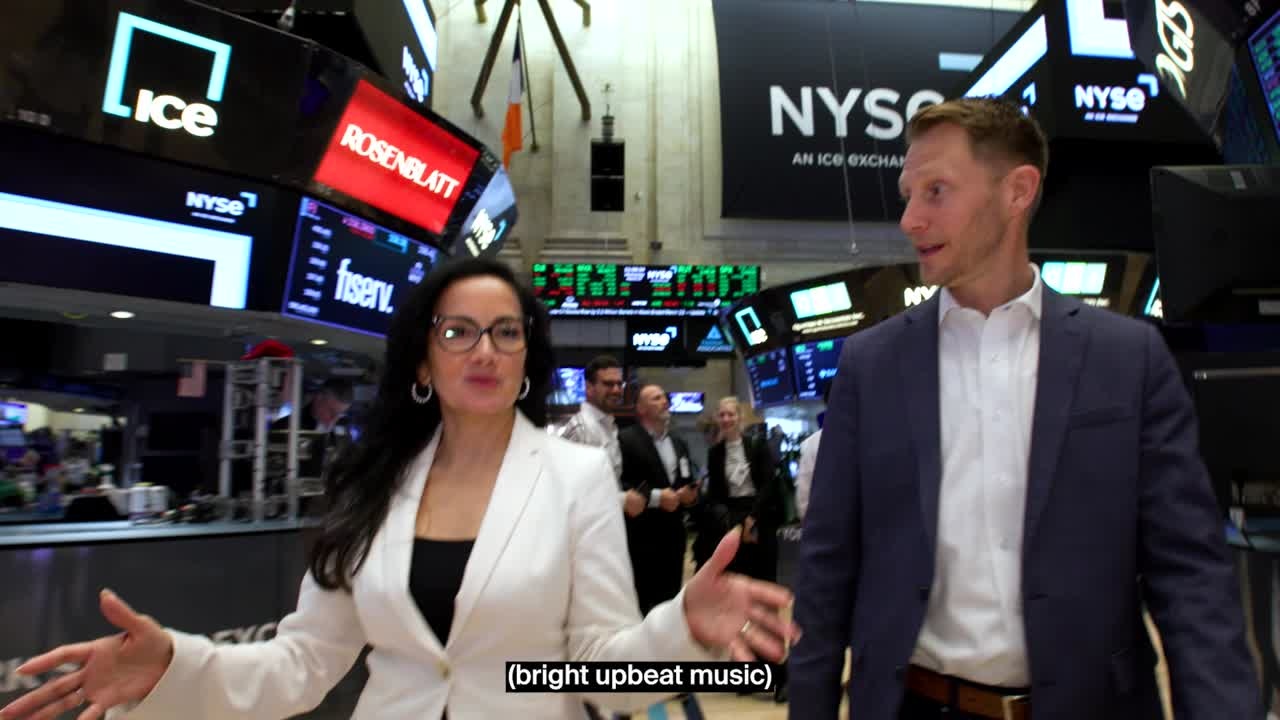
ATS began trading on the New York Stock Exchange on May 25, 2023, adding a US listing to its Toronto presence. Hider later rang the opening bell to mark the occasion. The annual report treated the ceremony as a moment of wider investor exposure and improved liquidity. A bell makes a convenient photograph; the work that earns another year of investor interest is harder to frame.
In 2024, he walked the trading floor with Judy Khan Shaw for an interview about the year since the listing and ATS’s place in the automation value chain. The setting put the company’s factory work in front of an entirely different audience. The conversation concerned a business that connected technical capability to other manufacturers’ ambitions.
When Baxter announced his recruitment in July 2025, it pointed to nearly doubled adjusted ATS revenue over the previous five fiscal years and a Toronto share price more than three times its level at his 2017 appointment. Those were measures for specified periods, with adjusted revenue defined separately from standard accounting figures. They explain the attraction of his record without making the next assignment a foregone conclusion.
He also joined Tennant’s board in August 2022. The cleaning-equipment manufacturer valued his experience in manufacturing, global business and disciplined execution. He now serves on its Audit and Executive Committees. The connection extends a career spent thinking about what happens when an industrial product meets a customer’s daily routine.
Taking a layer out
Hider became Baxter’s CEO on August 19, 2025. Brent Shafer moved from interim chief executive to independent chair. Separating the jobs gave Hider responsibility for daily strategic, operating and financial matters while Shafer led the board. The distinction matters: running the business and overseeing its leadership are substantial assignments of their own.
By October, Baxter had launched its Growth and Performance System, or GPS. The familiar interest in continuous improvement had acquired a new name and a different corporate setting. In his 2026 shareholder letter, Hider described the company as being in the early stages of a turnaround. There was no suggestion that installing a management system amounted to finishing the job.
The changes included removing a leadership layer and placing more functional capabilities inside the businesses. The stated purpose was quicker decisions, clearer responsibility and stronger execution. In practical terms, the people expected to act would sit closer to the markets and customers involved. Removing a box from a chart can be quick; establishing who decides what takes rather more attention.
Eight points in Belgium
A visit to Lessines, Belgium, supplied a more tangible example. Hider credited plant manager Abdellah El Kacem and the local team with applying daily management, standard work, root-cause analysis and kaizen. He also acknowledged that transformation work was already underway. That qualification gives the employees their share of the story.
The reported result was an eight-percentage-point improvement in on-time, in-full delivery in the first quarter of 2026 compared with a year earlier. Hider described faster changeovers, clearer ownership and fewer disruptions. These were his account of one site’s progress. The measure is useful precisely because its scope is specific enough to understand.
Year-over-year improvement in on-time, in-full delivery at Lessines, Q1 2026, as reported by Hider.
His leadership conference message that year also put AI alongside lean methods and customer experience. He framed AI as a practical capability for improving productivity and how work gets done. That places a fashionable subject next to a stubbornly unfashionable test: does the working day improve for the people doing the work?
The next answer has to last
In July 2026, Baxter reported second-quarter sales of $2.96 billion, up 5% on both reported and organic measures, and raised its full-year outlook. Hider said the quarter exceeded expectations, while acknowledging a tariff refund alongside operating performance. Adjusted earnings per share nevertheless fell 5% from a year earlier. Progress was accompanied by qualifications, as operating results usually are.
Then came another practical handover. Hider was appointed to cover the finance chief’s job during the short interval between Anita Zielinski’s September departure and John Rogers’s October 1 start. He retained the CEO role and received no extra compensation for the interim assignment. Even the chief executive occasionally has to cover the gap in the rota.
The Baxter chapter remains a test of the habits developed across those earlier businesses. Can decisions move faster? Can local teams own the changes? Can better performance keep repeating? Hider’s career has brought him plenty of opportunities to supply an answer. The lesson from that walk between buildings is that the people who remain must be able to carry it on.