In 2018, Michael O’Grady acquired two jobs with rather different ideas about what belongs in a frame. In January he became chief executive of Northern Trust. That same year, he became chair of the Museum of Contemporary Art Chicago’s board of trustees. A bank requires accounts to reconcile. A contemporary art museum can make a perfectly respectable afternoon out of refusing to reconcile anything.
O’Grady had an explanation for the attraction. He saw contemporary art as a way of understanding how people experience the world around them. Madeleine Grynsztejn, the museum’s director, valued something more practical in him: management judgment and financial understanding. He had been a trustee since 2012. By the time he took the chair, this was an established working relationship, rather than a banker’s sudden enthusiasm for a fashionable opening night.
The pairing offers a useful introduction to his public life. O’Grady works with institutions that have histories, obligations and constituencies. He arrived at Northern Trust decades after its founding. The museum had its own founders and traditions. In both settings, the question was how an institution keeps doing useful work as the people around it expect something different.
The adviser crosses the table
His early professional credentials were in accounting. O’Grady graduated from the University of Notre Dame in 1987 with a bachelor’s degree in business administration in accountancy. Before Merrill Lynch, he worked at Price Waterhouse. He subsequently earned his MBA at Harvard Business School, where he belonged to the class of 1992.
That year he joined Merrill Lynch. He went on to become a managing director in investment banking, a position he held from 2000 until his departure for Northern Trust in 2011. The sequence matters: accounting, business school, investment banking, then responsibility inside the company. Each move changed what he was expected to answer for. An adviser can explain a decision. An executive has to live with what happens after it.
At Northern Trust he began as chief financial officer. From 2014 through 2016, he ran Corporate & Institutional Services, taking responsibility for a business that served institutional clients. He became president of the corporation in January 2017, with oversight of wealth management, institutional services and asset management. His route to the top included both the financial controls and the businesses those controls were meant to support.
- 1987Notre Dame accountancy degree
- 1992Harvard MBA; joins Merrill Lynch
- 2011Joins Northern Trust as CFO
- 2014Leads Corporate & Institutional Services
- 2018Becomes chief executive
- 2019Adds the board chairmanship
The succession announcement came in October 2017. Frederick H. Waddell would step down as CEO at the start of the following year and remain chairman. He had spent 42 years at Northern Trust. This was a handover with considerable institutional memory sitting across the table. O’Grady thanked Waddell and spoke about building on the foundation already in place.
On January 1, 2018, O’Grady became the tenth CEO in Northern Trust’s history. Waddell’s farewell assessment emphasized his successor’s experience, intellect, integrity and humility. Those are a predecessor’s judgments, rather than a personality test, but they show what the outgoing leader wanted the appointment to communicate. In January 2019, O’Grady also became chairman. The transition had unfolded over stages, giving the new leader progressively broader responsibility.
A bank with several answers
Ask what Northern Trust does and the answer can become a small procession of financial nouns. Wealth management. Custody. Fund administration. Asset management. Banking. In a 2019 conversation, Bank Policy Institute chief Greg Baer asked O’Grady whether to think of the company as a wealth manager, a technology company or a bank. His answer was economical: “All of the above.”
He described three connected businesses and technology that could serve them together. The interesting detail was his test for innovation: whether it made an existing business more scalable and flexible. He discussed automating transaction processing and a private equity administration experiment in Guernsey. That project needed clients, regulators, auditors and lawyers to participate. A clever system would accomplish little if everyone who had to use it declined the invitation.
This is an unusually populated picture of technological change. The software has company. The auditor gets a seat. Someone must still decide whether the records can be relied upon. O’Grady’s explanation placed those people inside the experiment, where their acceptance would determine whether it could become a commercial service.
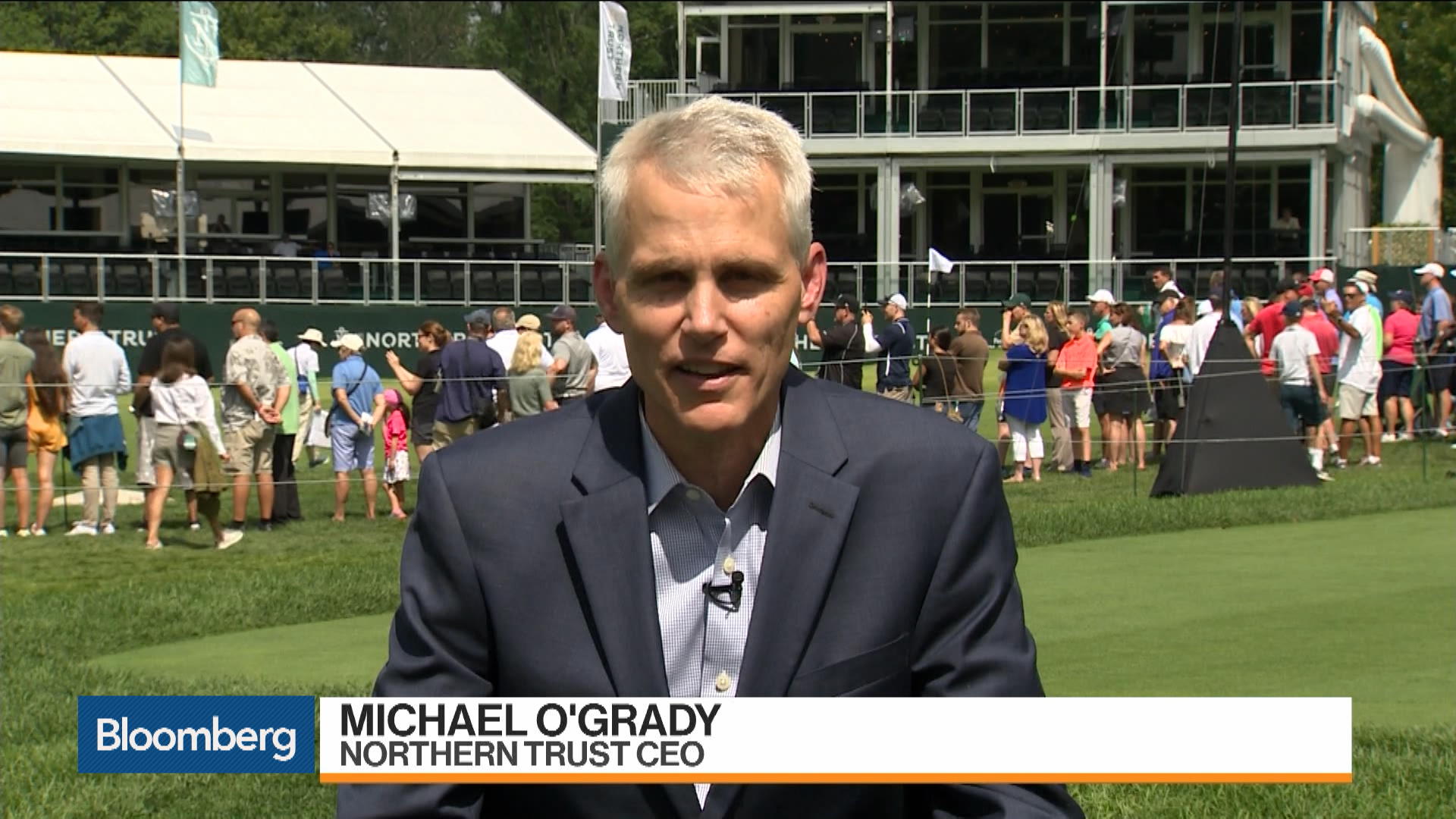
The golf course offered a more public setting for the same business of relationships. Speaking with Amanda Balionis in 2021, as Northern Trust’s final year as title sponsor drew to a close, he described the partnership as bittersweet. He pointed to brand awareness, experiences for clients and employees, and opportunities for philanthropy. The tournament was entertainment with several constituencies attached. Even outside the office, his explanation returned to who the institution served.
The arithmetic of keeping a promise
O’Grady’s 2024 shareholder letter offered three words of advice: “Prepare, don’t predict.” It is a pleasingly modest sentence for a profession so often asked to explain next Thursday. His argument was that the company should concentrate on what it could control while preparing for what it could not.
One example was almost aggressively unglamorous: a custody tax operations process. Reconciling holdings, tax rates and documents had taken approximately eight hours. The company reduced it to 30 minutes using process changes, analytics and other tools. An afternoon’s administrative burden had become half an hour. For a business handling records on behalf of others, that is a more useful demonstration than a grand prediction about the future of work.
Illustrates one reported custody tax operations process, not a company-wide average.
His 2025 letter moved that discussion into advisers’ daily work. Northern Trust had launched One Wealth Assistant, bringing investment insights into their workflows. The same letter described a deliberately selective growth strategy, aimed at specific clients and specialized services. O’Grady was making a case for choosing where the company could compete, and then making its people more effective there.
The numbers require some care. Northern Trust’s reported 2025 revenue fell 2% to $8.1 billion; excluding notable items, revenue rose 7%. Both statements belong in the account. Reading only the adjusted result would miss the reported decline. Reading only the decline would miss the underlying comparison management was asking shareholders to consider. The former CFO now had to explain both views from the chief executive’s chair.
What the larger numbers mean
By September 30, 2026, Northern Trust reported $19.9 trillion in assets under custody and administration and $2.0 trillion under management. These are different descriptions of client assets. They should never be added together to manufacture a more impressive total. Nor are they O’Grady’s personal wealth. Their significance here is the scope of the institution for which he is responsible.
Separate client-asset measures. Categories overlap and are not additive.
On October 21, 2026, the company announced third-quarter net income of $642.9 million and diluted earnings per share of $3.40. Its update described organic trust-fee growth in all three businesses. That provides a current checkpoint for his strategy, rather than a verdict on everything that follows. The chief executive’s promises remain subject to the next set of accounts.
There is another constituency in his working life: employees who have been there longer than he has. Northern Trust welcomed 288 people into its Quarter Century Club in 2025, bringing its community of colleagues with more than 25 years of service to nearly 1,600. O’Grady publicly celebrated their institutional knowledge. For a CEO who joined in 2011, those anniversaries are reminders that much of the company’s experience arrived before him.
Chicago gets another assignment
In June 2025, O’Grady succeeded Jennifer Scanlon as chair of the Commercial Club of Chicago and its Civic Committee. He had been vice chair for three years and chaired the strategic planning working group. The appointment expanded a civic life that already included the Field Museum, Catholic Extension and Notre Dame. At the MCA, the 2025 trustee roster listed him as immediate past chair.
He also serves as a Class A director of the Federal Reserve Bank of Chicago, with a term running through 2026. That class represents member banks. It is a defined governance role, and the distinction matters: a regional bank director’s position should not be confused with the Federal Reserve’s Board of Governors. His public responsibilities span several institutions, each with its own purpose and limits.
In September 2026, the Commercial Club and Civic Committee announced “Growth for All,” a regional agenda covering economic competitiveness, talent and livability. Its ambitions included returning Chicago’s population above three million and reducing the proportion of households in poverty by a quarter. These were targets for the region, rather than accomplishments to put beside O’Grady’s name.
“Growth creates opportunities,” he said at the launch. His statement connected growth to incomes, the tax base and the foundations on which businesses operate. It carried his work beyond the clients already inside Northern Trust. The civic assignment asks whether the surrounding region can offer more people a reason to stay, work and build something of their own.
“Step up, have confidence and embrace the richness of experiences you can have.”
Michael O’Grady, welcoming Northern Trust’s 2025 summer interns
His welcome to the 2025 summer interns offered a less formal expression of that interest in experience. “Step up,” he told them. The advice fits the visible progression of his career: learn a discipline, take responsibility for a business, then accept responsibility for an institution. In Chicago, that progression has also led him into museums and civic planning. The accountant’s work has grown to include quite a few things that resist fitting neatly into a spreadsheet.
Further into his working world
Conversations, letters and the institutions behind this profile.