Sara Greenstein was ten when she took a paying job doing field work on the farm next door. Her own family farm, in central Illinois, had already supplied an education in effort and uncertainty. You could put in the work. You could raise what you ate. You could still discover that the weather had a different agenda. Nature was an unusually candid early instructor in management.
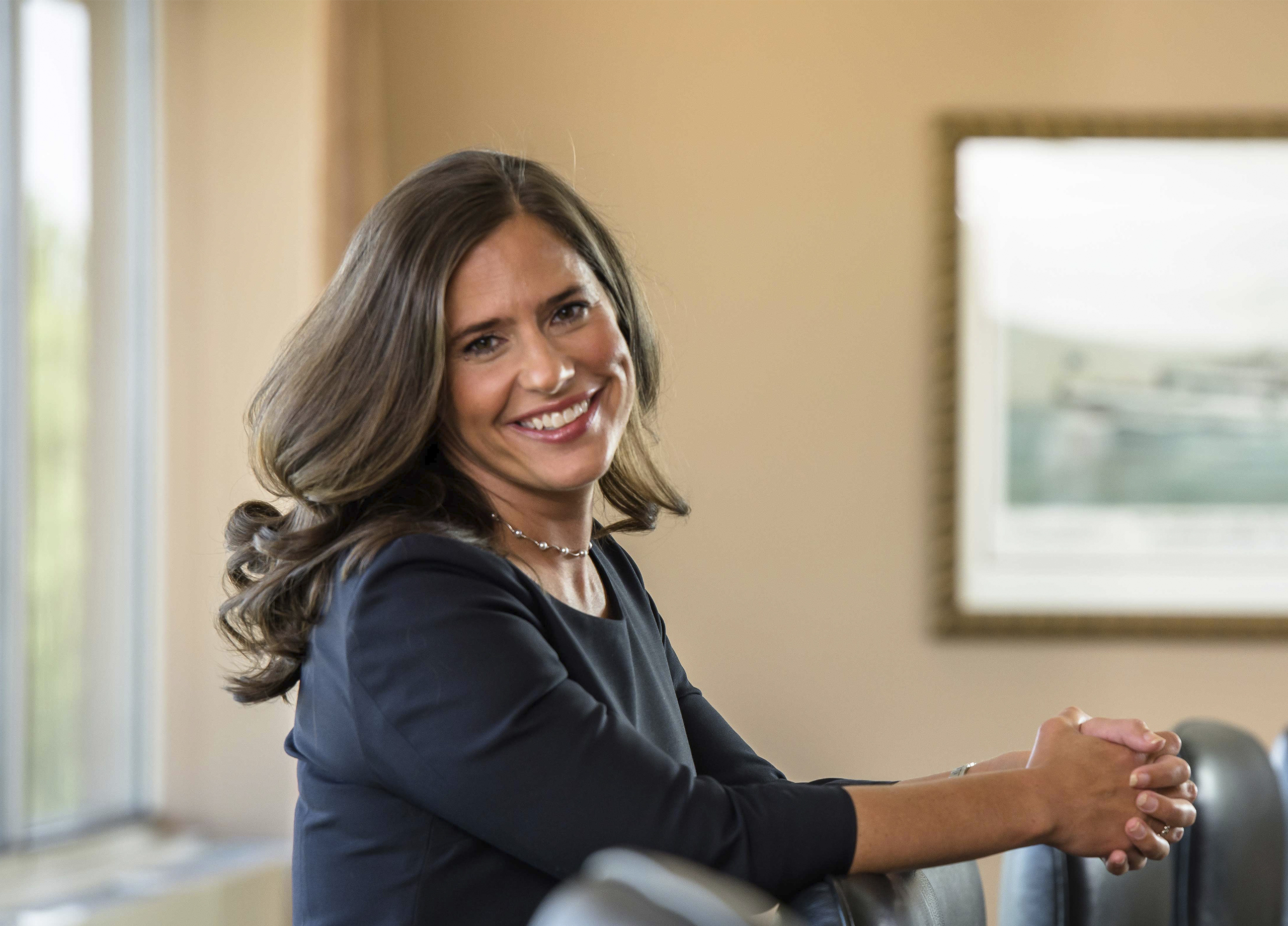
The girl who learned those lessons became a consultant, a senior executive at Underwriters Laboratories, the leader of a $4 billion steel business, and chief executive of Lydall. Since June 2022, she has been president and CEO of Axel Johnson Inc., a family-owned investment and operating company. Her working life has moved through businesses where decisions eventually have to survive contact with a factory, a customer or a balance sheet.
“I learned how to work before I knew what work was,” she has said. The remark has the economy of someone who sees little reason to decorate a plain fact. It also supplies a useful starting point for her career: the work came first. The language for explaining it arrived later.
The room, the skirt and the introduction
Greenstein studied business administration at the University of Illinois Urbana-Champaign, concentrating in industrial distribution management. She later earned an MBA at the University of Michigan’s Ross School of Business. Distribution is an apt subject for a future industrial executive. It asks how things move between people and places, and what has to happen for the promised delivery to become an actual one.
Her early career included Arthur Andersen Business Consulting and Boston Consulting Group. She worked on strategy and business transformation for large global clients. Consulting gave her an initial position close to the questions that would recur in her operating roles: how an established business changes, how it becomes more profitable, and how the proposed changes get carried out.
One recollection from Arthur Andersen gives the polished career history a human interruption. She was the only woman in her starting class. As the introductions around the table became increasingly impressive, she introduced herself by pointing out that she had just graduated and was the only person wearing a skirt. She remembers the global head remembering it. An introduction, at least, had been made.
Years later, at UL, a mentor encouraged her to be less critical of herself and to keep being herself at work. These two memories belong together. The first concerns the pressure of entering a room. The second concerns the pressure of staying in it. Her advice about leadership repeatedly returns to the value of bringing your own judgment to the table.
A short stay that lasted thirteen years
When Greenstein arrived at UL, she imagined a short assignment. By 2014, she was describing a stay of thirteen years. Her responsibilities changed, and the opportunity to influence both the business and its purpose kept her there. It is an unusually revealing detail in a career full of transformation: sometimes the thing that changes is your own expectation of how long you will stay.
She became president of Supply Chain and Sustainability in 2012. Earlier roles included chief marketing and strategy officer. During her UL years, she helped expand the business into Japan, India and China, and develop technology and software businesses. Product testing, information and international growth sat within the same working life. The geographical distance from an Illinois farm was considerable.
In May 2014, UL Environment issued its first closed-loop environmental claim validation to Dell. The claim concerned plastic from old electronics being used in new computer parts. Dell’s OptiPlex 3030 All-In-One was verified to contain at least 10 percent post-consumer closed-loop recycled content. Greenstein spoke about the validation as part of building more sustainable supply chains.
The distinction mattered. A recycled-content claim tells a buyer something about a material. A closed-loop claim describes a route by which an old product becomes part of a new one. UL’s work gave that route a defined test. Sustainability, in this corner of her career, involved specifications and verification as well as ambition.
A month later, UL announced the expansion of its Information & Insights division. Its services included a materials search engine and supply-chain information tools. Greenstein described the need to connect data across supply chains so product decision-makers could find and buy sustainable materials more quickly, with stronger assurance about quality. The practical problem was information arriving where a decision was being made.
There is a family resemblance between these projects. Both required other people to be able to check what a business was saying. Both made the details of a product easier to examine. A customer cannot build much of a purchasing decision on a handsome adjective. A usable specification is less glamorous, and considerably more helpful.
Dell validation, 2014: at least 10% post-consumer closed-loop recycled content in the OptiPlex 3030 All-In-One.
Four billion dollars, eight operating facilities
In November 2014, U.S. Steel announced that Greenstein would lead its Consumer Solutions commercial entity. The appointment took effect in December, during a wider reorganization called the Carnegie Way. The company wanted stronger customer relationships and better results. Greenstein was joining an industrial business whose products reached appliance, container, construction and other markets.
By the time she moved to Lydall, her remit was described as a roughly $4 billion global business with more than 4,000 employees at eight large operating facilities. Those numbers put some weight behind the familiar executive word “operations.” An operating decision at that scale travels through many hands before it reaches the customer. There are plenty of opportunities for an elegant plan to acquire an inelegant delay.
Her approach included lean manufacturing, more structured business processes, and product development carried out in closer collaboration with customers. The Consumer Solutions division recorded a 300 percent increase in EBITDA during her leadership, a result reported in accounts of her tenure. EBITDA measures earnings before interest, taxes, depreciation and amortization. It is a business-performance measure, rather than a measure of personal wealth.
The combination of methods is worth dwelling on. Lean manufacturing concerns the work inside the operation. Customer collaboration concerns the usefulness of what comes out. Process discipline helps connect the two. For Greenstein, the turnaround brought together commercial relationships and factory execution, rather than leaving either one to carry the entire explanation for a business’s fortunes.
Scale of her U.S. Steel remit, as described at her 2022 appointment. Figures describe the business, not AJI or her personal finances.
A turnaround with a price attached
Greenstein became Lydall’s president and CEO on November 18, 2019. The company made specialty filtration materials and engineered products, including thermal and acoustical solutions. Its operations extended across the United States, Europe and China. Sales and profits had been declining. She arrived with a clear need to improve performance, and an existing business whose technical capabilities gave her something to work with.
Her initial agenda emphasized collaboration between Lydall’s three business segments, communication and accountability. She also pointed to the company’s closeness to its customers as an asset. This is a recognizable problem in a diversified manufacturer: valuable expertise can sit in separate parts of the organization, while the customer experiences the company as a single supplier.
In June 2021, Unifrax, backed by Clearlake Capital, announced an agreement to buy Lydall for $62.10 per share in cash. The deal implied an enterprise value of about $1.3 billion. Lydall brought 23 manufacturing facilities worldwide to the combination, alongside technologies in specialty filtration and advanced materials. Greenstein’s tenure ended in October 2021.
The buyer’s stated rationale included electric-vehicle battery systems, filtration and energy-saving applications. That context gives the transaction more substance than its price alone. The business had industrial capabilities another owner wanted to combine with its own. A deal announcement gives a precise financial endpoint to a period of operating change, even though a company’s work continues under the next owner.
Approximately $1.3 billion implied enterprise value. These are different measures of the same announced transaction.
The next job came with a longer clock
Axel Johnson appointed Greenstein effective June 13, 2022. She succeeded Michael Milligan, who was retiring after twenty years with the company. Chairman Axel Morner described a search for someone who shared its approach to people, its long perspective, and its belief in the social role of business. Operating experience mattered, and so did the way that experience would be used.
AJI was founded in 1920 and is headquartered in New York. It belongs to the Stockholm Johnson family while being legally and financially independent. Five generations of family ownership formed the background to Greenstein’s appointment. For an executive coming from public-company leadership, this put investment decisions inside a different ownership setting: one explicitly organized around helping businesses grow over time.
Greenstein said the company’s values matched her own. She wanted to work with its business leaders, build on their strengths and develop a strategy for faster growth. There is a productive tension in that combination. A long horizon allows room for patient investment. Faster growth still asks management to choose, act and deliver. The calendar does not relieve anyone of the need to make a decision.
Her responsibilities now also extend beyond the CEO’s desk. She joined BorgWarner’s board in November 2021 and has served on Copeland’s board since August 2023. Her earlier board experience includes Briggs & Stratton. These appointments add another view of industrial businesses: asking questions about management, governance and performance from the boardroom, while running a company herself.
- 2001-2014UL
Testing, technology, supply chains - 2014-2019U.S. Steel
Consumer Solutions - 2019-2021Lydall
Specialty materials - 2022 onwardAxel Johnson Inc.
Long-term business ownership
A philosophy that has to leave the meeting room
In July 2026, AJI completed its move to full ownership of Fort Wayne Metals, following an initial investment in 2021. Greenstein emphasized the company’s people, customer relationships and innovation, and the intention to keep investing in its capabilities and products. The chronology gives a concrete example of the ownership horizon she joined: a relationship developed over several years before the transition to full ownership.
The personal measure of all this work is smaller than the transactions. After her son Matthew was born in 2005, Greenstein wrote down family priorities on an index card. Education and making her children feel loved were central to it. In 2023, she said she still carried the card in her wallet. It gave her a way to check decisions against commitments made well before her current title.
She has also described listening as an essential skill, and finds satisfaction in seeing colleagues develop beyond what they thought possible. Those comments suggest an executive interested in what other people can contribute. Her call for varied backgrounds and experiences in major decisions is practical: a wider set of inputs can improve the judgment that follows.
“Words matter, but actions matter more.” It is a brief statement to carry through a career of larger organizations and larger numbers. On a farm, in a testing business, on a steel shop floor, and among companies held for the long term, the same question can be asked of a decision: what happened after someone made it? Greenstein’s story keeps returning to the work required to answer.
“Words matter, but actions matter more.”Sara Greenstein