A stove is an unusually solid beginning for a story about startup finance. It has weight. It needs a factory. Somebody has to build it, sell it, and stand behind it. Marc-Antoine Cantin entered entrepreneurship through exactly that sort of business when he and his brother bought a Quebec manufacturer in 1999. More than two decades later, he leads Anges Québec, where the products are often less tangible and the companies much younger. The connection between those chapters is the work of being present.
There is a pleasing lack of glamour in that idea. Showing up rarely earns its own line in an investment announcement. Yet Cantin’s career gives it substance: operating a company, buying other businesses, working on industry standards, and eventually putting that experience into conversations with entrepreneurs. The cheque opens a relationship. What happens during the relationship is where his story gets interesting.
Two brothers, one purchase, thirty employees
Before the factory came accounting. Cantin completed his undergraduate business degree at McGill in 1996, worked as an external auditor at Ernst & Young in Montreal, and pursued graduate accounting studies at Concordia. He obtained his chartered accountant designation in 1998. This was an introduction to businesses through their records; ownership would put him on the other side of the decisions those records describe.
In 1999, Marc-Antoine and Jean-François Cantin went looking for a company to buy. They were 24 and 26. The brothers, originally from Repentigny, became majority owners of FX Drolet, the business from which their SBI chapter developed. It had about 30 employees. Buying an existing manufacturer meant beginning with people and products already in place. Their entrepreneurial starting line was somebody else’s working day.
By 2009, the business recorded sales of C$42.5 million. The following year, it employed more than 220 people, including employees in La Guadeloupe and Lac-Etchemin. Those figures give the acquisition a human scale: a small workforce had become an organization spread across several places. A purchase is a date on a calendar. Expansion rearranges many calendars.
The brothers buy
a manufacturer
SBI announces
the CEO handover
Cantin takes the helm
at Anges Québec
In 2010, Cantin was invited to tell his entrepreneurial story at the Conseil économique de Beauce’s dinner for young businesspeople. SBI then marketed seven heating-product brands and operated three factories. The invitation makes a useful pause in the narrative. A decade after the purchase, a young buyer had become someone other businesspeople wanted to hear explain how the work had gone.
Growth comes with assembly instructions
Acquisitions became part of Cantin’s operating education. Between 2002 and 2008, he helped SBI complete five purchases in the hearth industry. His responsibilities covered business development and operations, including product development, marketing, sales, and finance. That breadth matters when considering his later investment career. He had experience with the departments that a business has to coordinate after its growth plans leave the meeting room.
He also worked beyond his own company. From 2007 to 2010, he chaired the CSA B415.1-10 standards committee, and in 2010-2011 he chaired the Hearth, Patio & Barbecue Association. Standards work puts an operator in a conversation shared by an industry. It adds another dimension to the familiar picture of entrepreneurship: sometimes the work concerns the rules by which everyone’s products will be judged.
In 2017, SBI found a partner in Empire Comfort Systems. Cantin explained that a sale had not been the original plan. Discussions with Empire’s Nick Bauer changed the calculation by revealing what the organizations might accomplish together. He and his brother had been buyers; now they were evaluating a different kind of partnership.
“It was not on the radar screen for us to sell our company.”
Marc-Antoine Cantin, on the Empire partnership
The two manufacturers were to continue operating independently. That detail keeps the transaction grounded. An agreement can create opportunities without immediately folding two working businesses into a single operation. For Cantin, the episode also belongs to a longer pattern of making decisions with his brother. The family partnership survived the transition from acquiring companies to finding a partner for their own.
The stove business learns new tricks
The product category can make SBI sound more settled than the work inside it. By 2021, its recruitment needs included engineers in automation, mechanics, and electrical systems, alongside software and data specialists. A company making residential heating products needed a range of technical disciplines to work together. The stove remained familiar. The skills around it were changing.
SBI’s reported revenue had reached C$60 million in 2020. Its growth story therefore contained both scale and technical development. These are different demands: selling more products does not by itself solve the problem of designing, producing, and supporting more sophisticated ones. The company’s evolution is a useful reminder to examine what an operator actually handled before assigning an industry label to their experience.
In 2022, SBI announced the arrival of Mark Murphy, who would succeed Cantin as CEO before year-end. The announcement marked Cantin’s 23 years at the helm. It gives his manufacturing chapter an ending with a name and a handover. Every growth story eventually needs an answer to the question of who will take responsibility next.
Cantin’s own professional education continued. He completed the ICD / Rotman Directors Education Program, and his LinkedIn profile records the ICD.D designation in January 2022. His public profile also lists English, Spanish, and Portuguese at different proficiency levels. Together, these details sketch a career with several working vocabularies: accounting, operations, governance, and the language of the person across the table.
An angel with a calendar
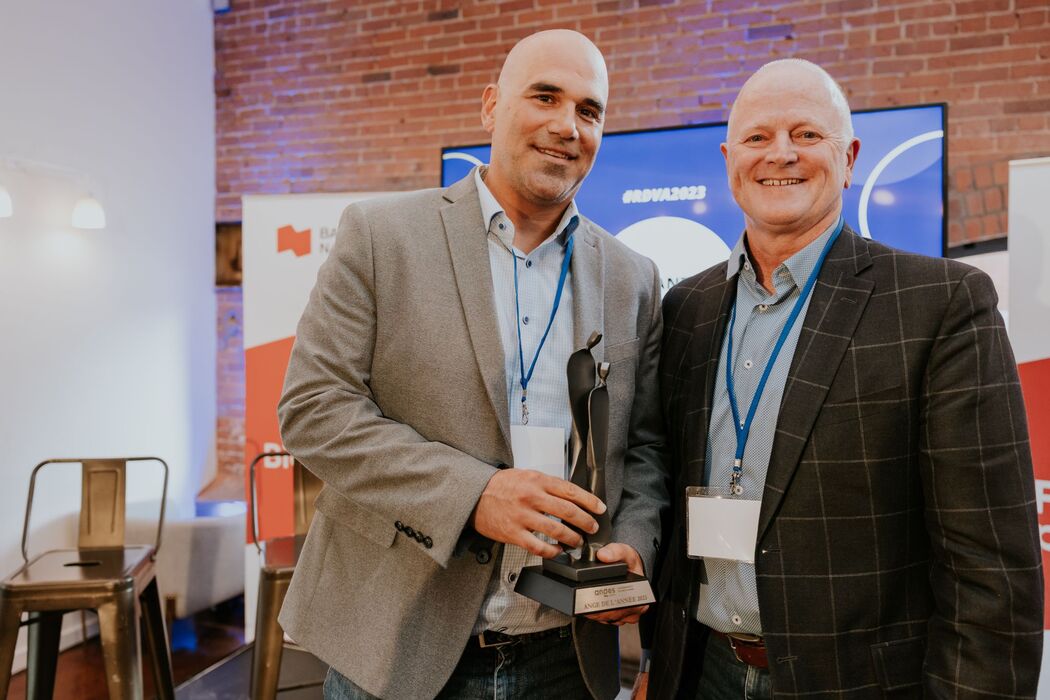
By 2023, Cantin was holding Anges Québec’s Angel of the Year Award. The photograph captures him beside Marcel Larochelle, the Novacap managing partner. The award belongs to the investor chapter of his career, but the manufacturing experience remains relevant. Having run a business gives him something to bring to the discussion after an entrepreneur has finished the pitch.
His metaphor for participation is disarmingly domestic: tomatoes. Comparing angel investing with stock-market investing, he turns to the idea of growing something yourself. The point is the time and involvement required. It is an image with more dirt under its fingernails than the usual vocabulary of capital allocation, and it suits a career built around making things.
That metaphor makes the investor’s role easy to picture. Buying into a young business begins a period of attention. The entrepreneur needs people who will return to the conversation, rather than treat the transaction as its conclusion. It is also a useful test of enthusiasm: a person can like the idea of supporting founders while having little room in the diary to do it.
In his December 2025 Investi appearance, Cantin described himself as a generalist. When discussing unfamiliar data-centre technology, he explained how a specialist within the investor network could help evaluate it. He also spoke about the pleasure of meeting employees and getting to know the people behind an investment. His description gives the network a practical job: put relevant experience within reach.
That is an appealingly ungrand view of expertise. A generalist can recognize a promising commercial question and still need help with the technology. The useful next step is a conversation with someone qualified to examine it. The network earns its value when members have both the knowledge and the willingness to contribute their time.
A larger room, and more people to teach
Anges Québec announced Cantin’s appointment as CEO in July 2025. He was already an active member and a director. The appointment moved him from participating in the network to taking responsibility for the organization supporting it. His operating background now had a second application: helping a group of experienced people work effectively together.
His stated priorities included educational events, networking, and a more organized curriculum for investors. The appeal was personal as well as organizational. He wanted work that brought him into contact with people.
“I’m not a guy who wants to sit behind a desk all day.”
Marc-Antoine Cantin
Anges Québec’s current investor offering describes a process extending through diligence, negotiations, legal work, and follow-up after investment. It also invites entrepreneurs, sector specialists, and experienced executives to contribute. Seen through Cantin’s career, this is a way of making different kinds of business experience useful to founders. The former operator brings one set of questions; another member may bring the technical expertise.
Education matters in that arrangement because success in one business does not automatically supply a method for investing in another. A network has to help its members ask better questions together. The work resembles running an organization in one practical respect: having capable people is a beginning. Giving their capabilities a useful place in the process is the continuing task.
The long wait after the beginning
The Elevia funds add another route into the network’s investment activity. The current official model targets roughly ten startups through an annual fund, with a C$25,000 minimum investment. It is designed for accredited investors seeking passive exposure alongside participating angels. The distinction in involvement is clear: some investors contribute directly to individual businesses, while others participate through a fund.
Elevia I currently targets C$1 million to C$2 million, with capital deployment planned over 12 to 18 months. Its estimated life is ten to twelve years. These are targets and time horizons, rather than completed results. They give the story a slower clock than a pitch event or an announcement. The beginning can be brief. The investment relationship can last years.
The wider setting also demands patience. The joint message from Cantin, Réseau Capital’s Olivier Quenneville, and Québec Tech’s Richard Chénier in the year-end 2025 ecosystem report emphasized execution and commercialization. Quebec recorded 122 venture-capital deals worth C$1 billion that year, with invested dollars down 48 percent from 2024. Bringing a business to market had become a central concern in a more selective environment.
In February 2026, Cantin was listed as a judge for ForumIN!’s startup-pitch session in Laval. It is a fitting place to find this stage of his career: listening to entrepreneurs, with a long operating history behind the questions. The setting has changed since two brothers bought a manufacturer. The responsibility to take a business seriously remains. Showing up has become something he can help other people learn to do.