Claudio Rojas is interested in the cheque that arrives before the applause. By the time a company has a familiar name, an imposing valuation and a queue of admirers, its beginnings can look almost inevitable. Someone had to make a less comfortable decision earlier. Someone had to believe there was a business worth building while there were still plenty of reasons to wonder.
On April 30, 2026, Rojas brought that concern to the Canadian Senate. Appearing before the Standing Senate Committee on Banking, Commerce and the Economy alongside Jim Balsillie, he spoke about access to capital for small and medium-sized enterprises. The setting was formal. The underlying question was practical: how does a promising Canadian company get enough support to become a larger one?
Rojas is the Toronto-based chief executive of the National Angel Capital Organization, or NACO. His job puts him among the people making those early decisions and the organizations that help them invest. In his Senate testimony, he described a membership spanning more than 4,000 angel investors and over 100 organizations. Their collective investments, he said, exceeded $1.8 billion across more than 2,000 Canadian companies.
The totals belong to a network, accumulated through many decisions by many investors. They are useful context for Rojas’s work, rather than a personal investment scorecard. His public argument keeps travelling back from the large number to the small beginning. A country hoping for more substantial businesses needs people willing to support them while they are still insubstantial.
A lawyer’s question inside an investor’s job
Before NACO, Rojas was studying another consequential beginning: the arrangements that determine who controls a company. He holds a law degree from Western University and an MBA from Ivey Business School. His professional credentials also include the CFA charter and the Institute of Corporate Directors’ ICD.D designation. Law, finance and governance give him several ways into the same business problem.
His 2014 paper, An Indeterminate Theory of Canadian Corporate Law, appeared in the UBC Law Review. By 2017, he was writing for Oxford Law Blogs about concentrated equity ownership and the founder-centric firm. The essay examined how bringing ownership and control closer together might affect a company’s ability to pursue longer-term growth.
Rojas was then a director at Hurt Capital and a founding member of the Institute for Founder Centric Studies. The European Corporate Governance Institute interviewed him about founder centrism in May 2017. These are rather scholarly surroundings for someone who would later spend so much time talking about startup cheques. Yet the connection is straightforward. Raising money can alter who gets to decide what happens next.
Ownership is one of those subjects that sounds dry until it belongs to you. For a founder, it can mean having the authority to persist with an idea, change direction or resist a convenient exit. For an investor, it raises questions about influence and accountability. Rojas’s research takes those arrangements seriously, treating the structure of a company as part of its economic life.
That interest followed him into NACO when he became CEO in 2019. In his first interviews about the role, he linked access to early capital with founders’ ability to retain influence over their companies. He pointed to founder-led Canadian businesses and argued that reducing the friction of fundraising could help entrepreneurs preserve their vision. His concern extended to the communities where those businesses began.
The dream had an unexpected advertiser
There is a more entertaining route into his national ambitions. In February 2019, discussing the first Canadian Dream Summit, Rojas recalled preparing a keynote called Building the Canadian Dream. He had discovered that the loudest voice promoting the phrase was an American car company: Chevrolet. A country’s aspirations were receiving some useful attention from the automotive department.
The anecdote gave a large ambition a human scale. Rojas wanted Canadian entrepreneurs to have a stronger claim on the story. He founded the Canadian Dream Summit to connect growing companies with capital, talent and customers. The first gathering took place at Telus Harbour in Toronto, bringing business and technology leaders together around the question of how Canadian companies could grow internationally.
Anthony Lacavera opened the day with a talk about how Canada could win as a country. Amanda Lang moderated a discussion about cultivating an environment for growth. Rojas’s interest was in the distance between having capable people and producing companies with global reach. He spoke about Canada’s research institutions, engineering talent and diverse workforce, then asked how those advantages might translate into more substantial businesses.
The summit offered a stage for that question, but the work it described was less glamorous than the word “dream” suggests. A company needs people to hire, customers to persuade and money to continue. Bringing those needs into one conversation was the point. Rojas was trying to make a national aspiration useful to the person responsible for next month’s business decisions.
Put more places on the investment map
For Rojas, access also has a geography. In a 2020 account of a Calgary radio interview with NACO board chair Sandi Gilbert, he described angels as investors rooted in local communities across the country. Their knowledge of a place could help them find founders who would otherwise remain outside the most visible investment conversations.
“Calgary has a long history of risk capital.”Claudio Rojas, Calgary radio interview published January 2020
He saw a connection between that history and the risks involved in backing young companies. He also emphasized education through NACO Academy: helping people approach startup investment with preparation and judgement. Enthusiasm supplies the first introduction. It takes more work to assess a business, understand a financing arrangement and decide how to help after the money arrives.
His advice to entrepreneurs in that conversation was to build relationships early. The logic was patient. An investor who has time to get to know a founder and a team has more to work with when an investment decision becomes possible. The relationship can begin before the cheque does. That makes room for observation, questions and a better understanding of the people involved.
Atlantic Canada was another part of the map. In August 2019, Rojas described NACO’s forthcoming Halifax summit as a critical step in developing angel networks. He spoke about the need to gather and educate investors in regions beyond the major centres. It was a concrete expression of his wider ambition: a founder’s opportunity should not depend entirely on proximity to an already busy investment district.
Capital + experience→Growing company
Customers + team→Later investment
Room to scale
NACO’s annual report covering his first year as CEO described regional and national summits, virtual roundtables and work to strengthen the funding continuum. Those activities suit the nature of his role. He leads an association whose usefulness depends partly on what its members can do together. Meetings, education and shared practices may sound modest beside a funding announcement. They help create the conditions for one.
The people behind the capital
Rojas has described the angel community as carrying a strong impulse to pay experience forward. That helps explain why mentorship appears so often alongside money in his interviews. Former entrepreneurs can recognize a problem they have encountered themselves. They can make an introduction, ask an awkward but useful question, or help a founder consider a decision before it becomes expensive.
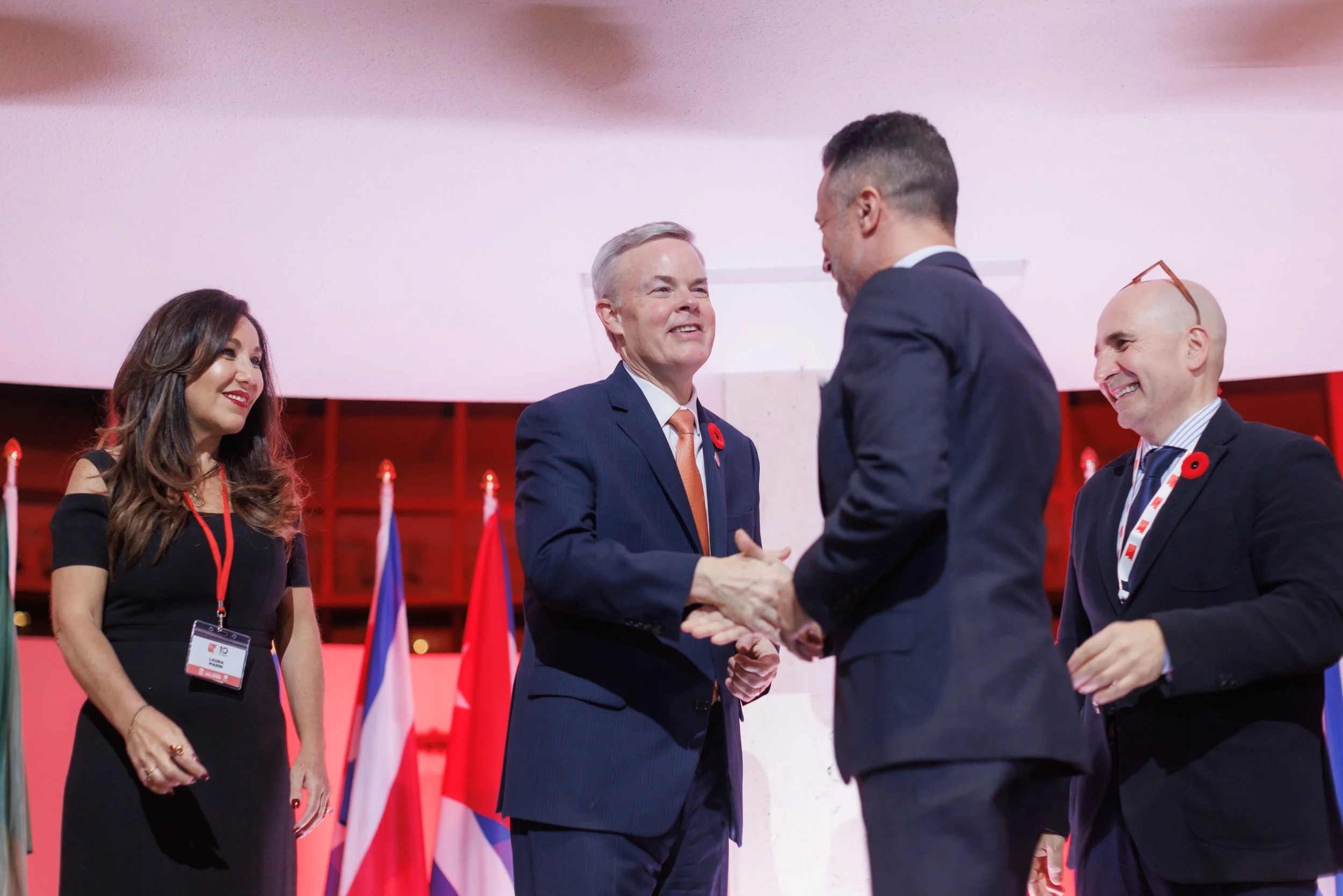
His own public life supplies a mixture of these worlds. His photographs place him with founders, investors, broadcasters and public officials. One shows him with Warren Buffett in Omaha. Others show festival discussions and conversations with Canadian entrepreneurs. The gallery is a reminder that the professional network behind investment is made of individual encounters, however neatly the results are later arranged in a report.
In 2024, Rojas was recognized among Canada’s 10 Most Influential Hispanics. His award biography describes his Venezuelan heritage and connects it with his involvement in initiatives supporting women and newcomer entrepreneurs. It also describes NACO’s work with the Start-up Visa program and its National Women’s Initiative. Access, in this account, includes widening who can participate on both sides of an investment.
From an early cheque to a policy proposal
The May 7, 2026 supplementary brief following his Senate appearance moved from diagnosis to design. Rojas proposed a framework for a “Canadian Sovereign Scalable Company,” with qualifying paths tied to private investment or to the characteristics of a Canadian-headquartered, knowledge-based business. The brief connected that framework to proposed tax measures intended to encourage investment and the reinvestment of gains.
Those measures were recommendations. The distinction matters: a proposal describes what its author wants to build. Here, Rojas’s intention was to connect the supply of capital, its deployment into companies and the recycling of returns. The next generation of founders would benefit from a system that keeps making room for another beginning.
Across the research, the summit and the association work, the recurring interest is continuity. A founder needs enough room to keep developing a company. A local investor needs a way to connect with it. A growing business needs further opportunities beyond its first financing. Rojas’s career follows the links between those decisions, with the first cheque always somewhere in view.
Success gives people a marvellous memory for inevitability. The early investor has to act without that convenience. Rojas has chosen to work around that uncertain moment, when a company’s future is still a question and someone must decide whether to help it become an answer.