In northern Jordan, the startup brief began with farmers. VentureX and HELVETAS interviewed 315 of them around Mafraq and Irbid, asking about the things that made their working lives difficult. Water was scarce. Fertilizer was expensive. Getting produce to a buyer could be an ordeal. An elegant invention would have to answer to some decidedly inelegant problems.
- The work: sector-specific accelerators, investment preparation and regional development programs.
- The distinction: agriculture, creative industries, healthcare and tourism each get their own support network.
- The useful lesson: a pilot with a real customer beats a forecast built entirely indoors.
This is a useful place to begin understanding The VentureX. The company’s name suggests the familiar world of venture investing, but much of its work concerns the machinery around the investment: who finds promising founders, who tests their assumptions, and who introduces them to somebody who understands their industry. It builds accelerators, then helps those accelerators build businesses.
A different room for each business
Consider the distance between a film producer and a farmer. Both may need a business model, financial forecasts and capital. Yet the useful introductions, technical questions and routes to customers are different. VentureX’s response is a family of specialist programs: Hassad for agriculture and agri-food technology, Ibda3 for cultural and creative industries, Startup Avicenna for healthcare and wellness, and Siyaha for tourism and hospitality.
The architecture has a public-policy side. Accelerate Jordan groups industry-based programs under a broader development effort. Accelerate Saudi names Monsha’at as its strategic partner. The company works where startup support meets institutions with a reason to care about a particular sector. That gives it a place between an early-stage investor, a business-support operator and an economic-development partner.
Walid Tahabsem is identified as co-founder and chairman. Managing partner Yousef Hamidaddin has been a public architect of the accelerator strategy; the World Bank describes his work on a framework for 15 accelerators with Jordan’s digital-economy ministry. The distinction matters: a framework is a plan for building capacity, rather than proof that every proposed program has opened.
Siyaha offers a concrete example. In June 2022, VentureX inaugurated the tourism accelerator with the Jordan Tourism Board. Its announced three-to-six-month program included marketing, financial forecasting, investment preparation and presentations. Tourism entrepreneurs were being asked to think about productivity and visitor experience, with the ordinary disciplines of running a company attached.
First, visit the customer
The farmer interviews, published in October 2024, supplied a more granular view of demand. Alongside irrigation and input costs, VentureX reported market-access problems, livestock disease and labor shortages. Dairy producers faced surplus milk without adequate refrigeration or routes to buyers. These are awkward facts for anyone hoping that a clever interface will finish the job.
The associated 20 Dunum for Change project offered selected startups grants of JOD 4,000 to pilot solutions, with a stated goal of matching 15 startups with farmers. Those were proposed pilot arrangements, not a claim that 15 successful businesses had emerged. Still, the sequence is instructive: establish the problem, identify the user, then pay for a bounded test.
Farmers consulted → intended startup matches
JOD 4,000 grant per selected startupFor another accelerator, the part worth copying is the sequence. Recruit people with problems before recruiting people with solutions. Give a test a customer, a budget and a purpose. The difficult condition is access: this method needs farmers, hospitals, tourism businesses or cultural institutions willing to participate. A list of mentors alone cannot supply that.
The bill for becoming investable
A GIZ case study describes Hassad’s model as 7% equity for services plus a 7% success fee on fundraising it facilitates. Those are documented program terms, not a current price list for every VentureX service. Equity dilution and a fee on capital raised deserve separate arithmetic.
The same study records overstated capabilities, optimistic financial plans and team conflicts. Hassad responded with stronger validation, fewer admissions and help securing smaller initial sales. The adjustment points toward a useful discipline: an accelerator needs evidence it can examine, and enough time to examine it.
“Working with VentureX was essential to the success of our Jordan Innovation Program.”
Juhani Kivikangas, chairman of Ultrahack
Other options in Jordan include Flat6Labs, Oasis500, iPARK and Jordan Start. Their offers differ. VentureX’s distinctive proposition is the combination of sector programs, regional partnerships and investment support. A founder should compare the actual access provided: which customer, which specialist, which qualified investor? A prestigious introduction is useful only when the person introduced can help.
Egypt supplies the next chapter
In May 2024, VentureX reported passing 1,000 trainees at Creativa Alexandria and launching operations at Creativa Beni Suef. Its account describes three connected strands: capacity building, startup support and Tech for Non-Techies. Students and graduates could acquire skills; existing founders could work on business development, sales and marketing; people with sector knowledge could learn to apply technology.
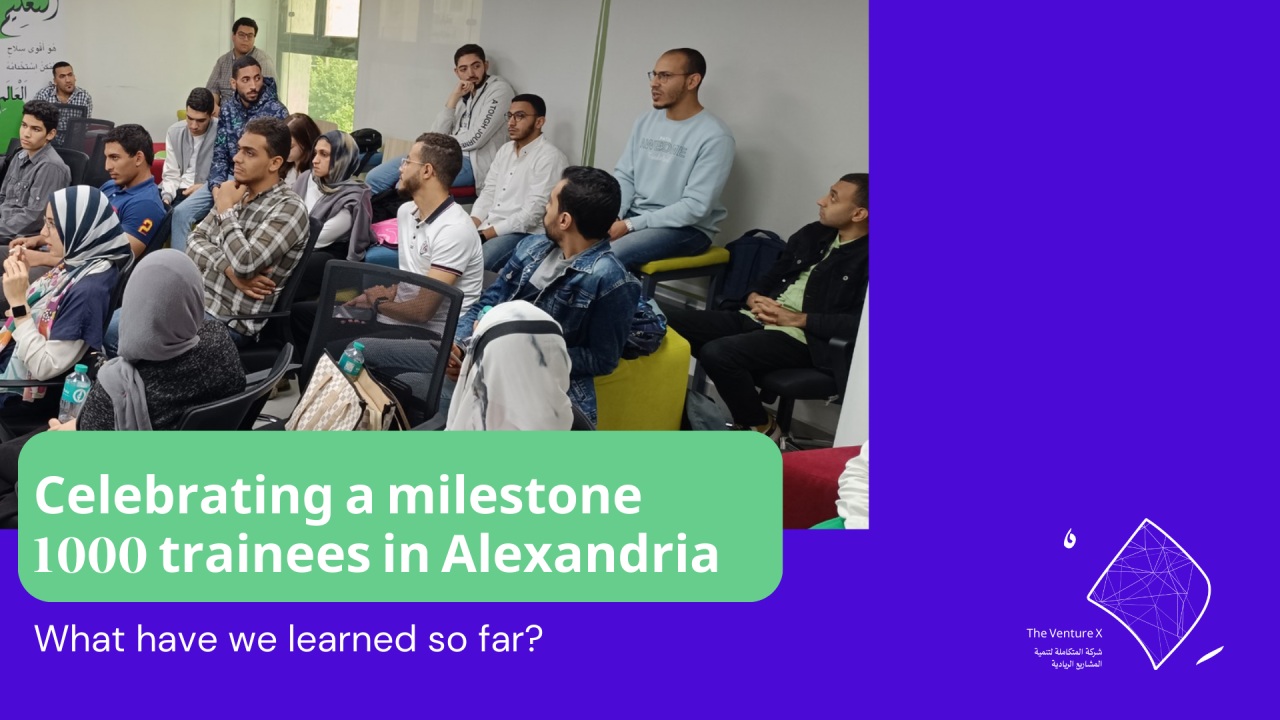
VentureX said practical business assignments were added to technical workshops, and some trainees obtained their first freelance gigs through an ElHarefa collaboration. This is a wider customer base than an investment fund normally serves. The company is also preparing the people who might work for, supply or eventually found a startup.
In December 2025, an investment in Egyptian company Croptimus made the financing side tangible. Croptimus works on regenerative agriculture and biochar, converting agricultural and food waste into biological products. The announcement linked the investment to Hassad and identified Croptimus as an accelerator graduate. Here, the relationship extended beyond training into backing a particular business.
Bring evidence to the clinic
The latest university extension follows the same logic. In September 2026, Al-Hussein Bin Talal University signed an agreement with VentureX covering practical training, hackathons, pitch events and AI workshops. An Entrepreneurship Clinic would offer investment advice and connections to funding networks. Universities become another entry point into the company’s development work.
For a founder ready to raise money, VentureX’s public investor-pitch route is more selective. A functional MVP is required; customer validation is preferred and traction recommended. The VX Clinic reviews the pitch before suitable companies reach the investor network. Participation carries no guarantee of investment. The practical invitation is clear enough: arrive with something that works, and people who have tried it.