A tape dispenser is an unusual object to put in front of shareholders. Larry Culp gave one the opening of his 2025 annual letter. At GE Aerospace’s plant in Terre Haute, Indiana, employees had been cutting tape by hand for a turbine center frame production process. They wanted an electronic dispenser. Their plant leader, Gerald Beuvelet, initially wanted an elaborate justification.
Then he saw the disappointment on their faces, reconsidered, and bought it. The machine acquired a name: “The Gerald.” Other improvements followed. A line that had delivered on time at a rate of 20% in 2023 reached 96% by the account in Culp’s letter. The dispenser was one intervention among many. Its purchase made a small, useful point about whose judgment counted.
There is something revealing about a chief executive choosing this particular opening. Culp had a rather larger story available: the restructuring of General Electric, the reduction of more than $100 billion in debt, the creation of three independent public companies. Yet he began with adhesive tape. Corporate grandeur would have to wait its turn.
The education before the corner office
Culp grew up in the Washington, D.C., area, the son of a small welding-company owner. Manufacturing was part of his early experience of business, before it became a career choice. There is a useful directness to that background: work has to be done, somebody has to do it, and a customer eventually decides whether it was worth paying for.
He graduated from Washington College in 1985 with a degree in economics and earned his Harvard MBA in 1990. The small Maryland college remained a continuing commitment. He joined its governing board in 2003 and served as chair from 2014 to 2018. His career would take him into much larger institutions without ending that relationship.
At Harvard, the attraction of management included its uncertainty. A case could support more than one plausible answer. You still had to choose. Culp later returned as a senior lecturer, teaching leadership, strategy, and general management. The journey from student to executive to teacher gave him several views of the same problem: how people make decisions with incomplete information.
He joined Danaher in 1990 at Veeder-Root, which makes fuel-management equipment, and became its president in 1993. Larger assignments followed, including responsibility for environmental and electronic test-and-measurement businesses and leadership of Fluke and Fluke Networks. By 2001, he was Danaher’s president and CEO. He stayed in that job until 2014.
Danaher was where the operating habits became durable. Its business system drew on the Toyota Production System, with attention to customers, wasted effort, and continuous improvement. Culp’s later vocabulary at GE would sound familiar to anyone who had watched those years. The names on the factory gates changed; the questions he wanted managers to ask traveled with him.
A job that required three invitations
By the time GE came calling, Culp had already stepped away from running Danaher. He was teaching and advising. Joining GE’s board in 2018 offered a different kind of responsibility. Becoming its chief executive was another proposition altogether, and he initially resisted it.
He later told David Rubenstein that the board approached him three times before he accepted. That detail improves the familiar story of executive ambition. Here was a person who had already spent years occupying the seat everyone was supposedly trying to reach. He understood something about its demands. The third invitation brought him back.
In October 2018, he became GE’s first outside CEO. The move from director to chief executive gave him a new appreciation of the company’s difficulties. His comparison was to baseball: a fastball looks considerably quicker from the batter’s box than from the owner’s box. A board seat has an excellent view. It offers limited batting practice.
The task involved both financial repair and operational change. Debt reduction made the company less burdened. A narrower portfolio made its businesses easier to see and manage. Those decisions belong alongside the daily work inside the plants, rather than being treated as a separate, more glamorous species of management.
The restructuring ultimately produced GE HealthCare, GE Vernova, and GE Aerospace. Culp took on the additional Aerospace CEO responsibility in June 2022 and became its chairman and CEO when the aviation-focused company launched independently in April 2024. The result gave his working life a clearer center: engines, their customers, and the people who keep them moving.
The meeting belongs near the work
The everyday method is less photogenic than a stock-exchange bell. A team follows a process, finds a point where work stalls, tries a change, and checks the result. Kaizen, the Japanese term associated with continuous improvement, supplies a name for this discipline. The challenge is getting people to practice it after the visiting executives have gone home.
Culp has a schoolboy explanation for the underlying idea. His junior-high basketball coach warned that players either got better or got worse. Practice was the response. It is easy to imagine why this analogy has survived in his repertoire: a team cannot explain away a missed pass with an improved presentation about passing.
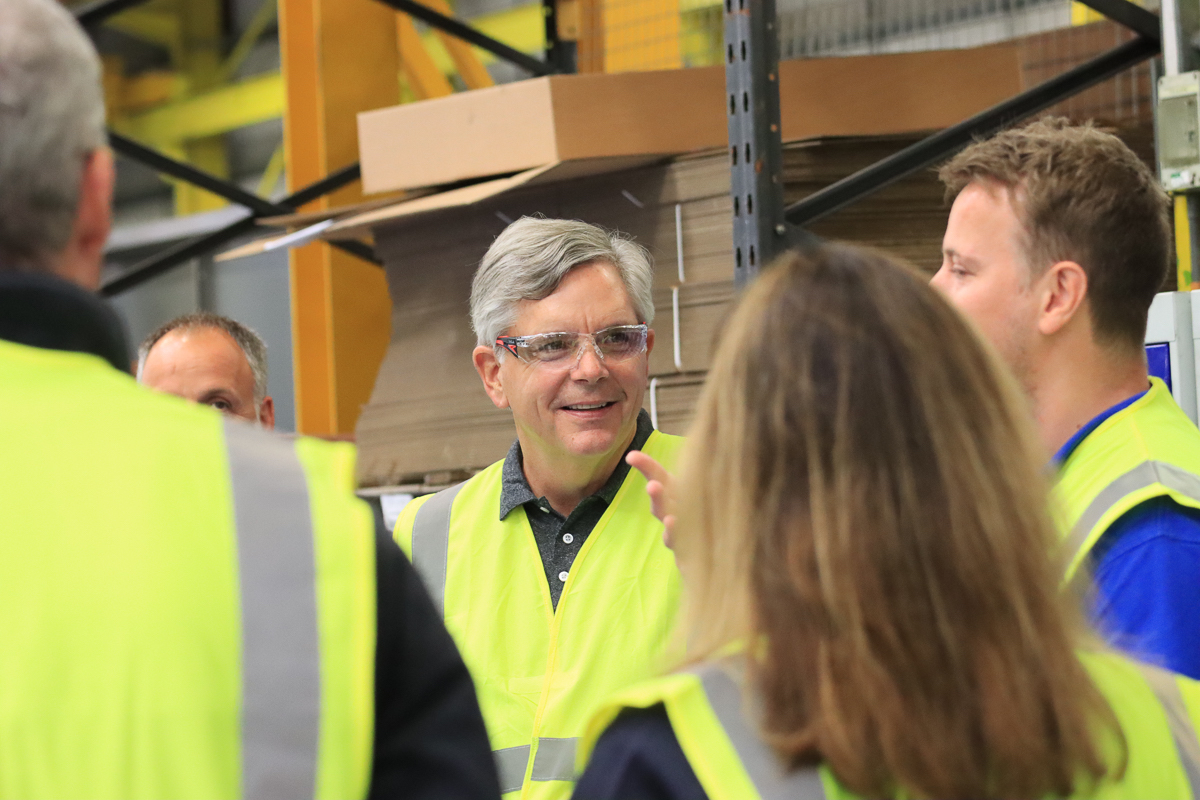
At GE’s Wales operations, his reflections on kaizen emphasized people using the tools to run the business, rather than merely displaying them. There is a distinction any employee will recognize. A visual board can help solve a problem; it can also become another surface that must be tidied before somebody important arrives.
His account of introducing lean is similarly practical. He asks people to experiment. Skeptics can see what changes during a concentrated week of work. The experience matters because instructions from the top can produce obedience without much ownership. People have a better reason to continue when they have helped make a process work.
GE Aerospace gave its operating model the name FLIGHT DECK in 2024. It combines respect for people, continuous improvement, and attention to customers with routines including daily management, problem solving, and standard work. An operating model inevitably comes with terminology. Its usefulness depends on what a team can accomplish with it on an ordinary working day.
“You either get better, or you get worse.”
The basketball coach’s lesson Culp still recalls
That dependence on daily behavior makes the approach demanding in a particular way. Announcing a program is finite. Listening repeatedly, following through, and letting a colleague identify a flaw in a familiar process are recurring obligations. There is no ceremonial occasion at which a manager can declare the listening complete.
A bell in New York, then back to Ohio
On GE Aerospace’s launch day, Culp shared the New York Stock Exchange podium with employees. He then flew to Evendale, Ohio, for celebrations at headquarters, with colleagues joining virtually from other locations. The travel itinerary put the public-market moment and the working company into the same day.
There was a financial expression of that idea, too. In May 2024, Culp discussed a takeoff equity grant intended for all 52,000 employees then at GE Aerospace. Becoming independent offered an occasion to reconsider how the workforce participated in the company. Share ownership gave the launch a meaning beyond a new corporate description.
He also took his interest in improvement outside manufacturing. At GE’s 2023 Lean Mindset event in New York, he talked leadership with basketball player Giannis Antetokounmpo. Executives, entrepreneurs, and athletes shared the program. The connection was intelligible: preparation and repetition remain useful even when the equipment is a basketball rather than a jet engine.
The educational commitments fit this pattern. Alongside Washington College, Culp serves on Wake Forest University’s board of trustees. In October 2025, he announced a foundation workforce-training initiative committing $30 million over five years. A manufacturer’s ambitions eventually become questions about who has the skills to carry them out.
The larger purchase order
The next chapter also involves buying something the production system needs. In September 2026, GE Aerospace announced an agreement to acquire Consolidated Precision Products, a supplier of engineered castings. The relationship already stretched back more than fifteen years. Culp described the proposed combination in terms of capacity, performance, and the introduction of engine technologies.
An acquisition agreement is a promise of future work. Integrating manufacturing capabilities, expanding output, and maintaining quality require execution after the announcement. This is where Culp’s earlier experience at Danaher meets the demands of a focused aerospace company. The business needs both decisions about where to invest and close attention to what happens inside a process.
On October 20, 2026, GE Aerospace reported quarterly orders of $19 billion and GAAP revenue of $14.1 billion, up 49% and 16% respectively from a year earlier. It raised its full-year guidance. Cash from operating activities was $2.2 billion, down 14%. The figures offer evidence of growth while keeping the account more interesting than an uninterrupted victory lap.
Harvard Business School recognized Culp with its Alumni Achievement Award in 2026. His public explanation of leadership still leaves room for uncertainty and inquiry. “Leaders don’t need to have all the answers,” he has said. For someone who once taught management, remaining a student seems a sensible use of the office.
The tape dispenser makes that idea unusually easy to picture. A manager changes his mind. A team gets a tool it has asked for. Work improves through a succession of decisions close enough to examine. Culp’s career has included transactions large enough to redraw a corporate map. He still seems interested in what happens at the table where someone asks permission to buy the tape.