Nine months into her working life, Jennifer Honeycutt had a problem with the laboratory. She had graduated from Grinnell, joined Hach in Colorado and begun developing analytical methods for water. The work suited her chemistry degree. The solitude suited her less. She remembers finding life “pretty lonely amongst the glassware.” So she volunteered to lead projects in research and development. The equipment stayed. Her relationship to the work changed.
It is an unusually useful beginning for a CEO story. There is no childhood prophecy to fulfill, no need to pretend the first plan was the final one. Honeycutt noticed a mismatch and found another job inside the job she already had. More than three decades later, she runs Veralto, a company whose business involves paying close attention to things most people are content to leave in somebody else’s hands.
Two degrees, several ways of seeing
Honeycutt graduated in 1991 with degrees in chemistry and French. The combination resists the tidy sorting that career advice sometimes demands. One subject concerns the behavior of substances; the other asks a person to move between languages and ways of expressing an idea. Neither qualification comes with a public company attached. Together, they suggest a student willing to keep more than one intellectual door open.
She later earned a master’s degree in technology management at the University of Denver. Her working life has crossed the United States and the United Kingdom, and her management responsibilities have extended across water instruments, product identification and scientific businesses. The range matters. A leader moving between those operations has to learn which questions travel well and which answers belong to a particular factory, customer or team.
Grinnell graduate. Hach research chemist. A career begins with water.
The apprenticeship inside the businesses
Hach became part of Danaher, bringing Honeycutt into a corporation that would supply much of her management education. Her assignments included Hach Ultra Analytics, Anderson Instrument Company and Linx Printing Technologies. These were operating jobs inside businesses making and selling specific things. The customer’s problem could not be answered by a handsome statement of corporate intention. An instrument or printer had to perform.
At Linx, based in St Ives, Cambridgeshire, she led a coding and marking business. When the company announced her successor in July 2013, it credited her preceding three years with helping grow the operation internationally. She was moving to become president of Beckman Coulter Life Sciences. The change widened her responsibilities while preserving a familiar requirement: understand the product well enough to organize the people who make it useful.
She became president of Pall in January 2017, later adding group responsibilities within Danaher. In January 2021 she became an executive vice president. The formal progression has the smoothness of a résumé. The underlying assignments were more varied: a succession of businesses, customers and technical settings. Whatever the title, she was accumulating experience in how organizations work when their products have to do something measurable.
- 1991Hach
Research chemist - 2013Linx →
Beckman Coulter - 2017Pall
President - 2021Danaher
Executive VP - 2023Veralto
Independent company
A new name with an old working life
In 2022, Honeycutt took responsibility for Danaher’s Environmental & Applied Solutions segment. She was selected to lead the business that would become Veralto. Here was a different kind of assignment: established operations would have to function as a company with its own identity, financial commitments and public accountability. Familiarity with the businesses was an advantage. Independence still required work of its own.
The separation took effect on September 30, 2023. Regular trading began on October 2 under the symbol VLTO. Veralto started with thirteen operating companies, including Hach, Linx, Videojet, Esko, Pantone and Trojan Technologies. Calling it new could therefore be slightly misleading. The stock-market identity was new; much of the customer knowledge, engineering and accumulated trust had been around considerably longer.
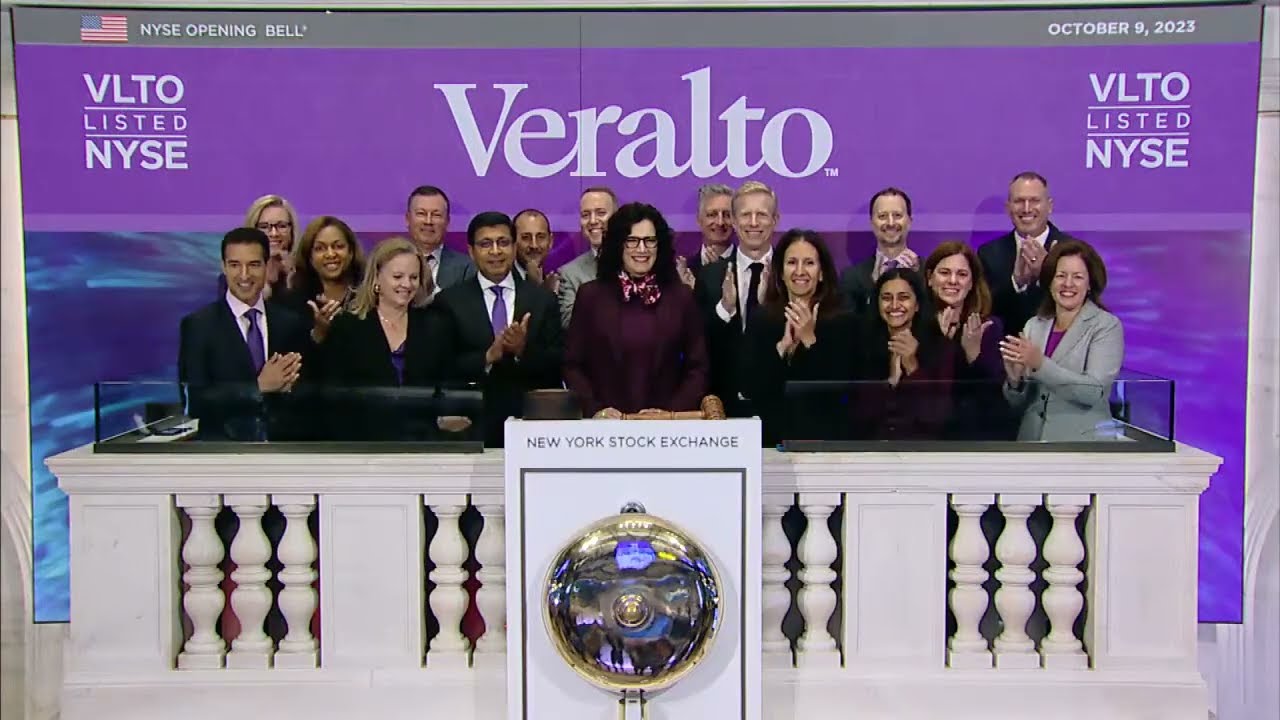
The bell ceremony arrived a week after trading began. Honeycutt stood with colleagues beneath a purple Veralto backdrop. It was the sort of public moment that gives a complicated separation an easily understood image. A bell is excellent at announcing that something has started. It offers very little assistance with the next quarterly report.
The business of being believed
A year later, speaking with the NYSE’s Judy Shaw, Honeycutt described the first year as “building trust and a track record.” She applied that idea to investors, employees and customers. Each group had a different reason to care. Investors wanted delivery against commitments. Employees needed a company in which they could do their work. Customers needed the goods and services they depended on to keep arriving.
“building trust and a track record”
Jennifer Honeycutt, on Veralto’s first year
The phrase is modest enough to be demanding. Trust requires somebody else’s judgment. A track record requires time. Neither can be installed along with a new corporate sign. For Honeycutt, the task was to give people evidence through repeated performance. It is a useful description of the distance between inheriting responsibility and persuading others that the responsibility is in good hands.
The business itself has two main parts: Water Quality and Product Quality & Innovation. One deals with water analysis and treatment. The other includes coding, marking, packaging workflows and color. A water measurement and a packaging file may appear to have little in common. Both become important when somebody must make a decision and needs the information to be dependable.
What happens after improvement week?
The organizing machinery is the Veralto Enterprise System, developed from the Danaher Business System. It connects fundamentals, operational excellence, growth and leadership through continuous improvement. Those words can sound comfortably abstract. Their usefulness depends on whether people can apply them to something sufficiently specific to change: a process, a handoff, a customer problem or a recurring source of wasted effort.
In March 2024, Veralto held its first CEO Kaizen Week. Executive team members joined more than 150 associates across twelve improvement events around the world. Participating businesses included Esko, Hach, OTT HydroMet, Pantone, Videojet and X-Rite. The format brought senior leaders into the work of addressing particular operating opportunities. For a company assembled from different businesses, it also provided a shared way to work on problems.
Honeycutt’s explanation was that “kaizen isn’t just an event.” The distinction puts an obligation on the ordinary weeks that follow. An improvement exercise can produce enthusiasm, photographs and a set of agreed actions. The harder test comes when the calendar moves on. Does the process work better? Can the next team repeat the result? Has the learning survived the meeting?
Her approach to people has similarly concrete expressions. She participates in every Veralto associate resource group and mentors colleagues from different backgrounds. She connects inclusion with creativity, collaboration and value creation. It is a business argument about whose experience reaches the discussion, as well as a statement about what working at the company should feel like.
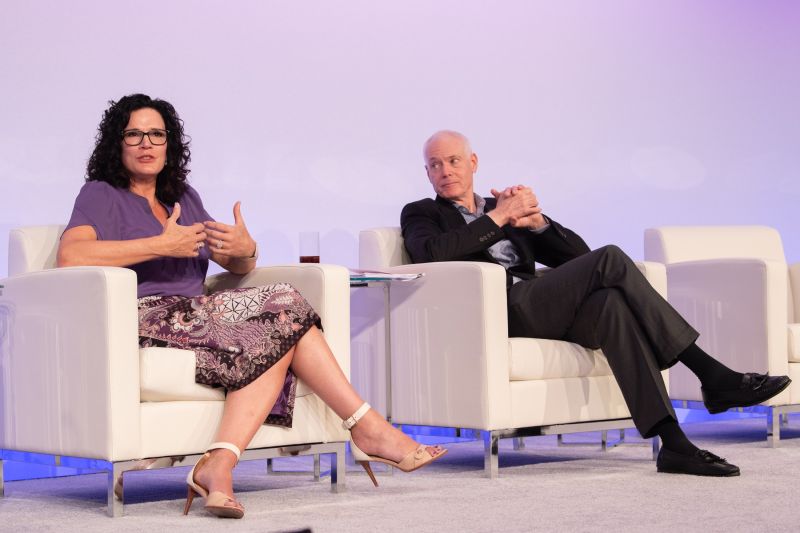
At the 2025 Veralto Leadership Conference, she shared the stage with management author Jim Collins. About 150 senior leaders attended. Honeycutt said she had read nearly all his books and followed his research for years. Her account of the meeting offers a glimpse of a CEO who remains interested in how other people explain the workings of companies. Running an organization evidently leaves room for doing the reading.
Follow the product, then follow its information
Veralto’s October 2024 acquisition of TraceGains showed where Honeycutt wanted to extend the business. The announced purchase price was $350 million, subject to adjustments. TraceGains supplied cloud software for ingredient information, supplier quality and related workflows. It complemented Esko’s packaging and label design tools. A product’s path to a customer involves documents and data as well as the physical object.
The attraction was the connection between those tasks. Ingredient inputs influence what a brand makes; packaging workflows determine how information reaches the product’s exterior. Honeycutt described the acquisition as an expansion of Veralto’s digital offering. The strategic idea was specific enough to examine: could related tools help customers handle more of the work that surrounds a product, from development through compliance and packaging?
$5.5BAnnual sales
~17,000Associates worldwide
~60%Recurring sales
The next set of decisions
The 2026 announcements put more detail around that direction. In July, Veralto acquired Mumbai-based Alfaa UV for integration into Trojan Technologies. The business added ultraviolet water treatment products and a commercial presence in India. In August, Veralto announced an agreement to buy Cleanwater1 for $465 million, with completion expected in the fourth quarter, subject to closing conditions. The agreement extended its intended reach into additional water treatment applications.
The operating figures provided another measure. For the second quarter of 2026, Veralto reported sales of $1.474 billion, up 7.6% year over year; its non-GAAP core sales growth was 4.2%. Honeycutt pointed to demand in industrial water treatment, reuse and environmental monitoring. Those are dated results and explanations, with the ordinary obligation to deliver again in the next period.
There is also a longer horizon outside the company. In 2026, Grinnell reported Honeycutt’s $750,000 gift toward a new endowed chair in environmental studies. Her first-year college tutorial had been called Wherever There’s Water. The connection has a pleasing economy: a subject encountered as a student, a career begun in water analysis, and support for the people who will study the questions next.
Her early change of mind now looks less like a departure than an adjustment in scale. She moved from doing analytical work to helping people organize it, then to leading businesses built around technical knowledge. The glassware was never the whole story. The interesting part was recognizing where she could contribute, and being willing to put her hand up before the next title existed.
Keep reading & watching
- Jennifer Honeycutt at Veralto ↗
- Her LinkedIn profile ↗
- Watch: the NYSE conversation with Judy Shaw · 5 minutes ↗
- Veralto’s YouTube channel ↗
- Grinnell: the environmental studies gift ↗
- Her 2021 executive appointment ↗
- The move from Linx in 2013 ↗
- Veralto’s 2024 sustainability report ↗
- Inside the Veralto Enterprise System ↗
- Honeycutt on the 2025 leadership conference ↗
- The TraceGains announcement ↗
- July 2026 operating results ↗
- The Alfaa UV acquisition ↗
- The Cleanwater1 agreement ↗