When APY Ventures decided to invest in Circle Games, the studio’s game had not been published. There was no finished hit to admire. What the investor had seen was a team that knew one another, understood its genre and could explain what came next. According to APY’s account, the game reached soft launch within weeks. In venture capital, a promise can be beautifully upholstered. Delivery is harder to decorate.
- The structure: an umbrella for Albaraka Portfolio Management’s technology venture funds.
- The audience: founders seeking investment and qualified investors seeking startup exposure.
- The habit to borrow: look for evidence of execution before falling for the presentation.
That small episode is a useful entrance to APY Ventures. Its portfolio stretches from financial software to manufacturing equipment, with games, AI and energy technology in between. The common question is practical: what has the team learned to do, and what will the next injection of capital let it prove?
One umbrella, several doors
APY is the public-facing brand for venture capital investment funds established by Albaraka Portfolio Management. It is a meeting point between two groups whose needs are quite different. Founders want money, introductions and help making difficult decisions. Investors want a way to participate in young technology businesses through a managed structure.
The current site names eight funds: Fintech, Start-up, Bilişim Vadisi, OSTİM, T3, Yeni Nesil Teknoloji, İvedik and THY. Each has its own strategy. That matters more than the number. A treasury-software company and a manufacturing startup may both need capital, but the people who can evaluate them, introduce customers and understand their sales cycles need not be the same.
In January 2026, fund manager Mustafa Keçeli reported approximately $80 million in combined fund size and around 1,600 qualified investors. For 2025, he described 24 investments: 12 new investments and 12 follow-ons. Those are dated measures of the operation’s scale, rather than a valuation of APY itself.
Equal counts. Investment amounts may differ.
The fund wrapper changes the invitation
The Start-up fund is sector-agnostic, backs technology companies from early stages and is listed on the exchange. APY describes it as Turkey’s first exchange-listed venture capital investment fund. Its published design includes a nine-year term and access for qualified investors.
Meanwhile, the Bilişim Vadisi and OSTİM fund pages identify those funds as unlisted and closed to new investors. The distinction makes the brand’s architecture tangible. Seeing “APY Ventures” on a website does not mean every fund offers the same entry point, timetable or terms. The vehicle is part of the proposition.
The Bilişim Vadisi fund began with 100 million Turkish lira in initial capital, according to its partners’ account. That figure describes the pool assembled for investing, rather than what it cost to launch the APY brand.
The business model sits in that arrangement: investor capital is pooled into managed funds, which invest in startups. Founders receive backing and portfolio support; investors receive exposure through the fund. Anyone approaching APY should begin with the relevant mandate. A good company and a suitable investment are related questions, but they require separate answers.
A customer conversation beats a decorative slide
Consider Flowla. In its February 2026 investment account, APY describes trying the product and speaking directly with customers. Flowla tackles the loose ends between sales and customer success: emails, spreadsheets, documents and handoffs that turn an ostensibly organized process into a scavenger hunt.
Its digital sales rooms become an automation layer for those workflows. APY’s reasoning emphasizes the founders’ grasp of the problem and the product’s approach. The useful lesson for another founder is specific: make the problem visible, let an investor experience the remedy and bring customers into the conversation. A working demonstration gives an abstract claim something to stand on.
Cendra offers a neighboring example in hospitality. Its tools address guest inquiries, maintenance tasks and revenue opportunities for accommodation operators. APY’s account connects the team’s operational experience to the product. Across these examples, domain knowledge earns its place when it appears in the work itself.
“Founders with Vision. Capital with Ambition.”
APY Ventures’ stated proposition
The factory is part of the pitch
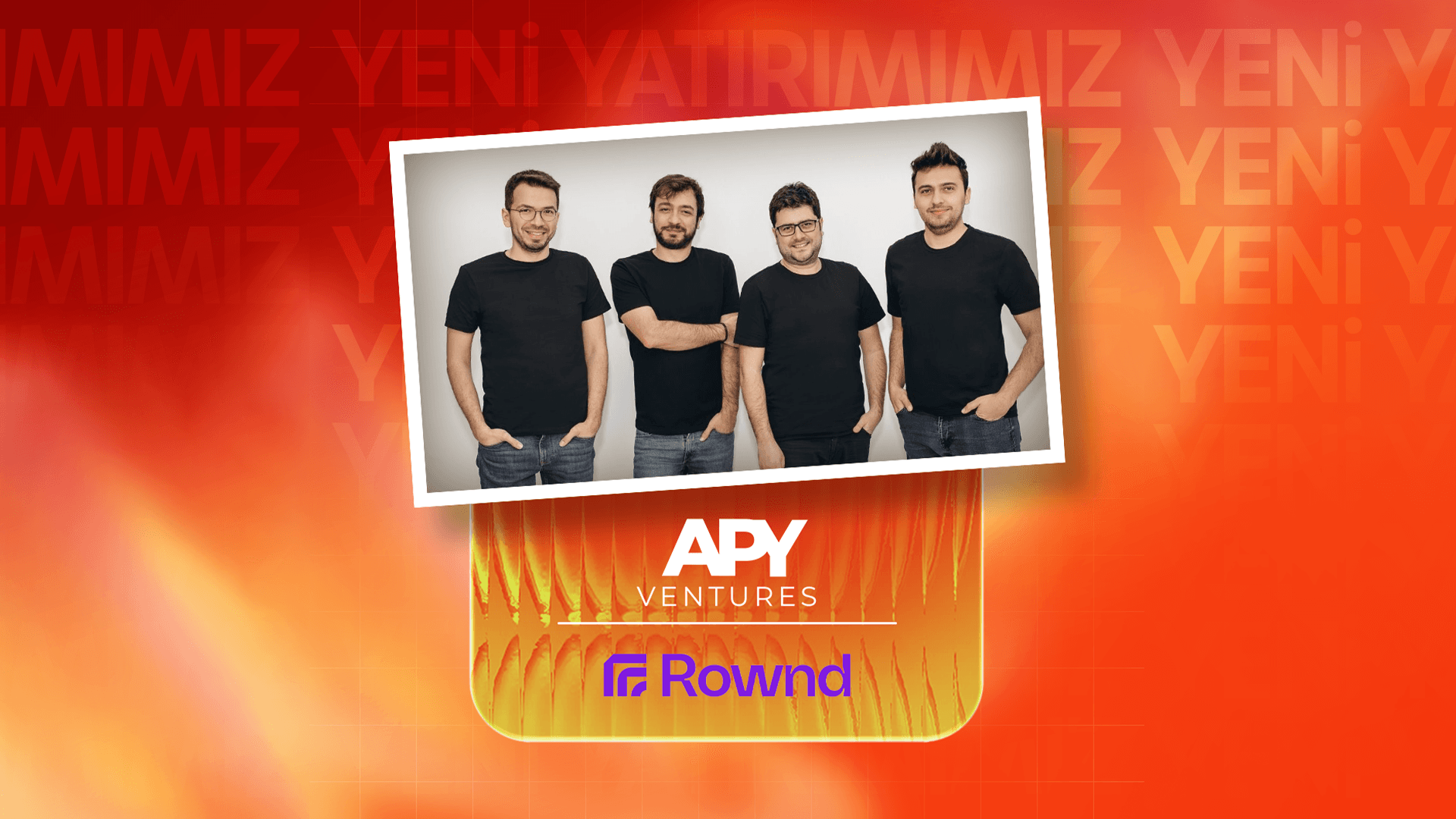
Rownd Precision makes desktop CNC machines. Conventional industrial equipment can demand space, money and expertise that smaller users struggle to supply. Rownd’s proposition is to bring precision manufacturing into a smaller footprint, combining its own electronics and software.
APY’s December 2025 investment account mentions visits to the production facilities. It also reports shipments to more than 40 countries across six continents. Here, the evidence lives partly outside the laptop: engineering, production and a product that travels. Hardware asks an investor to inspect a different kind of execution.
The OSTİM fund supplies a fitting institutional backdrop. Its strategy centers on Ankara’s industrial ecosystem and technology that can help smaller industrial businesses digitize. The potential advantage is proximity to users. A factory owner who understands an operational headache may be a more useful introduction than another roomful of people discussing innovation.
Money buys the next experiment
The July 2026 EELI Technology announcement makes the next milestone unusually concrete. APY says it led a round supporting a lithium-recovery company whose process uses electrical current and specialized electrodes. The financing is intended for commercial pilot systems, customer-site deployment and further scaling.
That is an intelligible use of capital. A laboratory process has to survive contact with an industrial site. The investment buys an opportunity to test that transition; successful deployment remains work to be done. For another entrepreneur, the copyable move is to describe the next experiment precisely enough that an outsider can recognize success.
Treasy’s path supplies another version of the same discipline. Its founders brought banking-technology experience to a treasury platform, then modernized it with microservices and cloud architecture under an independent company. The APY account describes expertise being reorganized into a new business. Experience becomes interesting when it produces a new capability.
Bring something the room can examine
APY’s place in the market is as a technology investor with several fund mandates and an institutional network behind it. The support it describes includes strategy, business-model development and corporate partnerships. Those services are most useful when a founder has a specific obstacle that an investor can help remove.
The practical approach is to identify the appropriate fund, show what customers or users do and explain the milestone funding will purchase. A business outside the mandate, or an investor outside the eligibility rules, may find another route more suitable. The Circle Games anecdote leaves a modest standard to copy: give the room something it can examine, then make the next promised thing happen.