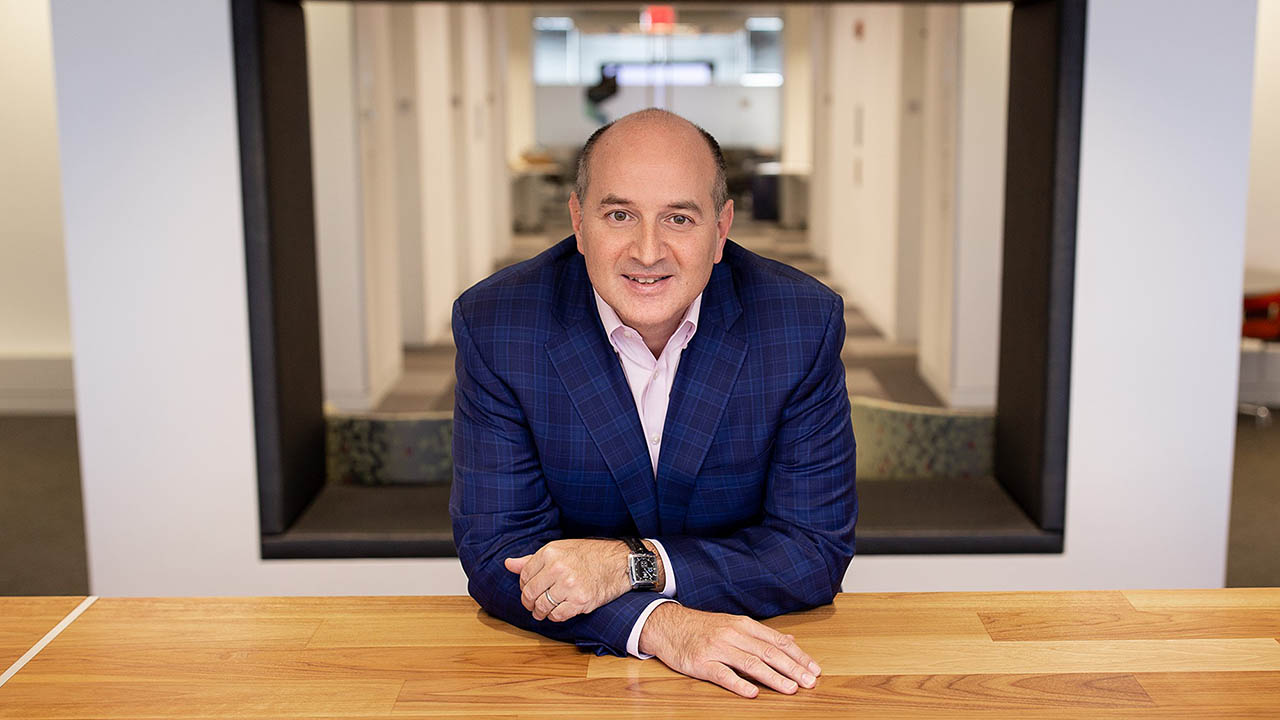
Bill Burns has a question for the age of artificial intelligence: “How do I make the newest employee as good as my best employee?” It is a useful place to begin with the chief executive of Zebra Technologies. He is thinking about the person holding the device, the decision waiting to be made and the experience that person has yet to acquire. The technology has to earn its place in that small, practical interval.
Burns became Zebra’s CEO on March 1, 2023, after joining the company in 2015. He had already run two technology businesses. Yet his explanation of the job often returns to the fundamentals of selling: understand the customer, understand the work and establish whether something you can provide will help. There is a refreshing lack of theatre in that sequence. Even a computer with considerable ambitions must eventually be useful to somebody.
Zebra gives him plenty of occasions to test the proposition. Its devices turn up at supermarket checkouts, in warehouses and with delivery workers. These are places where an elegant presentation has limited influence over a missing parcel. The daily work involves finding things, identifying them and getting them to the right place. Burns’s career has brought him closer to those apparently ordinary moments, where the digital economy has to put its shoes on.
A sales education, with engineering in the background
His academic record crosses the technical and commercial sides of business: an associate degree in engineering from Pennsylvania State University, a bachelor’s degree in business administration from Misericordia University and an MBA from Temple University. The combination fits a career spent moving between products and the people who buy them. It also complicates the easy picture of the technology chief who travels along a single professional track.
Burns’s early career was in sales and sales leadership at Tellabs. His responsibilities there grew to include Europe, the Middle East and Africa, as well as global marketing. Regional responsibility adds another dimension to a sales job: customers operate in different markets, teams work across borders and a promising product still needs service and support. Those roles gave his later executive career a commercial starting point with an international reach.
He joined Spirent in November 2004. The company’s announcement of his promotion to group CEO on November 6, 2008 described a series of earlier responsibilities: global sales, corporate marketing, service assurance and leadership of the communications group. It was a progression through operating jobs before responsibility for the whole company. At Spirent, the subject was communications testing, a business in which other people’s confidence in a network depends on what the equipment can demonstrate.
Embrane came next, a venture-backed Silicon Valley startup where Burns served as CEO before Cisco acquired it in April 2015. A listed testing company and a privately backed startup offer different conditions for the same managerial questions: where to invest, how to win customers and how to turn a technical proposition into a business. By the time Zebra hired him that year, he had worked in both settings.
- TellabsSales, regional leadership
and global marketing - 2004 / SpirentJoined in November;
group CEO from 2008 - EmbraneCEO before the
April 2015 Cisco acquisition - 2015 / ZebraBusiness-unit leadership,
product strategy, then CEO
The company that had just changed size
Burns arrived after Zebra’s acquisition of Motorola Solutions’ enterprise business. The deal had expanded a specialty-printing company into mobile computing and data capture on a much larger scale. His initial Zebra role was senior vice president of Enterprise Visibility and Mobility. That placed him inside the acquired operations, with responsibility for businesses that helped change what the Zebra name meant to customers.
He subsequently became chief product and solutions officer, overseeing portfolio strategy, investment and development. The job connected engineering decisions to commercial ones: which products to build, where they should fit and what customers would pay for them. Someone had to make a coherent offering out of multiple specialist businesses. A scanner, a printer and a mobile computer can each be sold separately; a customer’s work may require them to function together.
His promotion to CEO came with an unusual degree of familiarity. Anders Gustafsson, his predecessor, became executive chairman. Burns described a working relationship extending across two earlier companies and roughly two decades. In his first-day message, he set himself the paired task of “maintain continuity and drive change.” That is an exacting brief. It asks a successor to preserve the relationships that made the business work while deciding which inherited assumptions deserve another look.
“maintain continuity and drive change”
Bill Burns · His first-day CEO message, March 2023
Three legs, and a difficult first year
In Burns’s account of leadership, the business rests on three constituencies: employees, customers and investors. The order of events matters to him. Attract and retain capable people, enable them to serve customers and build financial performance from that work. It is a straightforward explanation of responsibility, and one that becomes more demanding when the numbers stop cooperating.
The first year of his tenure included a sharp demand reset. In an April 2024 interview, Burns described examining property and travel costs, offering voluntary retirement programs and looking for internal opportunities for employees. He put the difficulty plainly: “it’s always hard to get smaller.” That sentence supplies a useful counterweight to the tidy career chronology. Taking over a business also means becoming responsible for decisions that nobody would choose as the subject of a celebratory speech.
Continuity, under those conditions, requires more than repeating the strategy. Employees experience a company through the choices it makes when work becomes harder. Customers still expect deliveries and support. Investors expect discipline. Burns’s three-part account offers a way to judge his leadership against competing obligations, rather than against a collection of agreeable statements about culture. The uncomfortable periods are where those obligations acquire a price.
An aisle is a long way away
Burns talks about technology through the coordination problems it should solve. A retail worker needs to reach a colleague. A manager needs to assign a task. A store needs to know whether the item a customer wants is actually there. In his 2023 description of Zebra’s strategy, mobile devices provide a base for software that supports scheduling, communication and work on the shop floor.
The breadth of the portfolio makes more sense viewed from that position. A product catalogue has categories; a store has a shift to get through. Burns’s emphasis on customer feedback follows from the difference. Knowing that a device works is only part of the sale. Knowing where it fits in a working day helps determine whether it will be used, whether the customer will buy more and whether another piece of software belongs beside it.
Partners are part of that practical machinery. In a public post marking PartnerConnect’s tenth anniversary in 2026, Burns described an ecosystem of more than 10,000 partners. Zebra supplies technology; partners contribute specialist knowledge and implementation. For someone whose career began in sales, that is a consequential choice of operating model. Success depends on people outside his organization understanding the products well enough to make them useful inside somebody else’s.
Knowing which businesses to keep
The decisions grew larger. Zebra completed its approximately $1.3 billion purchase of Elo on September 30, 2025. Elo’s touchscreens, self-service products and customer-facing technology widened the company’s reach across frontline operations. The strategic connection is tangible: the customer using a screen and the employee using a handheld device occupy different points in the same transaction. Bringing those products into one portfolio creates opportunities, along with the work of making the combination deliver.
In April 2026, the portfolio moved in the other direction. Skild AI acquired Zebra’s Robotics Automation business, with Zebra receiving cash and an equity stake. The announced focus shifted investment toward RFID, machine vision and frontline AI. Acquisition and disposal belong in the same account of Burns’s tenure. A strategy must specify where ownership helps, where another company can take a business forward and where management wants to concentrate its attention.
The second quarter of 2026 provided a financial marker: Zebra reported $1.557 billion in net sales, compared with $1.293 billion a year earlier. Reported growth was 20.4%; organic net sales growth was 9.2%. The distinction matters after an acquisition. The larger percentage describes the reported business, while the organic measure gives another view of underlying growth. Neither number alone tells the whole story, and neither makes the integration work disappear.
Burns also joined the board of Oshkosh Corporation in July 2024. The vehicle and equipment maker cited his experience in technology, innovation, sales and global operations. The appointment extends his work into another industrial setting where software and physical equipment meet. It is a connection consistent with the career: the commercial value of technology has to survive contact with an actual operation.
Useful by the next shift
His comments about AI retain that practical test. In discussing its internal use, Burns offered a brief qualification: “The coder still needs to check the code.” The appeal of faster work comes with responsibility for the result. It is an appropriately workmanlike sentence from the head of a company whose products are expected to behave reliably while other people are busy.
In a 2026 conversation shared on LinkedIn, Burns described customers improving operations through continuing changes as well as larger transformation projects. That leaves him managing two clocks. Customers have things to accomplish today. Technology investment has to prepare for demands that are still emerging. The art lies in making those schedules meet without asking the customer to suspend the working day.
For Burns, the next stage of the business returns to the worker holding the device. Can that person find the item, reach a colleague or make a better decision? His route from sales to product leadership to the chief executive’s office gives the question its consistency. The presentation can wait. Somewhere, a shift is already under way.