A boat is an excellent place to discover whether an engineer has made your life easier. Wind, current and a crowded stretch of water have little patience for a complicated control panel. In 2017, while leading Mercury Marine, John Pfeifer described his ambition for the company's products in unusually domestic terms: “Our intent is that you don’t have to use an owner’s manual to use our product.”
The remark accompanied a New York demonstration of marine engines and controls. The equipment included joystick piloting and a virtual anchor that could hold a boat in position. There was horsepower to admire, certainly. But the more interesting achievement was taking an awkward task and making it manageable. Anyone who has attempted to park something expensive while an audience watches can appreciate the distinction.
Pfeifer now runs Oshkosh Corporation, whose machines go to building sites, fire stations, military operations and airports. The surroundings have changed considerably. The question running through his career has stayed remarkably consistent: what should sophisticated machinery ask of the person using it? His answer keeps pointing toward fewer complications at the controls, backed by a great deal of work elsewhere.
The language before the machines
His preparation included an academic combination that looks rather different from the standard industrial executive biography. At the University of Michigan in Ann Arbor, Pfeifer studied economics and Japanese language. One subject offered a way to understand markets; the other offered a way to enter a manufacturing culture that had caught his attention.
Growing up around Detroit, he wondered how Japanese manufacturers could deliver quality at lower cost. He studied in Japan, then took a job with a Japanese automaker and spent four years there. A sourcing role put him frequently on the plant floor, learning about workforce participation, quality circles and just-in-time inventory before he had fully attached the vocabulary of lean manufacturing to what he was seeing.
It is an origin story with very little theatrical machinery of its own. There is a question, a language requirement and a willingness to go somewhere unfamiliar to investigate. The eventual chief executive began by putting himself in a position to learn. Factories, in this account, were places where knowledge lived among the people doing the work.
His subsequent career included executive and general management positions at Milacron and ITT. Long before he became associated with fire trucks, he was accumulating experience across manufacturing businesses. Economics and language had proved a useful starting pair: the cost of making something matters, and so does understanding the people who make it.
Hong Kong, Belgium, Wisconsin
In 2006, Pfeifer was living and working in Hong Kong when he joined Brunswick to lead its Asia Pacific businesses. Two years later, he moved to Belgium, taking responsibility for Europe, the Middle East and Africa while continuing to oversee Asia Pacific. International management sounds agreeably cosmopolitan until the markets start falling together.
The financial crisis supplied that less agreeable education. He later described the European downturn as comparable in severity to the American one. Australia and New Zealand also suffered. The task became restructuring how the business served its markets while preserving what made it useful to customers. Geography offered variety, but no immunity from the cycle.
He returned to the United States in 2012 to run Mercury Marine's global operations. In 2014, he became its president, succeeding Mark Schwabero. His route to the job had passed through regional businesses and factory operations. That matters because the same product looks different from a dealer's desk, a production line and a customer's boat. He had held responsibilities that put all three into view.
At Mercury, the product questions were wonderfully specific. In early 2015, Pfeifer explained why a marine engine deserved its own design rather than continued dependence on automotive derivatives. Road engines were evolving around road requirements. A boat engine faced prolonged demands for torque and power, along with its own durability requirements. Borrowing increasingly elaborate automotive technology could bring cost without a corresponding benefit on the water.
Mercury's new 4.5-liter purpose-built sterndrive arrived in 2014 alongside investments in casting, machining, assembly and research capacity. This was a useful expression of Pfeifer's outlook: better equipment required both a convincing design and the means to manufacture it. A launch announcement could celebrate the engine. Behind it sat a less photogenic collection of production decisions.
An instruction manual is a design problem
By the 2017 New York demonstration, the conversation had expanded from engines to the experience surrounding them. The virtual anchor and joystick controls addressed an old boating problem with new combinations of propulsion and control. Power was only part of the sale. Confidence and ease mattered too.
There is a pleasing severity to the owner's-manual test. It gives the customer permission to judge a machine by how naturally it works. The manufacturer cannot simply point to the sophistication inside the housing and expect applause. If the controls require an apprenticeship, some of that sophistication has failed to travel the final few inches to the user's hands.
That is an interpretation of a recurring theme in Pfeifer's public remarks, rather than a claim that every product achieves it. It also explains why an executive who once discussed outboard engines can talk coherently about airport equipment. The industries differ. The operator still has a task to finish, limited attention and very little interest in admiring complexity for its own sake.
“Our intent is that you don’t have to use an owner’s manual to use our product.”
John Pfeifer · 2017
A different job at the top
Pfeifer joined Oshkosh in May 2019 as executive vice president and chief operating officer. Initially, his remit included Access Equipment, Fire & Emergency and Commercial. When he became president in May 2020, it expanded to include Defense along with global supply chain, digital technology and marketing. The chief executive appointment followed in April 2021, succeeding Wilson Jones.
Jones had established the company's People First initiative. When the succession was announced, he pointed to Pfeifer's commitment to that culture. The handover was a continuation with a new leader, rather than a freshly invented origin for everything the company did. In a business with established brands and long engineering histories, that distinction is worth keeping.
Pfeifer has described having to resist the gravitational pull of operating details after becoming CEO. He estimated that people occupied about 40 percent of his time; capital allocation was another central responsibility. His explanation was straightforward: business presidents already had jobs to do. A chief executive who duplicates them can become an expensive obstruction.
The administrative work is part of the product story. Someone must decide which capabilities to develop, which factories to expand and which leaders to trust with the next difficult assignment. The machine at the end of the line reflects those choices. Delegation may sound less thrilling than a new propulsion system, but it also needs sound engineering.
- 2006Brunswick Asia Pacific
- 2014Mercury Marine president
- 2019Oshkosh COO
- 2021Oshkosh president & CEO
Three hundred shades of practical
Oshkosh gives Pfeifer plenty of opportunity to discuss engineering without discussing passenger cars. In March 2024, he described a company with roughly 1,600 to 1,700 engineers devoted to design. Its fire trucks came in more than 300 shades of red. Municipal individuality, apparently, survives even where everyone agrees on the basic color.
The range ran beyond the paint chart. There were electric fire trucks, refuse vehicles, construction equipment and the Postal Service's Next Generation Delivery Vehicle. Oshkosh had also acquired AeroTech in 2023, adding airport ground support equipment. These are markets where understanding a particular working day can matter more than winning the attention of a general consumer.
The move into airport equipment also puts another kind of connection in view. Acquisitions can widen the set of customers a company serves and the problems its engineers encounter. A portfolio becomes useful when knowledge can travel across it. Otherwise, it is merely a collection of businesses sharing the stationery.
The bell, the robot and the factory floor
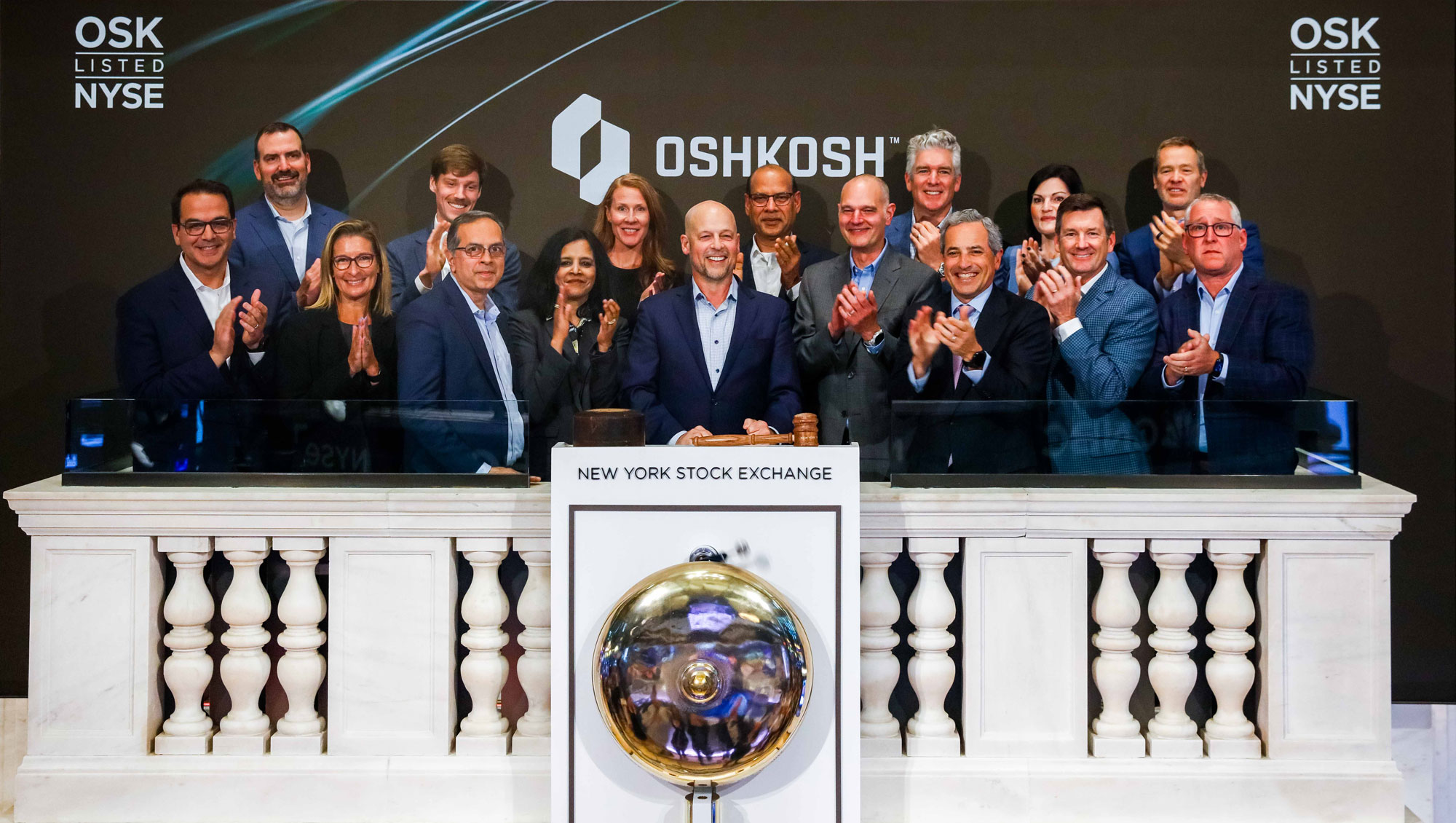
In June 2025, Pfeifer and fellow Oshkosh leaders took their plans to New York for Investor Day and the stock exchange's closing bell. They presented 2028 targets including revenue of $13 billion to $14 billion and adjusted earnings per share of $18 to $22. Those were ambitions with a date attached, rather than accomplishments already in the bank.
The presentation made his external task clear. Investors needed to understand how a manufacturer of specialized equipment intended to grow through technology, production capacity and its order backlog. The photograph at the bell captures the ceremonial version of that explanation. The more consequential version would be delivered in factories and customer operations over the following years.
At CES in January 2026, Oshkosh showed the other end of the argument. Its HARR-E electric refuse robot had evolved to a two-piece design, with waste measurements and route optimization. Airport robots were being developed around configurable tasks. Roadside collision-warning technology had been field-tested with fire departments. These were applications tied to particular jobs and environments, rather than a single promise that autonomy would do everything.
A refuse robot also provides a useful antidote to the usual romance of technological progress. The future still has to take out the rubbish. Pfeifer's industrial setting makes that literal: a successful invention must meet an ordinary obligation repeatedly, under conditions that a demonstration can only begin to represent.
By July 2026, that obligation was visible in the numbers. Second-quarter sales rose 6.7 percent to $2.92 billion, while operating income fell 16.6 percent to $243.2 million. Pfeifer described slower-than-expected improvements in fire truck throughput as new material-flow processes were introduced. Oshkosh lowered its full-year adjusted earnings-per-share outlook to about $11.
The result places a necessary limit on the smoothness of the story. Demand, technology and a convincing strategy do not automatically produce a faster factory. Pfeifer's early interest in how manufacturing actually works remains relevant at the top of the organization. The question comes back with larger numbers attached and less room for a merely elegant answer.
His ambitions now have several audiences: the employee building the equipment, the customer buying it, the operator using it and the investor financing its future. They will not all judge success in the same way. But each can recognize a machine that reliably does its job. The owner's manual remains a useful place to start. So does the factory floor.