Consider the small absurdity of tuition reimbursement. An employer offers to pay for college. The employee must first find the money for college. For someone whose paycheck already has several destinations, the benefit can stop working before the first class begins. The barrier appears in the payment schedule, long before it appears in an admissions decision.
- Employers fund learning. Guild handles the connections, payments, and support.
- Workers get pathways ranging from education benefits to training for specific roles.
- The test is whether learning leads to useful skills and career movement.
Guild built its business around making that arrangement usable. Founded in 2015 by Rachel Romer and Brittany Stich, it connects employers, education providers, and working adults. Its ambition is practical: help a company develop the people it needs from the people it already employs. That makes a benefits policy part of a hiring strategy.
01 / THE FRICTIONThe money has to move first
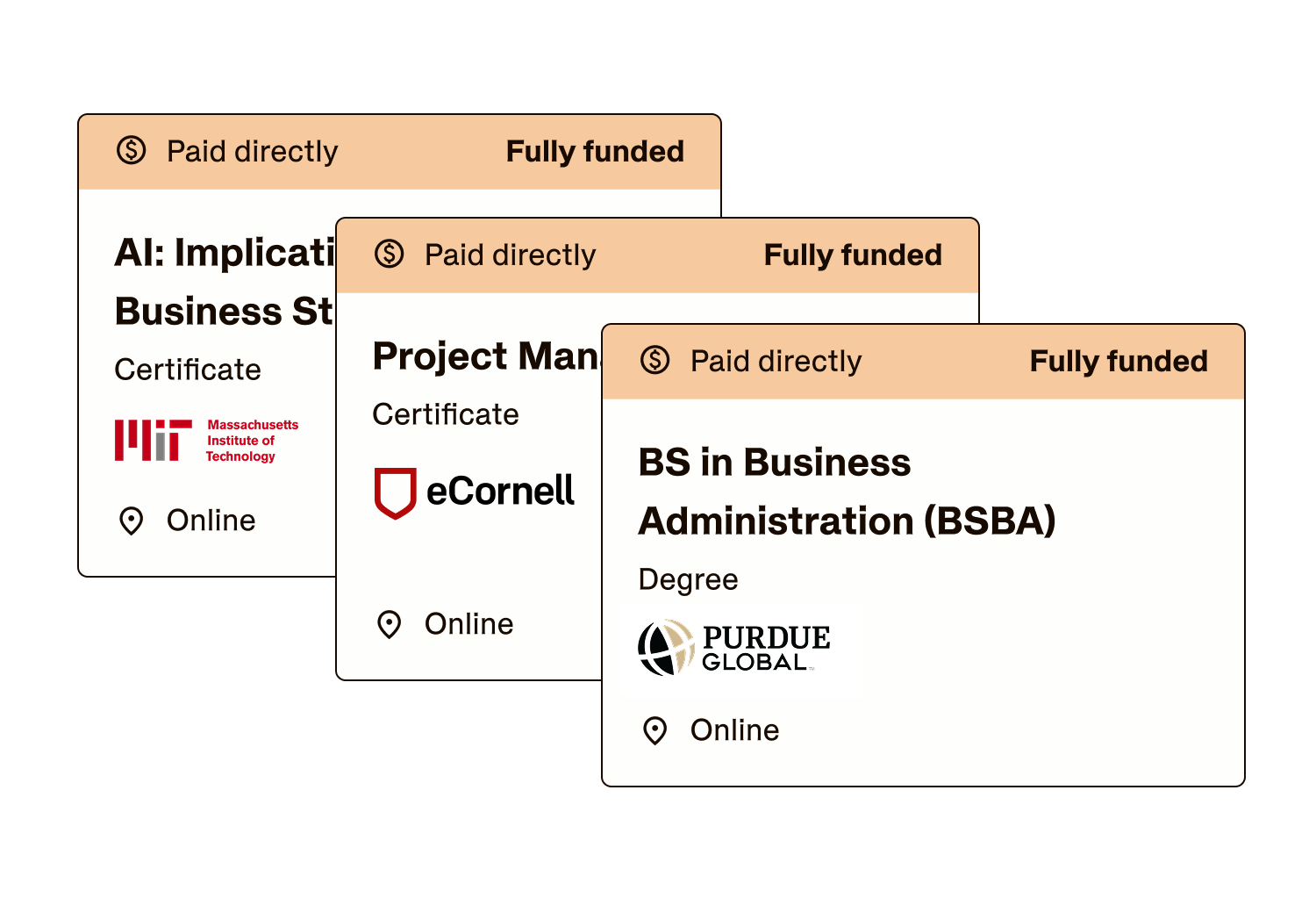
Under Guild’s tuition-assistance model, the employer pays the learning provider directly. Employees browse the programs their employer covers, see funding information, and get help choosing and completing a course. Coaches and specialists address the less glamorous questions: Am I eligible? Which qualification fits? How do I keep going?
Target made the scale of the proposition visible in 2021. It announced a $200 million investment over four years, working with Guild to offer select debt-free undergraduate programs, certificates, and other learning. U.S. part-time and full-time employees could qualify from their first day. Books and course fees were included in the covered offering.
That $200 million was Target’s announced program investment, not Guild’s revenue. The distinction matters. Guild sits between the promise and its delivery, coordinating policies, providers, payments, and support. A generous budget still needs someone to make the plumbing work.
02 / THE NEXT STEPThree ways to get to the next role
The current product range reveals how the company’s thinking has widened. Guild Grow is the broad education benefit: a curated marketplace, tuition support, coaching, and reporting. It can accommodate a degree or a shorter credential. Each employer’s policy determines what employees can actually choose.
Guild Academy addresses a different problem. A team may need to change how it manages, collaborates, or uses new tools without sending everyone into a degree program. Academy uses tailored, cohort-based learning. Guild’s October 2024 announcement of its acquisition of Nomadic supplied a concrete step toward that collaborative model.
Guild Navigator, announced in October 2025, gets more specific still. It connects education, hands-on training access, cohorts, and support for licensed, certified, and other hard-to-fill roles. Think about the distance between deciding to become a technician and being ready to do the work. Navigator is designed to manage that distance.
03 / THE BUSINESS CASEThe buyer wants a vacancy filled
In July 2026, Guild announced that Amazon had selected it for Career Choice, connecting hourly employees to reliability maintenance and engineering technician opportunities through Navigator. The arrangement makes the sales pitch unusually tangible. An employer has technical roles to fill. Existing workers get a structured way to prepare for them.
Other partners include Chipotle, Target, Walgreens, JPMorgan Chase, Hilton, Spectrum, and Providence Health. Guild sells across benefits, talent, and learning functions. Historically, reporting described revenue sharing with learning providers tied to tuition volume. Current pricing is negotiated rather than published as a simple consumer subscription.
Guild’s expertise lies in coordinating institutions that run on different clocks. Employers set benefit policies. Schools set admissions and course requirements. Workers fit study around shifts and families. Payments and eligibility checks are part of the product because a mistake in either can interrupt the learning that everyone has agreed to fund.
Its competition includes InStride and Bright Horizons EdAssist, which also connect employers with education benefits. Upfront funding and advice are not exclusive inventions. Guild’s case rests on the combination: a curated marketplace, payment administration, learner support, employer reporting, and increasingly specific routes into work.
“There’s an immediate retention benefit.”Bijal Shah, speaking with WorkingNation, June 2024
There is evidence of scale. Guild reported supporting more than a quarter million learners in 2025, and 90,000 role changes over its first decade. Those are different measures. A learner count is not a graduation count; a role change is not automatically a promotion. Reported comparisons with nonparticipants are encouraging, but cannot alone prove that Guild caused the difference.
Company-reported in January 2026. Different measures, different time periods.
04 / GROWING PAINSA bigger business, with real bruises
Investors financed the expansion enthusiastically. Guild announced a $175 million Series F in June 2022, led by Wellington Management, at a $4.4 billion valuation. That is a financing-era valuation, not a live price tag. The company’s own workforce subsequently faced cuts: 172 jobs in 2023 and roughly a quarter of staff in May 2024.
Bijal Shah became CEO in April 2024 after serving as interim leader while Romer recovered from a stroke. The leadership transition and layoffs complicate any frictionless growth story. A business devoted to career opportunity still has to make difficult decisions about its own employment and operating costs.

Expansion now reaches beyond employer benefits. In October 2026, Guild described state and regional workforce partnerships, including Oklahoma and Ohio, providing administration, payment infrastructure, and reporting. It also announced a certified Workday integration for employee eligibility data. Both developments put more of the company’s work behind the scenes.
The public-sector work also changes who can participate. Guild described a Birmingham medical-assistant pathway for unemployed and underemployed residents, built with the city and UAB Medicine. That extends its approach beyond people already on a partner’s payroll. The design still begins with employer demand, then connects training and hands-on experience to the possibility of employment.
05 / THE USEFUL IDEACopy the sequence
For an employer, the useful lesson is to start with a real role, then work backward. Identify the qualification, find suitable learning, remove upfront cost where possible, and give people guidance. Measure completion and movement into work alongside enrollment. Buying access to a catalog is only one part of that sequence.
For a worker, the first step is checking employer eligibility and the covered catalog, then asking about schedules, costs, and the job the credential supports. For someone weighing two programs, the useful comparison is the commitment each requires and the work each prepares them to do. Study still takes time. Internet access, suitable programs, and actual openings still matter. A benefit cannot manufacture a promotion. Guild’s proposition becomes persuasive when all those practical pieces meet.