On his first day at American Management Systems in 1988, Tim Hurlebaus was assigned to a contract supporting the U.S. State Department’s payroll system. Every two weeks, it paid 32,000 people around the world. He had just graduated from Purdue. The distance between a university programming assignment and somebody’s missing pay was suddenly rather short.
Payroll makes an unromantic introduction to technology. Nobody gathers around the office printer to applaud a correct payslip. Success is largely the absence of a conversation. Yet the work carries a simple, persuasive standard: people expect the right result, on time, wherever they happen to be.
Thirty-eight years later, Hurlebaus became President and Chief Executive Officer of CGI. The appointment took effect on May 12, 2026. Artificial intelligence had become a central question for the business. His first assignment still offers a useful way into his story: technology gains meaning through the obligations attached to it.
A career with several sets of instructions
Hurlebaus’s degree was in computer information systems. His subsequent work stretched across software development, user training, implementation, business development and program management. These are adjacent disciplines with different views of success. A program can satisfy its designer and still bewilder the person expected to use it. Training is an efficient way to discover the difference.
His assignments included the Canadian government, banks and telecommunications companies, followed by work in CGI’s European operations. In a 2016 account of his career, he described moving between commercial markets and federal business. The breadth is significant. The next client could bring a different budget, a different purchasing process and a different definition of urgency.
The route also included a stint at Touchstone Consulting Group in 2004 and a CGI Federal role beginning in 2005. He later led its National Security and Defense Programs business unit, before becoming president of CGI Federal in 2015. By then, he had spent years dealing with the space between an institution’s ambitions and its operating machinery.
That experience gives his biography its particular texture. It contains plenty of technology, but also the work that surrounds technology: explaining, coordinating, preparing an organization to use something new. The glamour quotient varies. The need for judgment persists.
One career, a widening circle of responsibility
- 1988American Management Systems
Developer and consultant - 2015CGI Federal
President - 2021U.S. commercial & state government
President - 2024United States, U.K. & Australia
President and COO - 2026CGI worldwide
President and CEO · May 12
The systems behind the public counter
At CGI Federal, the work included the administrative systems through which government gets things done. His 2018 Federal 100 recognition pointed to several examples: helping the Agriculture Department move to a cloud-based shared-services platform, working with the Army on contract writing and management, and introducing credential management for 26 federal agencies.
The examples have little in common with a consumer product launch. Their importance lies in the institutions using them and the processes they support. Contract management and digital credentials rarely make lively dinner conversation. They become considerably more interesting when they fail.
Recognition followed across several years. He received Wash100 awards in 2016, 2019, 2020 and 2021. The awards register the standing he acquired in government contracting; the underlying work explains the kind of executive he was becoming. His experience involved keeping large organizations functioning while trying to change how they functioned.
In March 2021, he moved to lead CGI’s U.S. commercial and state government operations. Stephanie Mango succeeded him at CGI Federal. The move gave him responsibility for another part of CGI’s American business, bringing a broader mix of clients into his operating remit.
Empathy, with the objectives left in
Asked about leadership in 2018, Hurlebaus identified empathy and clarity of purpose
. His explanation tied understanding another person’s circumstances to helping them meet expectations. He wanted teams to know the objective, understand how progress would be measured, and work with information they could share.
In the same conversation about leadership, he described his style as practical, transparent and consistent. These were his own characterizations, and they came with a fairly concrete account of the work: make the goal understandable and let people see whether they are getting there. A clear target does at least save everyone the trouble of guessing what pleased the boss.
“Empathy and clarity of purpose.”
Tim Hurlebaus · on leadership, 2018
He has also singled out former CGI president Donna Morea as a mentor. What he admired was her way of asking people to investigate an idea, then defend their conclusions. Disagreement was acceptable when someone had done the work. An unexamined assumption received a cooler reception. It is a useful distinction in a company paid to offer advice.
Understand the situation.
What is the person trying to accomplish? What is getting in the way?
Make the goal visible.
What is the objective? How will the team recognize progress?
The talent is somewhere in particular
Hurlebaus’s account of CGI’s location in Northern Virginia is similarly specific. In a 2025 video interview, he discussed the benefits of nearby universities, technology partners and clients. He named George Mason, the University of Virginia, Virginia Tech, James Madison and William & Mary among the institutions connected to CGI’s talent pipeline.
That is a map of relationships as much as a recruitment argument. Universities educate prospective colleagues. Technology companies supply capabilities and partnerships. Government and commercial organizations bring problems to solve. Having them close together creates opportunities for the repeated conversations on which consulting depends.
The pipeline also reaches people before university. In 2018, Hurlebaus described a nationwide STEM@CGI program that had held 15 camps and engaged more than 3,000 students. Its focus included groups underrepresented in technical fields. The figures belong to that period, but the initiative adds another dimension to his discussion of talent: a company can participate in developing the interest it later hopes to recruit.
There is a useful connection here to his own starting point. A degree opened a door, and an assignment put that education under pressure. For a prospective technologist, contact with working professionals offers a chance to see where classroom skills might lead. For the employer, it creates a reason to look beyond the people already applying for a vacancy. Neither benefit appears instantly in a quarterly result. Both fit the longer view of building a workforce capable of taking on the next complicated assignment.
His community commitments have had a local scale too. He served as president of Annandale-North Springfield Little League from 2011 to 2013 and later chaired the board of The Women’s Center. A corporate organization chart and a youth sports league require different vocabularies. Both provide ample opportunities to discover that other people have plans of their own.
The international curiosity predates the executive titles: as a school student, he spent a month in Hamburg on an exchange. He later spoke about the value of travel in understanding other people. Away from work, a 2016 profile also described an enthusiasm for downhill skiing. The career has covered rather more terrain than an office directory suggests.
A promotion in an unsettled market
In October 2024, Hurlebaus became president and chief operating officer, with responsibility for the United States, United Kingdom and Australia. Those operations represented nearly half of CGI’s annual revenue when he was appointed CEO. He arrived at the top with experience of a substantial part of the business already under his belt.
He succeeded François Boulanger, whose retirement was announced alongside the appointment. CGI’s board emphasized Hurlebaus’s operating experience, familiarity with clients and understanding of its ownership culture. The company’s vocabulary places clients, employees and shareholders together in its account of long-term value.
The circumstances were demanding. At the time of the May 12 leadership change, CGI’s share price had fallen 42 percent over the preceding year. AI had intensified uncertainty about the future of established IT consulting firms. A faster way to produce software could create new demand while changing the economics of the work companies already sold.
That tension gives Hurlebaus’s appointment its stakes. Experience with complex organizations is part of CGI’s case for its future. Clients still need systems to connect, decisions to be implemented and responsibility to be assigned. The commercial question is how those needs change as the available tools become more capable.
The compliment he remembers
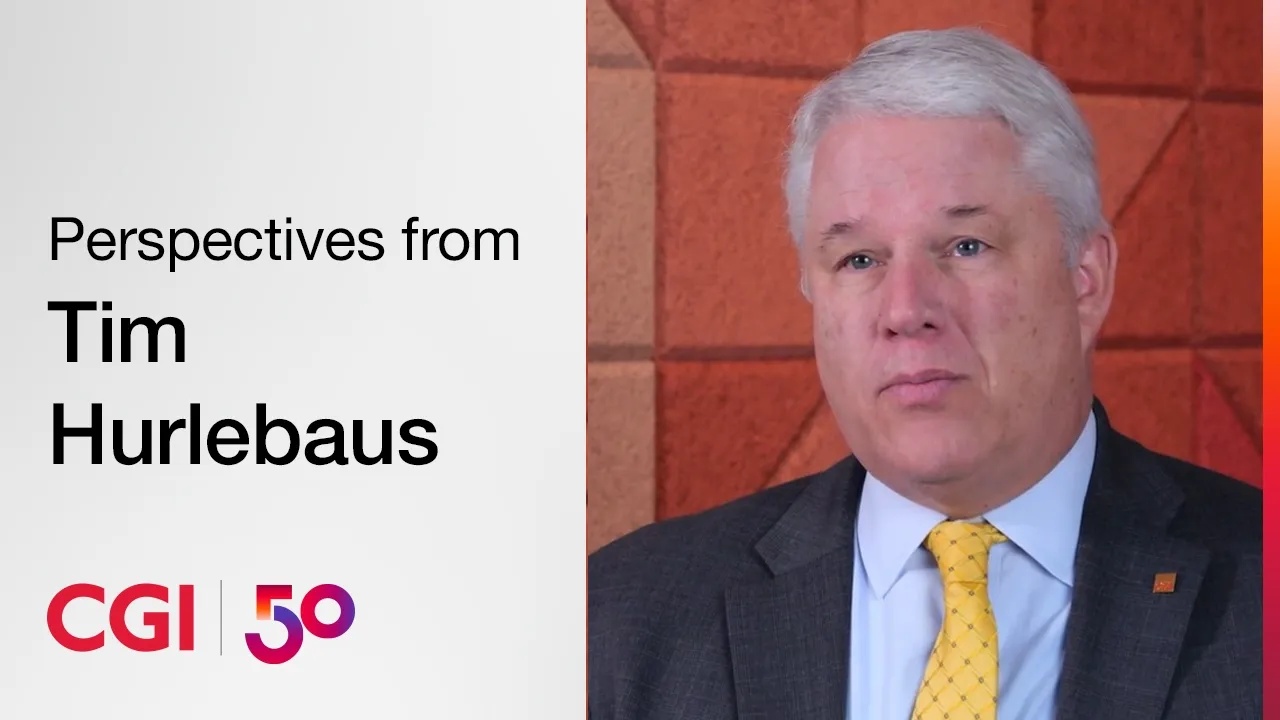
In CGI’s fiftieth-anniversary reflections, Hurlebaus chose a revealing example of client praise: Your people know my business better than I do.
He was recalling a response he had seen in client assessments. The attraction of the compliment is understandable for someone whose working life has moved across industries.
He explained that consultants can encounter a similar problem in several organizations, accumulating experience that someone working inside a single institution may never have occasion to collect. Collections in financial services and telecommunications, or budgeting in government, offer different settings for knowledge to travel.
His anniversary remarks paired that expertise with listening. Both matter to his argument about CGI’s future. An experienced adviser brings patterns from elsewhere; a useful one also notices what is peculiar to the client in front of them. Otherwise experience can become a particularly expensive form of inattention.
By October 2026, his public updates described his first Annual Tour as CEO, with conversations in Montreal, Stockholm and Paris about the fiscal year ahead. He kept returning to a practical concern: employees understanding how strategy connects to their own work. The scale of the audience had grown. The preference for an intelligible objective remained.
Hurlebaus now has the opportunity, and the obligation, to apply those ideas across CGI. The first assignment had a dependable deadline every two weeks. The latest one involves a less predictable technology market, a global workforce and clients with plenty of deadlines of their own. His career has supplied a long education in what happens after the presentation ends.
Keep following the story
- Tim Hurlebaus at CGICurrent biography and responsibilities
- Tim Hurlebaus on LinkedInPublic posts and career updates
- CGI at 50: perspectives from Tim HurlebausVideo conversation on YouTube
- CGI’s May 2026 leadership announcementThe appointment and the board’s priorities
- The market context for CGI’s CEO changeChristopher Reynolds, The Canadian Press
- CGI’s websiteCompany news, services and perspectives