A desk is a peculiar place to put social work. A family may need help in a living room. A child may be at school. The useful information may be sitting in an office computer, enjoying excellent connectivity while the person who needs it is somewhere else. RedMane Technology has built a substantial part of its business around this mismatch.
- RedMane sells case management software and the services needed to make agency systems work.
- Its mCase platform follows workers into the field, including places without connectivity.
- Public contracts reveal separate costs for implementation, licenses, and project management.
- A failed Arkansas project makes configuration, testing, and scope essential buying questions.
Consider Virginia. In a 2020 account, RedMane described a rollout of mCase Child Welfare Mobile to nearly 3,000 staff on iPads, integrated with the existing state system in less than a year. Workers could complete assessments, collect signatures, and access case information away from the office. Almost 40 percent of users reported time savings on contact documentation. That is a worker-reported finding, rather than a measured reduction in child maltreatment or a stopwatch study of every visit.
The distinction matters. A software company can make documentation easier. Whether that produces better services depends on how people use the time. Still, removing a second round of typing is a respectable ambition. Few caseworkers entered the profession for the pleasure of meeting the same form twice.
A platform that can leave the building
mCase is RedMane’s configurable, cloud-based case management platform. Its scope includes intake, assessments, eligibility, service planning, financial processing, and ongoing service delivery. It supports mobile work without internet or cellular connectivity, then synchronizes information when a connection returns. The point is continuity: a visit need not become a memory waiting to be transcribed.
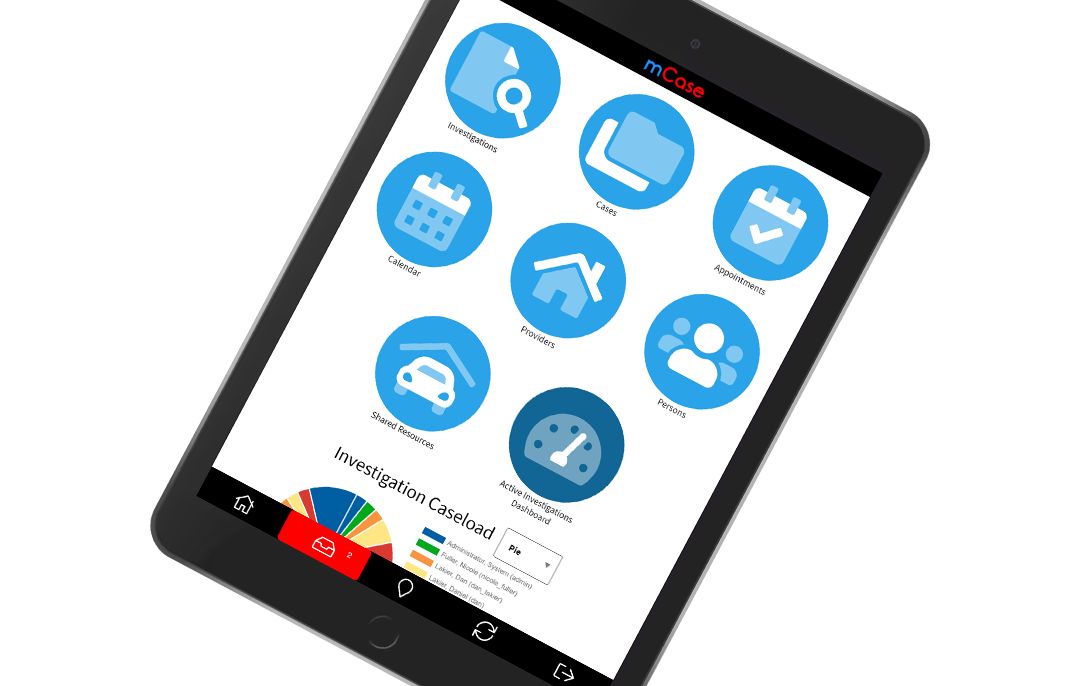
The buyers are organizations. The daily users include caseworkers, supervisors, and program staff. RedMane serves state and county agencies, Canadian organizations, and Indigenous communities, alongside commercial clients. Its territory includes child welfare, child support, benefits eligibility, adult protective services, justice, and veterans’ services. These programs have different rules, but a recurring administrative problem: keeping a person’s circumstances connected to the decisions and services that follow.
In the office or the field · Offline capture → later synchronization
The platform’s appeal is its combination of reusable functions and agency-specific configuration. RedMane can also supply the implementation team. That makes it a product company and a systems integrator, with consulting, maintenance, modernization, analytics, and cloud services around the software. An agency can buy help with an existing system as well as commission a replacement.
The giraffe comes before the government contract
Founder Tony Lakier offers an unusually good explanation for the company’s name. He grew up around his family’s Johannesburg Lion Park in South Africa. In a 2018 interview, he said he had a pet giraffe named George. Most technology founders settle for a garage; Lakier had rather more headroom.
His business origin was less picturesque. After an acquisition, he disliked his employer’s push toward a narrow industry and solution. He wanted to concentrate on delivery. RedMane began in 2000, and Lakier credits a multimillion-dollar Louisiana contract, awarded when the company had five people, with giving it a platform for growth.

“We’re a problem-solving company. Technology is just one of our tools.”Tony Lakier · Founder and President
RedMane describes a flat organization where people shift roles, with honesty, integrity, respect, and quality as its stated values. Those are company descriptions, best judged by clients and employees over time. Its service method is more concrete: bring leadership and hands-on users together for discovery, examine the underlying process, and then decide what to build.
That approach requires expertise in the programs themselves. In Missouri, RedMane describes work maintaining and enhancing MEDES, the Medicaid eligibility system built on IBM’s Cúram platform. The assignment spans integration, testing, architecture, databases, and deployment. Knowing the application is only one part of knowing the job.
The bill has more than one line
Alameda County’s 2023 HealthPAC memo shows a purchase under pressure: its existing One-E-App enrollment software was being discontinued. Officials recommended a $597,184 RedMane agreement, including implementation and first-year licenses. They cited mCase’s built-in functions and its use in comparable neighboring programs. This was a replacement decision with a deadline, rather than an appetite for novelty.
RedMane implementation + first-year licenses
$487,184Year-one licenses
$110,000
The lesson for buyers is mundane and expensive: budget for the work surrounding the license. Requirements, coordination, and implementation remain someone’s responsibility. Reusable software is valuable when the reuse survives contact with an agency’s actual rules.
RedMane competes in a market where large integrators bid for the same work. Kansas’s 2025 CCWIS presentation lists Accenture, Tata Consultancy Services, and Unisys among competing bidders. RedMane won the design, development, and implementation award; the company reports its value at $44 million. A contract award establishes a commercial win. It does not establish the eventual result.
Arkansas supplies the uncomfortable test
The Arkansas ARfocus project demonstrates the difference. The state hired RedMane in 2022 to modernize child welfare technology. Reporting based on public records found that hotline workers complained of slowness after the first release went live in May 2023. Other concerns included reporter portals and stalled servers. RedMane staff attributed slowness to an infrastructure issue; agency confidence nevertheless deteriorated.
Arkansas paid RedMane $12.2 million between April 2022 and January 2025, according to invoices reported by the Arkansas Advocate. The initial seven-year project had been expected to cost $26.2 million. These figures describe that engagement, rather than the normal price of statewide modernization.
The August 2024 Maximus oversight report recorded a proposed path forward with reduced scope, an additional $15 million request, and a later deployment date. Following review, the parties agreed to end the project. Maximus also identified a configuration-versus-customization problem: meeting requirements had called for more custom behavior, complicating updates, documentation, and testing.
A reasonable buying lesson follows from those records: establish which requirements the platform already handles, which demand new code, and how each will be tested. Early releases need credible performance under real workloads. When that boundary remains unsettled, a configurable platform can become a bespoke development project with a license attached.
The next sale may leave the old system standing
RedMane’s recent announcements offer a different route alongside full replacements. In September 2026, it promoted IntelliSuite and mCase enhancements at ISM, including IntelliCoach transcription and question suggestions, AI-assisted intake and triage, and document intelligence. The pitch includes adding an intelligence layer around existing systems. These are described capabilities and intentions; they are not evidence of universal accuracy or savings.
Other updates are more tangible. RedMane reported that Florida’s Agency for Persons with Disabilities launched a statewide incident management system on mCase in July 2026, supporting a network of approximately 30,000 providers. John Murray became CEO in May, with Lakier remaining President. The company continues to sell both systems and the labor of making systems useful.
For an agency, the practical starting point is a representative piece of work: an intake, a family visit, a renewal, an incident report. Ask who enters information, who needs it next, and what happens when the connection disappears. Then make the supplier demonstrate that journey. RedMane’s appeal lies in its attention to that traveling case. Its record also supplies a reminder that the journey must work before anyone declares the destination reached.