Imagine a customer placing an order. Sales has the customer’s details. Finance has the account. Operations has the stock. Each department possesses a very respectable piece of software. Now ask a less respectable question: do all three agree about what just happened? This is an illustrative problem, but it explains the territory in which Jeevan Technologies made its living. The company sells the expertise required to make business systems useful together.
- Jeevan’s specialties include Salesforce, ServiceNow, Microsoft, development and testing.
- Nobl Q acquired it in December 2023, bringing those skills into a broader ERP business.
- The acquisition announcement reported more than 200 global Jeevan clients.
- The practical lesson: follow the business process across applications, and give the connections an owner.
Enterprise software is remarkably good at acquiring names. There is a name for managing customers, a name for planning resources, a name for handling service requests. It is less good at assigning responsibility for the journey between them. Somewhere between “the customer agreed” and “the invoice is correct,” a human being may still be copying a number into a spreadsheet. The spreadsheet, naturally, was never invited to the strategy meeting.
A photograph before the acquisition
Jeevan began in 2000 under Nepoleon Duraisamy, an entrepreneur also known for his acting career. That biographical detail supplies the obvious joke about a second act. The more useful detail is less theatrical: the company built delivery capacity in India while developing a business presence in the United States.
Duraisamy’s historical account records a second offshore development centre at Chennai’s Elnet Software Technology Park in 2006. Two years later came a third at DLF IT Park. The account describes the DLF facility as 30,000 square feet, with room for about 360 employees. Capacity is not headcount, but it tells us what kind of business Jeevan was preparing to run: one requiring people, desks and sustained technical work.
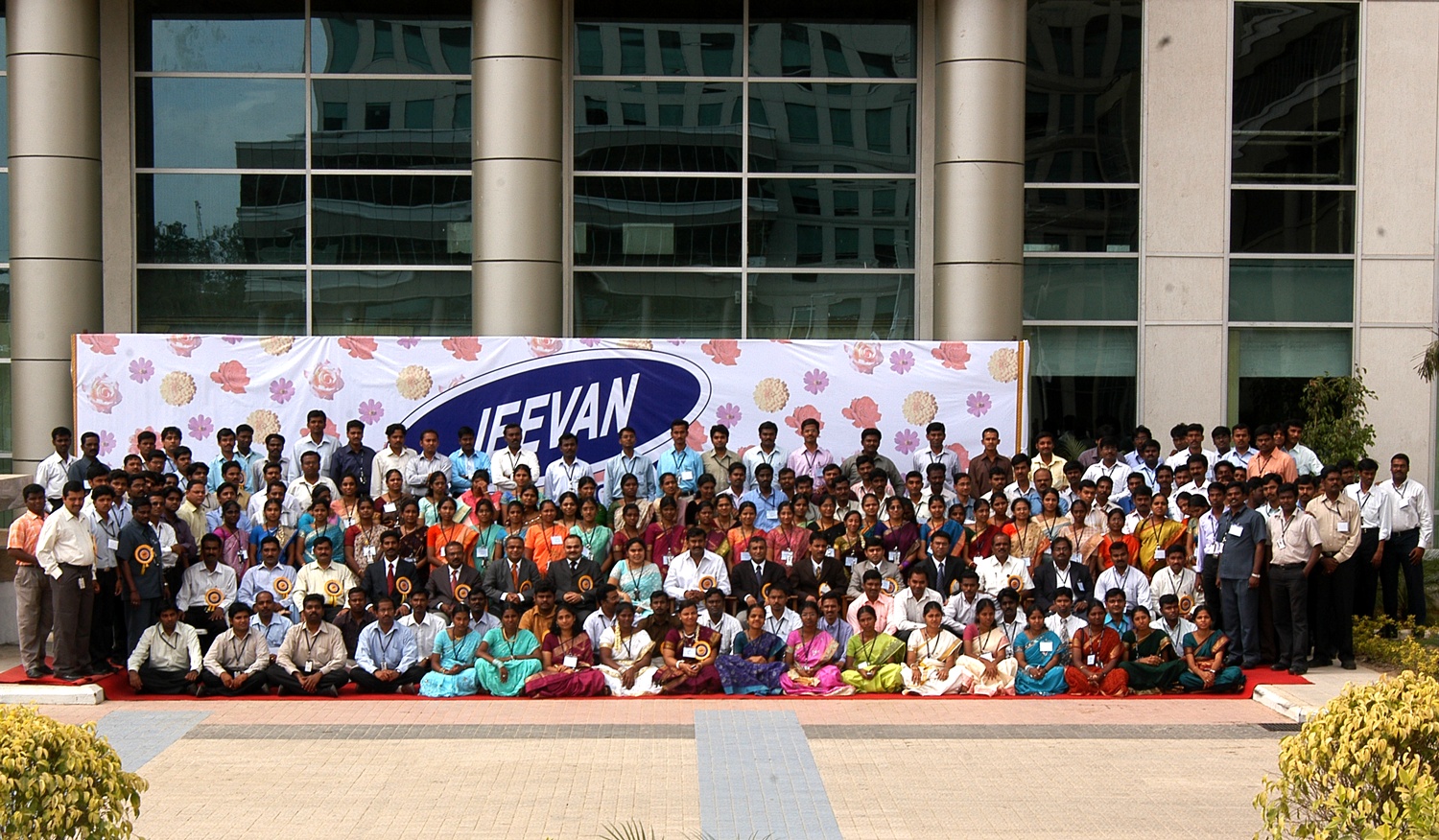

The photograph is a useful antidote to the language of technology services. “Delivery capability” looks abstract in a presentation. Here it has faces. A services company must assemble skills, retain knowledge and turn individual expertise into something a customer can rely on. The software vendor supplies the platform. A firm such as Jeevan supplies people who can interpret what the customer needs it to do.
Why an ERP business wanted Jeevan
On December 18, 2023, ERP Logic announced both its new name, Nobl Q, and its acquisition of Jeevan. The pairing had an intelligible logic. ERP Logic’s background lay in SAP and cloud ERP. Jeevan brought experience in Salesforce, ServiceNow and Microsoft. Put those practices together and a customer could ask a broader question than “Can you install this application?”
The deal announcement described a combined organization of more than 800 associates, operating across North America, Europe, India and the UK. That was the combined business at the time of the announcement. Jeevan’s own contribution was a specialist practice with a reported customer base exceeding 200 global organizations.
“We are delighted to align our growth journey with NOBL Q”
Nepoleon Duraisamy · December 2023
The commercial attraction is easy to see. Customer information can begin in Salesforce, become an order in an ERP system, and generate service work elsewhere. An implementation partner that understands several parts of that journey has a plausible advantage when the problem crosses a boundary. This is an interpretation of the combination, rather than proof that every customer received a seamless result.
Conceptual workflow, not a documented client architecture. Integration and testing carry the work between layers.
The ownership story moved again in March 2026. Yellow Stripes Capital acquired a majority stake in Nobl Q. The announcement said Duraisamy had sold his remaining interests, alongside Nobl Q founder Caldwell Velnambi. Jeevan’s founder had reached an ownership exit; the practice sat within a continuing enterprise services business.
Credentials are a beginning, not a result
For a buyer, Jeevan’s Salesforce partner listing offers something more concrete than an adjective. It identifies a Ridge/Silver consulting partner and, when researched, displayed 42 certified people holding 121 certifications aligned to Salesforce competencies. Those counters describe credentials held by people, not 121 separate consultants. The distinction is small enough to miss and large enough to matter.
Jeevan’s Salesforce partner-directory counters, researched September 2026. Credentials describe a technical bench; they do not measure project outcomes.
The listing describes work across Sales Cloud, Service Cloud, marketing, field service, CPQ, analytics and integrations, including MuleSoft. Its industry experience spans healthcare, pharmaceuticals, manufacturing, financial services, technology and real estate. These are organizations with business rules that rarely fit neatly inside a software demonstration.
The current Nobl Q Salesforce practice adds a more explicit proposition: recover value from existing licenses, connect the CRM to the rest of the technology estate, and maintain it after launch. Its ServiceNow practice covers service management, operations, assets and governance. Microsoft work includes Dynamics 365 and Power Platform. These are present parent-company offerings; they describe the wider business Jeevan joined.
There are several alternatives in this market. A buyer can choose a specialist devoted to one platform, a larger systems integrator, a staffing supplier or an internal team. Jeevan’s position within Nobl Q combines a specialist heritage with access to neighboring practices. That breadth deserves consideration when the problem is integration. A narrowly defined application task may need a much narrower supplier.
The bill continues after the ribbon is cut
Jeevan’s business is built around services: consulting, implementation, custom development, testing and access to technical talent. The distinction matters when buying. A license gives permission to use software. A services engagement establishes what somebody will configure, build, validate or operate on your behalf.
Nobl Q’s current professional-services menu makes the choices unusually visible. It offers staff augmentation, agile delivery pods, centres of excellence, offshore development centres, hire-train-deploy arrangements and build-operate-transfer. The amount of customer ownership varies. Hiring a specialist into an existing team assumes the customer can direct that person. Commissioning a delivery pod asks for a more organized unit of capability. Transferring a built operation makes eventual ownership part of the plan.
The economic proposition also depends on where the work happens. Nobl Q describes senior onshore architecture and accountability combined with offshore execution capacity. That is a proposed division of responsibility and cost, not a universal formula for savings. A buyer still has to compare the actual scope, seniority, handovers and service commitments.
Ongoing support deserves its own line in the decision. The parent separates managed operations from enhancement services: keeping a system stable and continuing to improve it. Break-fix work, monitoring and administration compete with new features unless somebody plans for both. The launch photograph records a day. The support contract describes what happens on the following Monday.
Give the handoff an owner
What can a reader copy from this story? Start with a complete business journey. For example, trace an order from customer record to payment and service request. Identify every place data moves, every place a person intervenes and every place the rules change. Then decide who is responsible for the whole journey. This is a buying discipline suggested by Jeevan’s service mix, not a claim about an undisclosed client project.
Ask for tests that cross those boundaries. A successful screen demonstration proves that a screen works. It says much less about whether the right account receives the right invoice after an exception. Jeevan’s public specialties include testing and automation, and the parent’s development offering describes requirements traced to tests and regression checks across releases. Buyers can make that connection an explicit acceptance criterion.
Put limits around the engagement, too. An outsourced team cannot decide business rules that the customer has left unresolved. A broad platform practice can be excessive for a small, simple task. Credentials help establish capability; relevant references and a scoped piece of working software help establish fit.
In September 2026, Nobl Q appointed Eric S. Peters Chief Revenue Officer and described its move toward solving business problems independently of a single platform. The language has changed since Jeevan opened those Chennai offices. The useful test remains wonderfully ordinary: after the consultants leave the room, does the work move through the business with fewer interruptions?