David Orgaz, founder of Madrid Space, described a peculiar discovery after joining IoT Tribe’s Space Endeavour programme. His company had learned how valuable its technology was. More usefully, it had learned how to demonstrate that value to somebody else. An invention can be perfectly intelligible to its inventor and commercially invisible to everyone holding a chequebook.
That small distinction explains much of IoT Tribe. The company runs accelerators and innovation programmes, but its recurring subject is the distance between making something work and getting an organisation to use it. Deep technology supplies plenty of the former. The latter requires a customer, a convincing use case and a route through the institution.
- Founders get help validating products, meeting adopters and entering markets.
- Corporate and public partners get curated technologies, pilots and venture support.
- Several documented accelerators charge founders no fee and take no equity.
The bottleneck had a calendar
IoT Tribe grew out of Startup Scaleup, a European accelerator that began in 2015. Its own history records 132 startups across eight cohorts in two years. The successor company arrived in 2017, led by founder and CEO Tanya Suarez. It inherited something more useful than a fashionable name: relationships with founders and the organisations around them.
In a 2017 interview, Suarez identified the biggest obstacle as the time required to develop relationships and funding. Keeping the community active after its initial acceleration round had also taken work. That experience helps explain the emphasis on continuing support. A programme finishes on schedule; a customer’s purchasing process has no obligation to be so considerate.

The early industrial programme found a home in Barnsley’s Digital Media Centre. Local manufacturers, universities, Rolls-Royce, the Advanced Manufacturing Research Centre and the council contributed connections. The proposition was practical: bring founders into a place where somebody could recognise a factory problem, test an answer and help the company navigate production.
What the customer is buying
Today, IoT Tribe offers themed accelerators, market-access programmes, open innovation challenges and corporate venturing. Its Tech Studios help organisations shape solutions with technology companies through proof-of-value pilots. The expertise combines commercial development, technical validation, mentoring and introductions across industries. Its place in the market is the working junction between startups and institutional adopters.
There are two constituencies here. A founder wants traction, access and a clearer route to scale. A corporate or public partner wants a technology that solves an actual operational problem. IoT Tribe organises programmes around that meeting. Public and corporate delivery partnerships support the model; the May 2026 ESB announcement explicitly describes a competitive tender.
The cost question has a concrete answer for particular programmes. Connected Places advertised fee- and equity-free participation, as did Singapore’s Deeptech #03. That makes the offer different from an accelerator funded by taking founder equity. It does not remove the work of testing, integration or selling. Founders still need to examine the terms and demands of each programme.
Selection matters, too. The 2021 Connected Places call asked for a team, evidence of product-market fit and some traction. Siemens Flywheel specifies seed-stage dual-use AI, a defensible solution and technology readiness levels between four and six. These offers suit companies ready to validate and sell something concrete. A founder with only an idea would face a different task before gaining much from buyer introductions.
Count the contracts
Space Endeavour provides a revealing example. IoT Tribe reports a structured programme for 30 startups, with access to space expertise and market players. Applications included infrastructure monitoring, port environmental monitoring and supply-chain cybersecurity. Space technology acquired an earthly job description. The commercial question became which organisation needed the capability, rather than whether the technology sounded impressive.
The reported results include 242 new contracts, 39 proofs of concept, 108 new employees and €12.15 million in participant investment. These are company-reported programme outcomes, rather than a controlled experiment showing what would have happened without it. Still, contracts are a more informative category than applause. They put the conversation nearer to a customer’s decision.
Space Endeavour’s reported participant outcomes. Contracts and proofs of concept are separate measures.
Singapore offers another version of the same approach. The Deeptech Accelerator, delivered with Enterprise Singapore and the Economic Development Board, reports 34 companies across three cohorts and more than 120 deals during and after the programme. CheckToBuild’s founder described completing a demonstration project with an Asian construction company. Market entry became a specific project with a prospective adopter.
The enthusiast and the budget holder
The model now reaches into defence. In November 2024, DASA appointed IoT Tribe to lead Janus, a consortium bringing acceleration, investment and technical connections together. Its original announcement named Atmos VC, SETsquared and Arrow as specialist partners. Janus supports technologies with civilian and military applications, including delivery within NATO’s DIANA network. The UK’s 2026 cohort includes eight companies.
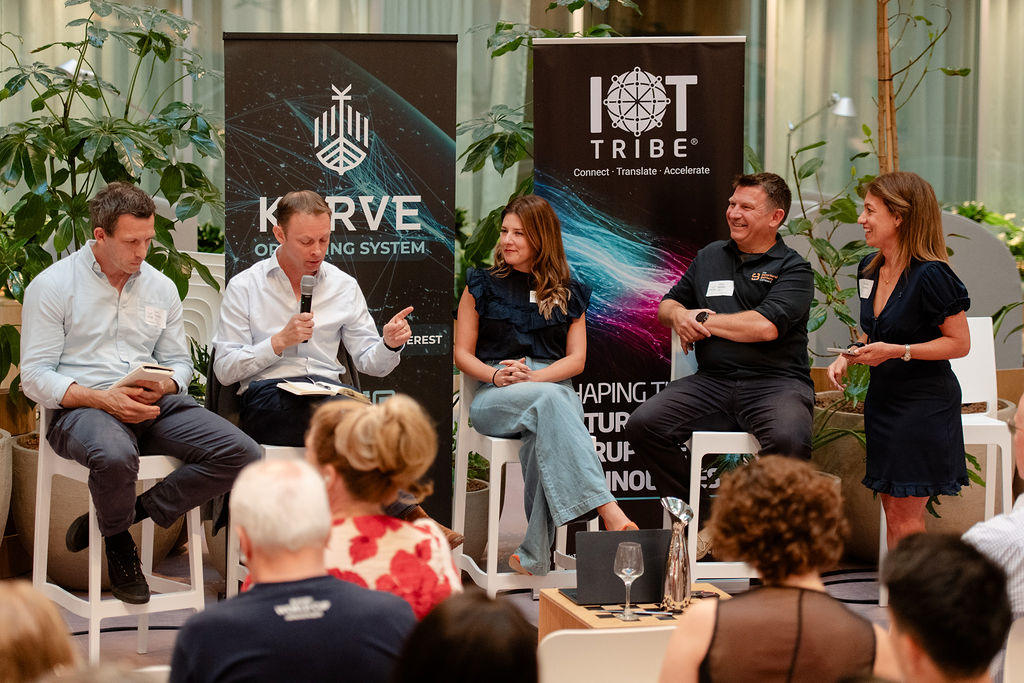
A September 2026 panel recap makes the difficulty plain. John Moffat of The Structural Battery Company warned that interest need not become demand. NATO DIANA’s Ryan Benitez highlighted a related problem: the user and the person authorising payment can be different people. A trial can therefore succeed technically while the purchase goes nowhere. The commercial link is what stalls.
“The IoT Tribe programme is like a compass”
David Orgaz, founder and CEO, Madrid Space
The practical implication is to involve both sides early. An enthusiastic operator can explain the working environment; a decision-maker can explain what evidence and approval are required. That is a useful discipline for founders comparing accelerators: ask who will join the pilot conversation and what happens when the demonstration ends.
A utility puts the method inside
In April 2026, IoT Tribe formally opened Dublin operations. The following month it announced a three-year partnership to run ESB’s X_Potential employee innovation incubator. The brief covers electricity-system decarbonisation, resilient infrastructure and customers. Here the ideas begin inside a large organisation. IoT Tribe’s job is to help turn them into validated business opportunities, with the team based at Trinity’s innovation hub.

The copyable lesson is to design the pilot around a buying decision. Identify the user, find the budget holder and agree what evidence would justify adoption. An introduction helps only when the organisation has a problem it will address, and a prototype must be ready for the setting in which it will operate. Under those conditions, a useful relationship can become a sale.