Before there was a company to run, there was a car to get running. As a teenager, Mark Morelli and his brother rebuilt an old Triumph. Their father was an amateur rally driver who enjoyed the country roads of Europe, so an interest in cars had a respectable family pedigree. The brothers supplied a more practical version of the enthusiasm: take something apart, work out what belongs where, and make it go again.
The episode helped inspire Morelli’s interest in engineering. It is a pleasingly concrete beginning for someone whose later work would involve words such as transformation and mobility. A car has little patience for vocabulary. Whatever the ambition, the parts must cooperate. A persuasive explanation of why the engine ought to start is rarely accepted as a substitute for starting it.
Today, Morelli is president and chief executive of Vontier, the Raleigh-based industrial technology company he has led since January 2020. Its businesses work in the places a journey depends on: the forecourt, the convenience store, the fleet fueling site, the car wash, and the repair shop. Much of that technology is easiest to appreciate when it stops working. Customers tend to remember a payment that fails rather more vividly than one that succeeds.
The Triumph is an appealing way into his story, though it cannot explain an entire career. Between that teenage project and Vontier lie military service, two universities, and a succession of industrial businesses. What those experiences have in common is a concern with the working world: machines, products, teams, and the often inconvenient distance between a plan and its execution.
A cockpit before the corner office
Morelli earned a bachelor’s degree in mechanical engineering at Georgia Tech, graduating in 1987. He began his career as a U.S. Army officer and helicopter pilot, and served as company commander of an attack helicopter unit. This was leadership with equipment attached. The title placed him in an organization where preparation and coordination had immediate practical consequences.
He later studied at MIT Sloan, attending from 1991 to 1993 and earning a master’s degree in management. His educational route brought together the technical and organizational sides of a problem. Mechanical engineering asks how a system behaves. Management adds the people who must build, operate, sell, and maintain it. A business can be sound on a drawing board and much less cooperative on a Monday morning.
In 1993 he joined United Technologies. Over the next fourteen years, his work moved through product management, marketing, strategy, and general management. His last assignment there was president of Carrier Commercial Refrigeration. The progression matters because it puts several different kinds of responsibility behind the later CEO appointments. He had worked on the product, on its market, and on the business surrounding both.
Refrigeration also belongs to the category of technology that does its job largely out of sight. Its usefulness is measured through reliable operation rather than applause. That makes it a fitting early chapter for a career that eventually arrived at the infrastructure behind everyday travel. The glamorous part of a journey may be the destination. Someone still has to keep the intervening machinery working.
- 1987Georgia Tech
- 1993United Technologies
- 2017Columbus McKinnon
- 2020Vontier
The solar chapter had a difficult ending
In 2007, Morelli became president and CEO of Energy Conversion Devices, an alternative-energy company. The appointment moved him into a business whose technologies included solar products. It also put him at the intersection of manufacturing, commercialization, and changing energy markets. Those subjects would appear again in his career, though the circumstances would be different.
This chapter deserves its difficult ending. In May 2011, Energy Conversion Devices announced a strategic corporate restructuring and appointed Jay Knoll interim president, replacing Morelli, who had resigned. A career told only through appointments and welcoming statements would miss that turn. The company was struggling, and his time at its helm ended as it reorganized.
It would be tempting to supply a tidy lesson in his voice here. The documented sequence is enough. An executive who had moved from a large industrial group into alternative energy went on to another operating role. The next chapter did not erase the previous one. It broadened the record of businesses and circumstances he had encountered.
From 2012 through 2016, Morelli served as president and chief operating officer of Brooks Automation. In February 2017, he became president and CEO of Columbus McKinnon, the material handling company. The products changed again. The underlying responsibility remained recognizably industrial: turn technical capability into something customers can use and a business can sustain.
What he noticed in a crane business
At Columbus McKinnon, Morelli visited STAHL CraneSystems in Germany and spoke with its staff. Asked afterward what he had learned, he talked about engineered solutions and the manufacturing process that delivered them. Asked what the addition of STAHL meant for the group, he emphasized its engineering content. His attention went to the substance of the product and the knowledge of the people making it.
“I believe that they exemplify ‘partner of experts,’” he said of the employees. The phrase is compact enough to survive the journey out of an industrial interview. It gives a glimpse of what he chose to praise: expertise applied to a customer’s problem. A crane business can be described through its machinery; Morelli’s answer also made room for the people who know how that machinery should work.
For a profile of a chief executive, this is a useful small scene. There is no need to imagine a dramatic factory-floor revelation. He visited, listened, and described what he valued. The distinction is in the emphasis. Engineering content made the acquisition fit his idea of an industrial technology company. That definition would travel with him to a business spanning several kinds of roadside technology.
“I believe that they exemplify ‘partner of experts.’”Mark Morelli, on STAHL CraneSystems employees
Founding a company with a past
Morelli joined Vontier in January 2020. On October 9 that year, the company began regular trading on the New York Stock Exchange as VNT after its separation from Fortive. He was its founding CEO, leading a newly independent company assembled from established businesses. It was a beginning with operating histories already inside it.
That is a particular sort of founding task. The brands brought products, customers, and their own ways of working. The new parent needed a coherent direction that made sense across those differences. Matco Tools and Gilbarco Veeder-Root meet customers in different settings, yet both participate in keeping vehicles and the businesses around them moving.
A corporate name can gather businesses on a balance sheet. Getting them to cooperate requires more. Morelli’s work at Vontier has involved building an operating culture and deciding how the portfolio should develop. The company’s business system centers on continuous improvement, a practice that treats the organization as something to keep adjusting rather than something finished on the day of its launch.
There is a human side to that ambition. In 2024, Morelli welcomed leadership coach Marshall Goldsmith to Vontier’s leadership gathering. In his public reflection afterward, he said the discussion resonated with his views about servant leadership. The connection adds texture to the military commander in his biography: his stated interest includes how leaders support the people doing the work.
He also joined Xylem’s board of directors in February 2022. Water technology takes him into another infrastructure business, extending his involvement beyond Vontier. The connection is practical rather than merely fashionable. Industrial technology increasingly combines physical equipment with digital capabilities, and both companies operate in that territory.
A conversation at the roadside
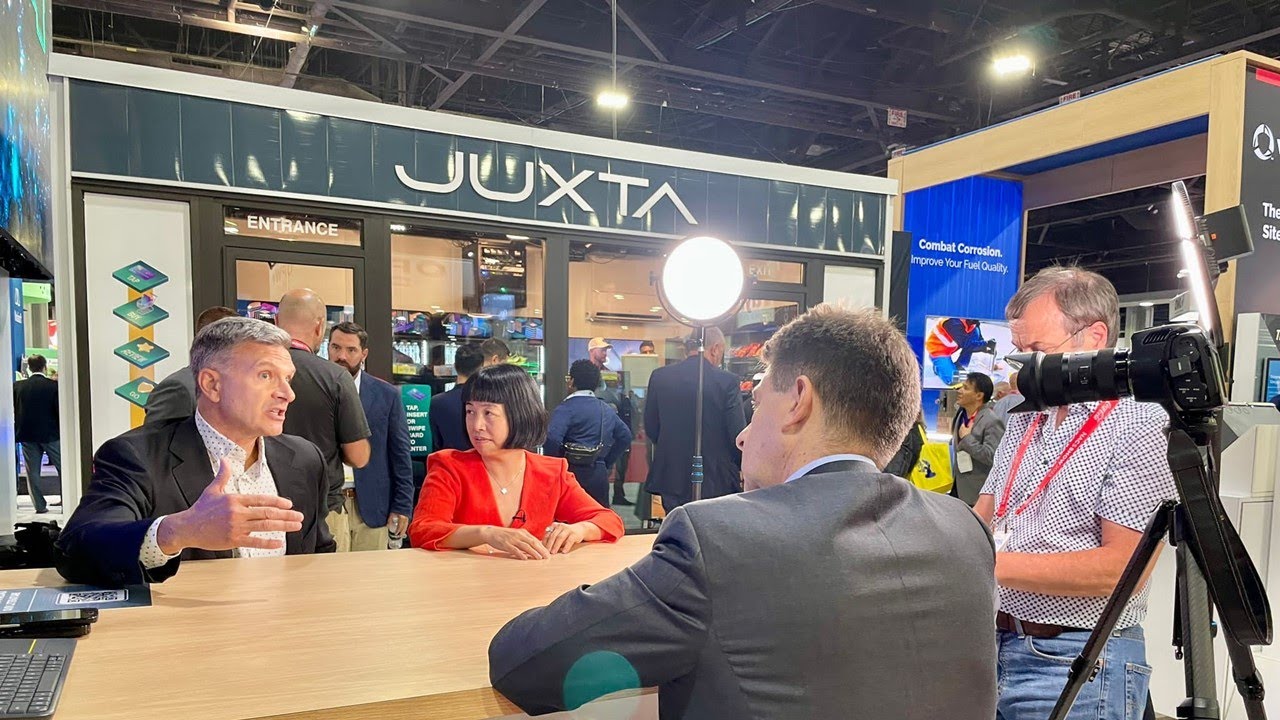
At the 2023 NACS Show in Atlanta, Morelli sat down with Carol Chen, then Shell Mobility’s global chief marketing officer and senior vice president, and host Dan Munford. The subject was the energy transition. Both Morelli and Chen had visited Norway’s market that year, and the discussion considered mobility hubs, charging infrastructure, and charger reliability.
The setting was appropriate: a trade show devoted to the businesses people stop at while traveling. The transition could be discussed in terms of a site, a customer, and equipment that needs to function. That brings an expansive topic down to the scale at which operators make decisions and drivers experience the result.
The conversation also considered how different markets move at different speeds. For a company serving existing fueling infrastructure alongside newer energy technologies, that variation is part of the job. Morelli’s remit includes businesses meeting present demand while customers decide what to add next. The future arrives through installations, contracts, software, and purchases made by people with today’s expenses still on the desk.
The repair continues
By June 2026, Morelli was writing publicly about kaizen and the discipline of controlling what an organization can control. He described Vontier’s annual leadership workshops and follow-up checks at thirty, sixty, and ninety days. At the end of those check-ins, he asks: “What support do you need? What can we do to help you succeed?”
The questions make his interest in servant leadership tangible. A workshop produces intentions; a follow-up asks whether people have what they need to act. There is something agreeably unceremonious about that. A date in the calendar and a question about support can be more revealing than a wall full of values.
The financial record supplies another test. In its August 6, 2026 results, Vontier reported second-quarter sales of $756.7 million, down 2.2% from the prior year. Adjusted operating margin rose to 23.0%, while GAAP operating margin was 19.4%. The company raised its full-year adjusted earnings-per-share guidance. Sales and profitability moved in different directions; the measures deserve to remain distinct.
GAAP: 19.4%
Sales declined 2.2% year over year. Adjusted margin rose from 21.1% to 23.0%; the adjusted measure is non-GAAP.
More recently, Vontier announced on September 18 that Tesco would deploy integrated payment and fueling technologies across more than 700 sites. Its October announcement for NACS 2026 brought the same theme into view: connect the technologies around a convenience retailer so the site is easier to operate. These are company developments, and they give a concrete setting to the work Morelli is leading.
The scale has changed considerably since the Triumph. The task now involves organizations as well as equipment, customers in different markets, and decisions with consequences across a public company. Yet the early anecdote remains a useful image to carry away: two brothers putting an old car back together, discovering that separate parts must work in concert. Morelli’s career has kept returning to the business of making that happen.