The toilet broke upstairs. The consequences arrived downstairs. In 1986, a colleague of Chuck DeSmet and Douglass Phillips returned from work to find a house flooded by a cracked second-floor toilet. Ceilings were ruined. Repairs meant months in a hotel for the family and its pets. Insurance paid for damage; it could hardly return the ordinary evenings that had gone missing. DeSmet and Phillips began looking for a way to stop the water automatically.
They eventually founded FloLogic in 1996. Their proposed “plumbing circuit breaker” gave a familiar household utility an unfamiliar responsibility: deciding when enough water had passed. DeSmet had chosen a peculiar thing to sell. Its most satisfying performance would leave remarkably little to admire. No ruined floor. No collapsed ceiling. Nothing much happening at all.
In July 2024, Bradford White announced that it had acquired the business. DeSmet was identified as founder, president and CEO. Twenty-eight years separated that announcement from FloLogic’s founding. The interval contains a founder’s problem that a polished acquisition announcement can make easy to overlook: people need a reason to pay for the trouble they have not yet had.
A valve with a rehearsal schedule
DeSmet’s name appears on a piece of the engineering, too. A patent filed in January 2001 and granted in April 2002 names Charles R. DeSmet as inventor, with FloLogic as the original assignee. Its subject is the periodic exercising of a water shutoff valve. Even plumbing, it seems, benefits from remembering how to move.
The design addresses deposits, corrosion and other conditions that can interfere with a valve left idle. A controller periodically operates the mechanism, helping it remain ready for a real shutoff. The patent discusses doing this during periods when the building is unoccupied or water demand is low, so the protective routine does not become a nuisance.
That is a revealing problem for a founder to work on. Detecting a leak provides only part of the answer. The device must also be able to act after long stretches without an emergency. A safety mechanism has an awkward employment contract: wait patiently, then perform immediately. DeSmet’s patent takes the waiting seriously.
The clock inside the pipe
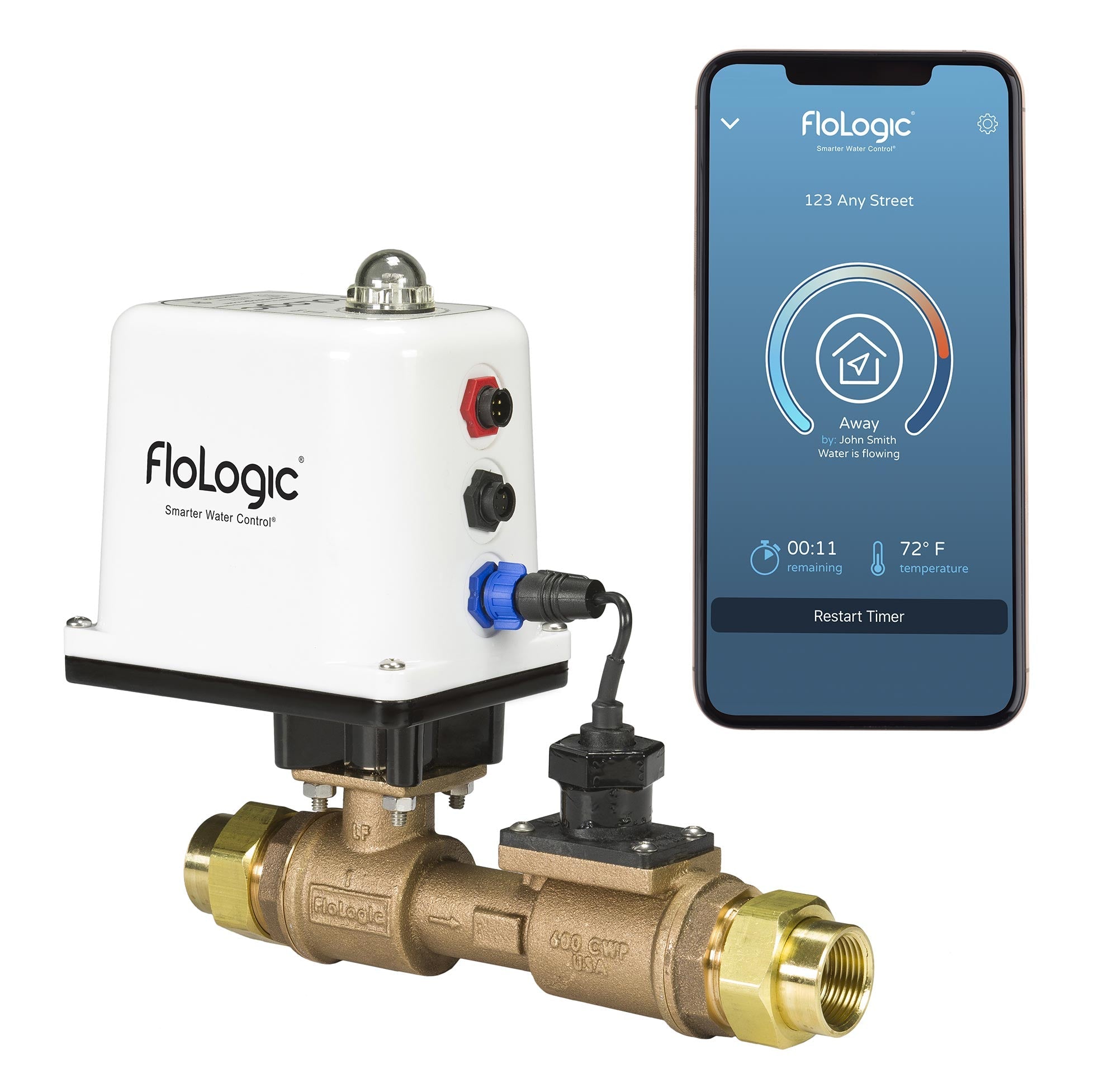
When DeSmet explained FloLogic in 2015, he described household water use as a succession of relatively short events. The system starts timing when flow begins. Water running uninterrupted beyond the selected limit prompts the ball valve to close. The distinction is intelligible even to someone whose plumbing knowledge ends at finding a wrench.
The Home and Away settings gave that idea two everyday contexts. The published defaults were 30 minutes of uninterrupted flow at home and 30 seconds while away, with settings adjustable by the user. A shower and a vacant cottage require different allowances. DeSmet also pointed to battery backup as useful for properties whose owners could not visit whenever the power failed.
The design makes absence a practical consideration. Nobody needs to stand beside the pipe, listening. Nobody needs to be close enough to hear water hitting the floor. For DeSmet, describing the device meant describing the ordinary lives around it: people leaving home, returning to another property, or expecting equipment to carry on without supervision.
The customer who already understood the bill
The early business ran short on the luxury of explaining itself to everybody. DeSmet later described financing that arrived only as it was needed, and the difficulty of raising capital after the dot-com collapse. FloLogic leaned on insurance relationships to reach customers. The people paying repair claims had a reason to understand prevention before the next ceiling failed.
By 2010, the company was also seeking credibility among the people who would work on the pipes. FloLogic announced that it had been selected as an endorsed vendor for the Roto-Rooter Franchisee Association convention in Palm Beach. DeSmet welcomed the recognition and said the business needed more capital to expand. The combination is familiar to a small manufacturer: an opening door and another bill arriving together.
That announcement illustrates the practical geography of his ambition. A homeowner might buy one installation. A professional network could put the equipment in front of many households. Demonstrating the system to franchisees created a different conversation from advertising to someone who had never worried about a water supply line. The audience already knew what failed plumbing looked like.
The later plumbing trade discussion shows the channel at work. Atlanta contractor John Wallace described receiving leads through FloLogic and valuing the company’s availability when problems arose. DeSmet, meanwhile, pointed to insurer incentives and consumers’ interest in connected protection as reasons the category was approaching wider adoption. The founder’s sales problem involved trust travelling through several pairs of hands.
“Being first is tough because you’re introducing a concept to the market.”
Chuck DeSmet
A leak test has an expiry problem
DeSmet carried the argument into a different room in 2012. In comments submitted to EPA’s WaterSense programme, he observed that testing a newly built home for leaks establishes its condition at a particular moment. It cannot establish that the plumbing will never leak afterward. He advocated monitoring for failures that develop later, naming FloLogic’s system as an example.
There is a quiet insistence in that distinction. The inspection ends; the building remains in use. DeSmet was asking the discussion to extend beyond the handover. A functioning pipe today is welcome information, but a household has to live with tomorrow’s pipe as well. His proposal put time into the definition of protection.
The February 2021 preview of the ANSI/CAN/IAPMO Z1349 standard lists C. DeSmet of FloLogic as chair of its technical subcommittee. Its subject covers devices for detecting, monitoring or controlling plumbing systems. That places the founder alongside representatives from other plumbing and water-technology businesses in the less visible work of the category: establishing a shared technical framework. Selling a device and helping define its field are different kinds of work.
The undramatic business of becoming easier to buy
DeSmet could also be refreshingly specific about an administrative mistake. FloLogic initially had one product identifier bought from a third-party barcode seller. As the range expanded, that arrangement proved inadequate for larger distributors’ systems. The business moved to GS1 US identifiers. A device could be clever inside a pipe and still need the correct label outside its box.
His account of growth included larger valve sizes and a widening set of sales channels: consumers, contractors, homebuilders, security integrators and wholesalers. These are separate working worlds. Each needs the product to fit its own routines. The barcode episode makes the founder more recognisable than an uninterrupted procession of milestones would. Sometimes expansion requires acknowledging that the small-company shortcut has run out of road.
Then came another kind of access. The CONNECT platform, covered in 2019, linked the installed system to an app over Wi-Fi. It brought remote notifications and control, including compatibility with FloLogic systems installed since 2012. The person looking after a property could see an alert without being there. For an established hardware company, the screen extended the usefulness of equipment already in service.
DeSmet’s public writing followed these concerns. His LinkedIn profile lists a 2014 article connecting water damage and conservation, then a 2017 piece on leak detection and the Internet of Things. These subjects belong together in his working life. The water has to be measured, the response has to happen, and the owner has to understand what the system is doing.
Small leaks, long consequences
The founder’s conservation message rests on an easily overlooked distinction. A leak that damages a room demands attention. Water quietly escaping down a drain can continue without producing a dramatic scene. DeSmet has argued that relatively cheap water and hidden plumbing help explain why people overlook those losses. A leak need not put on a show to be worth stopping.
That emphasis broadens the original flooded-house problem. Prevention concerns what happens to the building and what happens to the water. In his public advice about frozen pipes, DeSmet returned to disruption: damaged possessions, displaced households and the continuing cost of insurance. His language stayed close to the things an owner would have to deal with after the initial failure.
He also applied the argument to buildings with irregular schedules. Discussing protection for ministries, DeSmet pointed to a school over Christmas break or an unused wing of a building during the week. Those examples give the device a setting beyond the private house. A room can be empty while its plumbing continues to work, or fail. The calendar offers the pipe no particular protection.
In that discussion, he emphasised the value of automatically stopping the water rather than relying on an alert alone. A notification still requires someone to receive it and respond. The practical question is who, or what, can interrupt the flow while people are elsewhere. It brings the story back to the absence that made the original household failure so costly.
By the acquisition, Bradford White described FloLogic’s insurer relationships as an aid to adoption and awareness. DeSmet welcomed the additional resources for growth, development and customer service. “I am very proud of the company we’ve built,” he said. The pronoun matters. Phillips was there at the beginning; installers, engineers and distribution partners had roles in getting the idea into buildings.
A flooded ceiling is an efficient salesman, although its timing is dreadful. DeSmet spent his FloLogic career trying to arrange the conversation earlier. The result was a business asking a house to notice what its absent owner could not, then do something unusually sensible for an unattended house: turn off the water.