Hank McCarrick opened his water-meter box and found spiders. His utility had asked him to conserve water and suggested checking the numbers himself. The instrument could measure consumption; obtaining the information required a small expedition. For a former semiconductor process engineer, this seemed an oddly primitive arrangement.
- Subeca connects existing meters with retrofit devices and cloud software.
- Amazon Sidewalk and LoRaWAN give utilities different routes for their readings.
- Marin’s pilot was promising; Kinneloa’s later hardware concerns show why field durability matters.
A meter box full of spiders
McCarrick had previously built a business monitoring gases used in semiconductor manufacturing. Water presented a familiar engineering problem with unfamiliar customers. A sensor, a communications route and a useful display had to work together. In his account of the company’s beginnings, the first customers included Pepsi Cola, Caltrans, a university medical center, hotels and homeowners associations.
The early system was hardwired and needed a wall socket. That made it unsuitable for widespread utility metering. A device in the ground needed battery power and economical communications. The constraints pushed Subeca toward low-power wireless technology. The spiders had exposed an inconvenience; the absence of a plug dictated the engineering.
“I knew that this was a system approach, not a widget approach.”
Hank McCarrick, founder

A doorbell moonlights as infrastructure
Subeca’s proposition starts with an asset a utility already owns. Its Wireless Pin replaces the register on compatible mechanical meters. Wired Pin connects to compatible encoded or pulse-output meters. The water-measuring equipment can remain in service while its numbers acquire a route to the cloud. Engage, the company’s web platform and mobile apps, handles installation and monitoring.
One route is Amazon Sidewalk, the shared, low-bandwidth network supported by compatible Echo and Ring devices. A household gadget becomes a bridge for a utility reading. LoRaWAN provides another route through gateways. Bluetooth supports local interactions. Having options matters when the instrument is underground and the landscape refuses to cooperate.
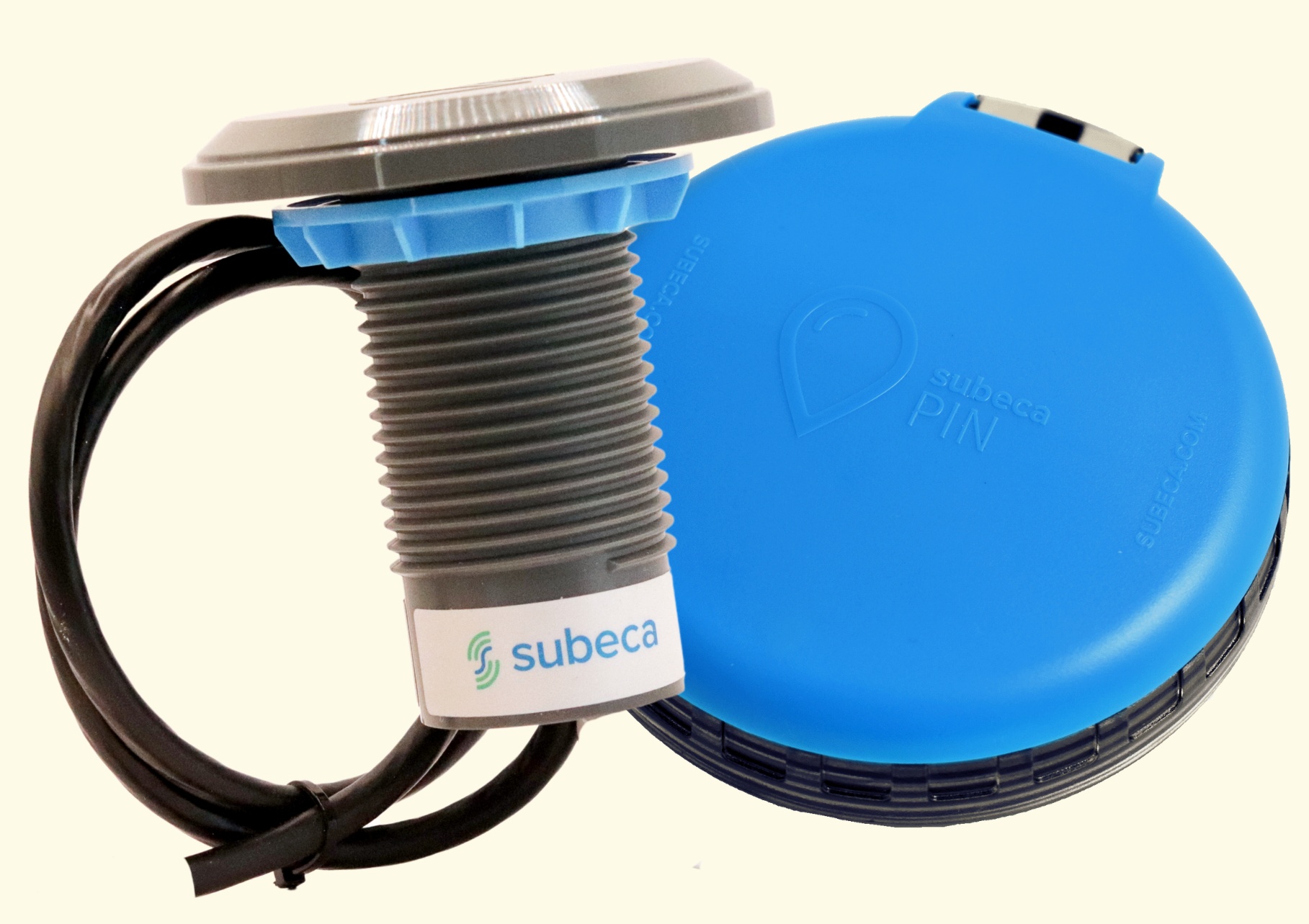
The combination required engineering work. An AWS case study describes a chip-level obstacle: Subeca’s chosen STMicroelectronics silicon did not support the desired community-network integration. Klika Tech worked with Subeca and STMicroelectronics to add Sidewalk. The product’s apparent simplicity depended on solving an incompatibility well below the customer’s dashboard.
- 01Existing meterMeasures consumption
- 02Subeca PinCaptures the reading
- 03Wireless routeSidewalk or LoRaWAN
- 04Engage + APIData for operations
Start with the awkward addresses
In January 2025, Marin Water began a Subeca pilot with 104 devices in difficult locations. Hills and vegetation made the communications question particularly interesting. Subeca’s July case study reported approximately 92% of reads within a three-day billing window. Its retrofit devices used Sidewalk without requiring new network infrastructure for that pilot.
Marin Water pilot, company-reported. A billing-window measure, not a guarantee of continuous readings.
Marin’s own staff report describes grant-funded Subeca registers and successful reads in places challenging for cellular or radio collection. It also discusses pilots from Kamstrup and Badger. That is useful context: a utility can test several approaches while preparing a procurement decision. The company’s reference to Marin’s 62,000 meters describes a potential expansion, not a completed Subeca installation.
The practical lesson is to choose troublesome addresses early. Easy locations can make a demonstration look handsome. Awkward ones reveal whether the network solves the actual problem. A buyer should define the acceptable billing window before celebrating a percentage.
Free telemetry still has a bill
Sidewalk’s appeal includes avoiding a separate telemetry charge. Subeca still sells hardware and software. Its business combines purchases and Engage subscriptions, with leasing available. In public Bolinas due diligence from March 2026, a lease example was $60 per device per year, including hardware and software. Half the lease payments could be applied to a hardware buyout; software fees would then continue separately.
Bolinas lease example, including hardware and software. Proposal-specific terms; installation and other project costs require their own assessment.
The distinction matters for small utilities. Avoiding a network build and postponing replacement of serviceable meters can change what a budget permits. A free communications route does not abolish operating expenses. The relevant comparison is the whole deployment over time, including support and integration.
That proposition attracted a $6 million Series A, announced in May 2024, led by SUEZ with Amazon’s Climate Pledge Fund and Burnt Island Ventures participating. The investors brought water-market and technology interests to the same table. Funding makes expansion possible; reliable installations still have to earn the next contract.
The seal matters as much as the signal
Kinneloa Irrigation District supplies a less tidy chapter. Subeca’s earlier account says its cellular AMI had failed and LoRaWAN provided an alternative. AWS documented deployment at 700 metered points. Later records complicate that success story. At a December 2025 meeting, Anne Mushow attributed hardware problems to sealing and said new Pins had corrected them.
The district’s meeting record preserves that explanation. Its March 24, 2026 minutes say staff believed replacement of Subeca might be needed and would develop alternatives. They describe concern and planning, not a completed switch. Connectivity and physical durability were separate tests, and passing one did not settle the other.
For buyers, the transferable discipline is plain: check meter compatibility, test local coverage, inspect replacement terms and agree how data can leave the platform. Without compatible hardware or a dependable signal, the retrofit proposition cannot deliver its promise. Even with both, field performance deserves continued attention.
More pipes, fewer plugs
Subeca’s current leadership page names Mushow as CEO, with experience at AWS and Xylem/Sensus. Its staff describes work crossing software, firmware and prototyping. The company is also offering a battery-powered clamp-on ultrasonic flowmeter in private beta, intended to measure consumption without cutting pipes or stopping water.
The ambition extends beyond billing reads to understanding water use. The attractive part is modest: keep useful equipment, make its information accessible and spare someone a trip to the meter box. Every deployment still has to prove that the message arrives.
Follow the signal
Explore Subeca, its metering products, coverage map and news and customer stories. Find the company on LinkedIn, X, Facebook and YouTube.