The household water meter is a masterpiece of neglect. It works in the dark, often under a metal lid, asking for neither applause nor a software update. Once a month it helps produce a bill. If a pipe is leaking or a toilet is quietly running, the meter knows. The homeowner generally does not.
Eric Adler found this arrangement absurd. During California's punishing drought, officials asked residents to use less water, but the request arrived without a useful feedback loop. Electricity had thermostats and dashboards. Cars had fuel gauges. Water had a number printed weeks after the fact. Adler, then a mechanical engineering student at California Polytechnic State University in San Luis Obispo, saw an old machine full of trapped information.
His answer became Flume: a sensor strapped to an existing meter, a bridge connected to Wi-Fi and an app that turns magnetic motion into a live account of household flow. No pipe cutting. No plumber required. It sounds obvious after someone has done the unpleasant work of making it real, which is the customary reward for good engineering.
A classroom project with a dry horizon
Adler's path to water technology began far from a startup pitch. He moved to Sisters, Oregon, at thirteen and attended a public school that treated the surrounding mountains and rivers as classrooms. Students backpacked, climbed, mountain biked and learned to guide multi-day whitewater trips. The outdoors supplied recreation and a responsibility. Adler later put the conclusion plainly: whatever career he chose, the result had to make a positive environmental impact.
Business arrived early too. After a couple of summers as a lifeguard, he discovered that buying and reselling vehicles through Craigslist paid better than minimum wage. He ran a small motorcycle and automobile trade through high school and college, learning to inspect an object, find the bargain and negotiate. It was a useful apprenticeship for a future in hardware, where every elegant diagram eventually meets a supplier, a unit cost and somebody else's timetable.
At Cal Poly, Adler studied mechanical engineering and spent weekends biking, skiing and wakeboarding. In 2014, California's drought made water impossible to ignore. He joined James Fazio, a software engineer, and Jeff Hufford, an electrical engineer, on a multidisciplinary senior project. The premise was simple: give households immediate information and they might change what they do.
“The whole concept was how do we really get data to people in real-time so they can change their behaviors.”Eric Adler
The trio carried the project through Cal Poly's Innovation Quest competition, the HotHouse Summer Accelerator and its incubator. Professor Thomas Katona kept advising the team after the class ended. Joe Fazio, a serial entrepreneur and James's father, joined early and brought experience across the business. The founding team stayed in San Luis Obispo, where costs were lower than San Francisco, Cal Poly supplied interns and alumni supplied something young companies tend to discover late: people willing to take a phone call before there is much glory in it.
Listen to the magnet, skip the plumber
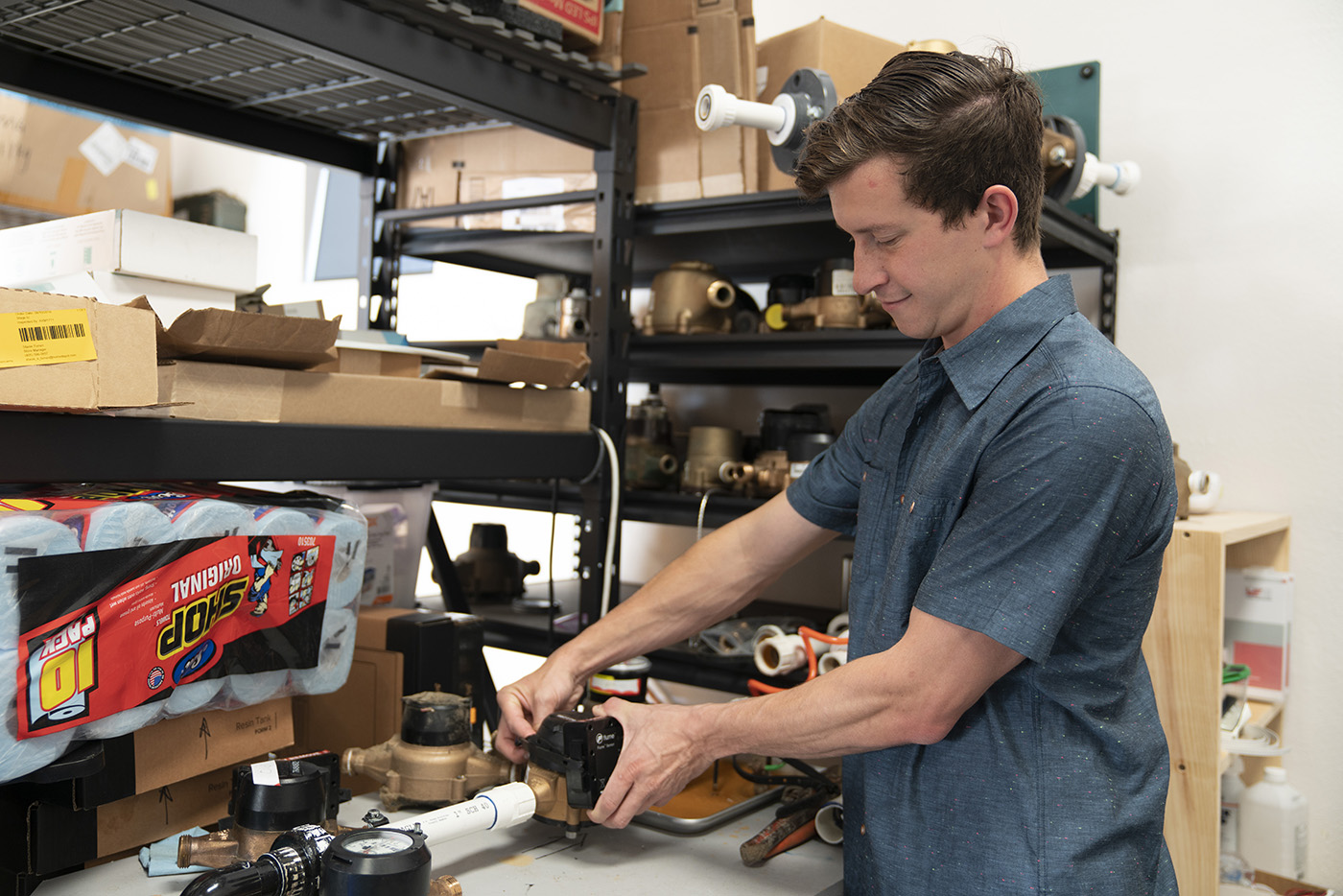
Inside a compatible water meter, a magnetic disc turns as water flows. Flume's battery-powered sensor reads that magnetic field and sends the signal by radio to a bridge inside the home. The bridge passes the data to the cloud; the app shows flow, budgets and unusual patterns. The patent record names Adler, Fazio and Hufford as co-inventors on the apparatus, with grants issued in 2019 and 2020.
The design decision matters. Retrofitting a meter avoids cutting into a pressurized pipe and makes installation accessible to a homeowner. It also gives an old piece of utility infrastructure a digital life without demanding that it be replaced. Flume says the current system works with about 95 percent of U.S. meters and can measure usage down to one-hundredth of a gallon.
What arrives on the phone is less romantic but more useful: the sprinkler schedule, the shower, the dishwasher, the faucet that did not quite close. Water becomes a pattern rather than a utility charge. A leak can appear as an alert while it is still a minor repair. Conservation stops depending entirely on virtue and starts borrowing the more reliable force of curiosity.
When feedback reaches the household
Hardware keeps its own calendar
The founders initially carried three cheerful assumptions: build the product and customers will come; a good idea will make funding easy; the company will be a clear success within five years. Each proposition encountered reality. Flume was creating a category with no familiar analog. Customers needed an explanation before they could want the product. Hardware attracted a small share of venture funding. Development took years before revenue could answer the market-research slides.
Adler tells this part without polishing away the discomfort. There were periods when the company's bank balance was negative and failure looked a week away. There were other periods when cash was available and demand was difficult to meet. He has advised founders to expect long hours, modest pay and a mortgage officer unmoved by the title “startup CEO.” His most durable time estimate is even simpler: everything takes twice as long as expected.
One financing story provides comic relief. Invited to pitch a group of angel investors, Adler thought he was attending something closer to a dinner party. He gave an informal hour of presentation and questions. At the end, a guest asked how much remained in the round. Adler said $500,000. The guest took out a checkbook and wrote the amount on the spot. The group eventually invested more than $1 million. Venture capital rarely behaves like a restaurant tip, but occasionally it brings stationery.
The Adler operating notes
- Choose work that helps someone beyond yourself.
- Create value in the product, the relationship and the business.
- Expect a new category to require education, not merely launch-day attention.
- Check progress against your own goal instead of somebody else's pace.
- Keep room for fun. Long hours are easier among people you like.
From a smaller bill to a smaller claim
Flume's first argument was made to homeowners: see water, spend less and catch leaks. Utilities noticed the same hardware could support conservation programs and reveal anonymized, fixture-level patterns that traditional billing could not. Partnerships helped move sensors into homes. In Los Angeles, a $15 million program announced in 2022 aimed to distribute devices to tens of thousands of customers. Adler reported that participating homes reduced water use by 15 percent on average and saved about $150 a year.
Then the economics widened again. Insurers pay for the damage that follows a leak nobody catches. Flume could offer an early signal and a distribution program, while the policyholder received the device, the water data and fewer unwelcome indoor ponds. Adler began spending more time describing a three-step loop: detect, notify, fix.
“Small shifts in perspective can result in major long-term changes.”Eric Adler
Small leaks are part of the strategy. A toilet flapper may waste water without threatening the house, but resolving it teaches the customer that an alert means something. Trust is rehearsed on a cheap problem. When the dangerous leak comes, the homeowner already knows the choreography. In a 2025 conversation about insurance, Adler said 95 percent of homeowners resolve an issue after receiving a Flume alert.
This is the useful trick in Adler's decade of work. The mission did not need to change when the customer changed. A homeowner wants control. A utility wants lower demand and better planning. An insurer wants fewer and smaller claims. All three can benefit when water becomes visible earlier. The sensor remains attached to the same meter; the value travels to a larger table.
Watch: Eric Adler on early detection and insuranceProfiles in Risk · Episode 712 · 36 minutesA company built around noticing
Adler's environmentalism has never sounded especially ceremonial. He talks about efficient appliances, walking short distances, reducing single-use plastic and making conservation affordable through utility support. The point is action close enough to touch. His preferred problems have a measurement, a piece of hardware and a person who can do something next.
That sensibility also explains the appeal of Flume. Water scarcity is enormous; a running toilet is specific. Infrastructure is political; a meter sensor fits in two hands. Climate language often asks people to imagine a distant future. An alert asks whether they left the hose on.
The three college friends remain with the company and, Adler says, remain friends. That may be the quieter achievement. They began with an engineering assignment and stayed through patents, funding scares, utility procurement, consumer reviews and the strange education of inventing a category. Hardware kept its slow calendar. Water kept moving. The meter, at last, had something to say.