Before there were membranes, there were hoodies. As a teenager in New Delhi, Devesh Bharadwaj sold sweatshirts for high-school graduation. It is an appealingly ordinary opening for a career that would later involve salt gradients, research papers and artificial intelligence. A hoodie has one advantage over an energy-storage system: the customer can try it on.
Years later, the founder and CEO of Pani would face a more complicated version of the same question. Would somebody use what he had built? His early work concerned the physics of water and energy. The company he leads today helps water treatment facilities make decisions using software. Between those two chapters came an education in what customers need, what they can adopt and what an engineer may have to change.
A hoodie, then a harder question
Bharadwaj grew up in New Delhi, where he encountered the resourcefulness often described by the Hindi word jugaad: finding a workable solution with limited means. He moved to Victoria in 2012 to study mechanical engineering at the University of Victoria. The scale of his interests soon outgrew the business of graduation clothing.
During his first year, he became absorbed in identifying the problems that would matter most to society over the coming century. He wanted to make something with broad value, and to bring something distinctive to it. A list compiled by Nobel laureate Richard Smalley helped direct his attention toward energy and water. He spent so much time investigating the question that it competed with his studies.
There is a charming mismatch between the size of that ambition and the position from which he began: an undergraduate choosing a field of work. The question did not come with a job description. It gave him a direction. Engineering supplied a way to start testing answers.
Salt was the first answer
His research involved the relationship between fresh water, salt water and energy. In 2016, he co-authored a paper on multistage pressure-retarded osmosis with Thomas M. Fyles and Henning Struchtrup. It examined how a series of membrane-based stages could recover energy from differences in salinity. This was a technical inquiry into efficiency, with pumps, turbines and membranes in the calculation.
Those relationships extended beyond a paper. Fyles, a chemistry professor emeritus, became Pani’s vice-president of research; Struchtrup, a mechanical engineering professor, served as an advisor. Bharadwaj’s early venture had roots in two disciplines and in a university community prepared to help a student carry research toward a company.
Pani Energy incorporated in March 2017, before he finished his degree. Early work included a way to make desalination more energy efficient and an approach to storing energy through differences in salt concentration. In March 2018, he demonstrated the storage technology at Vancouver’s GLOBE Forum.
The idea was to use available energy to separate salt from water, then recover energy when they mixed again. Unlike pumped hydroelectric storage, the proposal did not depend on having hills. It did require space for tanks. Its practical ambition was expressed with admirable economy: “Our goal is to be cheap and environmentally benign.”
The useful interruption
A prototype can answer a scientific question while leaving a commercial one open. In 2017, Bharadwaj sought support from Canada’s National Research Council Industrial Research Assistance Program. Industrial technology advisor Hong Yu met him at UVic to assess his work. At that point, Pani had neither full-time employees nor sales of its hardware.
Yu reviewed the technology and brought in colleagues to examine its market prospects. Her recommendation was consequential: reduce the scope and move toward a software product. The company’s knowledge of treatment processes could support an approach that was more affordable for customers to adopt.
Bharadwaj took the advice. Pani developed software intended to work with equipment already installed at industrial facilities. Support followed for AI development in 2018 and for pilots in the United States and India in 2019 and 2020. By February 2023, the business had about 40 staff.
The important personal decision sits inside that sequence. An engineer who had invested in a physical invention accepted that his knowledge might be more useful in another form. The work on membranes still mattered. It helped inform a product whose job was to understand a plant, rather than ask its owner to install a new piece of machinery.
The customer has a shift to finish
By April 2023, Bharadwaj was explaining the evolution of Zed, Pani’s software offering, through what the team had learned from treatment facilities. Conversations across more than ten countries had exposed differences in how customers purchased technology, made daily decisions and approached digital tools.
He urged founders to investigate the layers of a customer’s problem. A plant owner might support reducing emissions yet have a more immediate problem to solve. A product had to fit something the customer would pay for and prioritize. Otherwise, even a worthwhile idea could wait indefinitely.
“You have to really dig and peel the layers, and really understand where the pain is.”
Devesh Bharadwaj, 2023
That observation puts a useful limit on the grand language of technology. People who run treatment facilities make decisions under specific conditions. Their priorities determine whether a tool becomes part of the working day. Bharadwaj’s challenge was to translate an environmental ambition into help with those decisions.
Customers included facilities serving food and beverage businesses as well as ethanol and chemical industries. The audience was varied; the requirement was concrete. The software needed to offer useful options for operating costs and emissions in the circumstances of an actual plant.
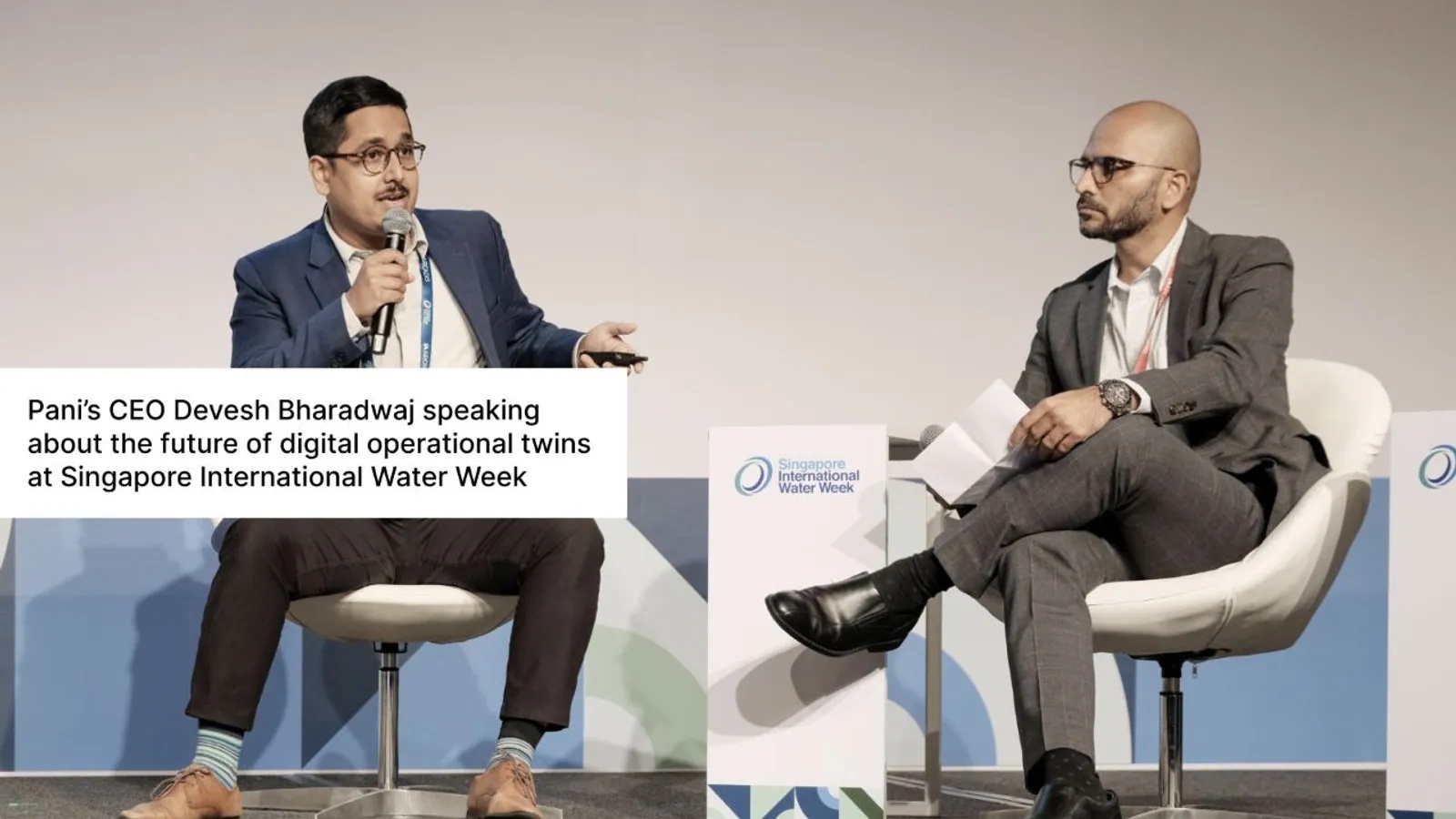
A business assembled with other people
Bharadwaj’s route through university included an entrepreneurship co-op semester devoted to his venture. He received the Coast Capital Entrepreneurship Co-op Award, a $6,000 award for students working on their own startups. Time and modest funding can be particularly useful when an idea has yet to earn its first commercial proof.
In June 2021, he joined fellow UVic founders Victor Nicolov of ANVY Technologies and Juan Orrego of Cuboh to discuss their experience. The conversation covered questioning assumptions, speaking with potential customers and seeking help. All three agreed that early backing and mentorship had mattered to their businesses.
Later that year, Pani announced a CAD $8 million capital raise. It combined a seed equity round co-led by Blue Bear Capital and Blue Coast with participation from Mazarine Ventures and Humanitas, alongside contributions from Sustainable Development Technology Canada and other public agencies.
The money was intended to extend sales, attract distribution partners and expand adoption. The product used existing systems and sensor data to support digital-twin simulations, operational analysis and maintenance forecasting. Financing gave that approach a route into more facilities. It also connected a university-born venture with investors focused on the realities of energy and infrastructure.
By the end of 2022, Pani reported deployments across five continents. New deals included Orange County Water District’s Groundwater Replenishment System, Woodard & Curran and SAWACO. Bharadwaj also presented at BlueTech Forum, where Pani received the Best Go-to-Market Strategy award. Those names mark the expanding circle of organizations around the work.
The next question is still practical
Recognition arrived along with that expansion. Bharadwaj was named to Forbes’ North America 30 Under 30 class of 2022 in Social Impact. That year, UVic gave him an Emerging Alumni Award. Clean50 recognized him as an Emerging Leader for 2023, for work applying machine learning to water treatment efficiency.
There are smaller details that make him easier to picture than an awards list does. Asked in 2017 what he wished he had invented, he chose the light bulb. His explanation was cheerful: “Who wouldn’t want to light up the world?” He named the mathematician Srinivasa Ramanujan as an inspiration and described planning work around its purpose, method and expected lesson.
In a water-innovation discussion published in May 2025, his attention remained on usable improvements. He called for clearer ways for facilities to measure and compare their performance, and for instrumentation that was simpler and cheaper to install. He also emphasized understanding the particular people experiencing an operational problem and building trust through relevant examples.
In that discussion, Pani’s role included preserving the knowledge of experienced operators as they retired. A municipal wastewater example in Washington state illustrated how software could help a new operator learn more quickly. It adds another human dimension to the company’s work. A facility contains knowledge as well as equipment: understanding accumulated through daily decisions, maintenance and the recognition of familiar problems. Making some of that experience easier to share is a practical use for a digital tool. It keeps the conversation close to the people who must interpret the information and decide what happens next.
These are specific requests from someone whose career began with a very large question. Better measurements help identify where improvement is possible. Easier instrumentation makes it less burdensome to obtain the information. Both concern the distance between knowing that a problem exists and giving somebody a workable next step.
Pani now describes a business built around plants that already stand, using the instrumentation they already have. It reports more than 200 plant deployments in over ten countries. Its technical approach has changed since Bharadwaj’s undergraduate days; the concern with affordable resource efficiency remains.
The hoodie could be tried on. A membrane could be tested. Software has to earn a place in the control room. Bharadwaj’s story follows the work between those forms of proof, and the people who helped him move from one to another. The next useful answer will still have to fit.