The least glamorous thing in a reverse-osmosis plant may be the most expensive: the grime. Salts crystallize. Bacteria settle in. Organic matter and tiny particles collect on a membrane's surface. Water production slows, pressure climbs, and eventually somebody stops the system to wash the element with chemicals. Then it all begins again.
Pure Blue Tech has spent more than a decade attacking that maintenance loop. The Bellingham, Washington company makes reverse-osmosis and nanofiltration elements with thin ultrasonic components integrated close to the membrane. Think less sonic toothbrush, more precisely placed microvibration. The energy is meant to interrupt fouling, scaling and concentration polarization before buildup hardens into an operating problem.
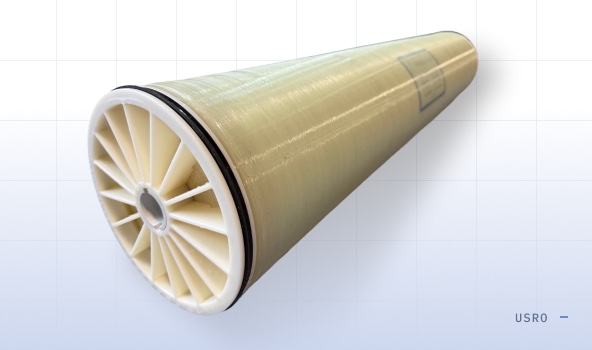
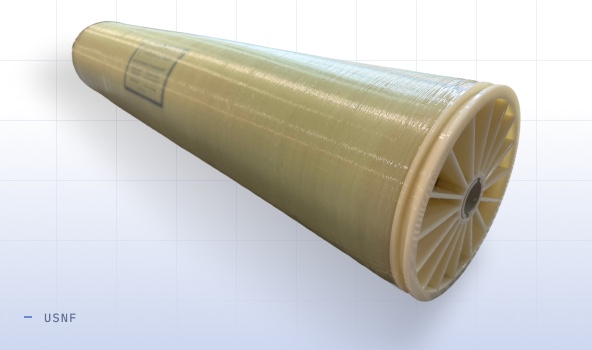
The company is not selling an exotic new plant. Its current USRO and USNF elements come in the familiar four-inch and eight-inch formats used in standard pressure vessels. Pull out the conventional element, put in the ultrasonic one, and leave the expensive steel plumbing where it is. For a municipal utility or factory manager, that compatibility may matter as much as the underlying patent.
The enemy has a cleaning scheduleA maintenance bill disguised as a science problem
Reverse osmosis works by forcing water through a selective membrane. Water passes; much of the salt and other material does not. The separation is elegant. The operating environment is not. Rejected material becomes concentrated along the surface, and every feed stream brings its own unpleasant personality - silica, microbes, dairy proteins, river sediment or industrial residue.
Plants manage the mess with pretreatment, chemical dosing, higher pressure and clean-in-place cycles. Each response carries a cost. Pumps consume more energy. Cleaning consumes chemicals and water. Shutdowns sacrifice production. Harsh treatment can shorten membrane life. Pure Blue Tech's pitch is therefore not really “buy ultrasound.” It is “buy fewer interruptions.”
In a demonstration at the U.S. Bureau of Reclamation's Water Quality Improvement Center in Yuma, Arizona, the company ran an element on Colorado River water for roughly two months. Pure Blue Tech reports a 51 percent weighted-average advantage in fouling rate, with some element segments reaching 76 percent. Its website translates that performance into two to four times longer between cleanings. Those are company-reported field results, not a universal guarantee: feedwater, recovery, pressure and plant practice all change the outcome.
Product evolutionThe first answer was grooves. The sharper answer was sound.
Pure Blue Tech began in 2013 with co-founders Ryan Vogel and Adam Greenberg, then recent University of Washington graduates. Their early work centered on physically engineered membrane surfaces. The PureMembrane concept used nanoimprinted grooves to increase turbulence and create more usable surface area. It won the university's business-plan competition and a $25,000 prize - useful money, though hardly enough to industrialize a membrane line.
The public product story later broadened to PureSound, an ultrasonic fouling-prevention system offered for plants from 10,000 gallons to 10 million gallons per day. By 2021, the development path had become more specific: embed thin, flexible polyvinylidene fluoride transducers inside membrane equipment, close enough to the surface to reduce energy losses and complexity.
That approach answered a problem that had dogged earlier ultrasonic experiments. Thick ceramic transducers mounted farther from the membrane needed high-powered drivers, and much of their useful energy attenuated before reaching the trouble spot. Pure Blue Tech's EPA project placed flexible PVDF components closer to the action. In Phase I, a benchtop cross-flow cell established the concept. Phase II moved toward commercial-scale spiral-wound reverse-osmosis and hollow-fiber ultrafiltration prototypes.
“Clean water is the backbone of every industry in the world - it's the backbone of life.”Ryan Vogel, co-founder and CEO
This looks less like a sudden change of mind than a decade of product narrowing. The company kept the same problem - membrane fouling - while shifting its commercial center from patterned surfaces and external systems to ultrasound integrated in the replacement element. That made the proposition easier to describe, test and install.
The businessSell the element; prove it in the maintenance log
USRO covers brackish water, seawater, high-rejection and lower-energy applications. USNF handles selective separations at lower pressures for process and reuse streams. Pure Blue Tech manufactures, rolls, tests and ships the elements from Bellingham using membrane components from established suppliers. It makes its margin on physical products sold directly to end users and through commercial channels.
The customer list is broad by application but narrow by job title: the people responsible for keeping water moving. That includes municipal reuse and desalination operators, plus industrial teams in food and beverage, semiconductor fabrication, boiler feed, cooling-tower makeup and wastewater recovery. The company says a Fortune 500 food-and-beverage processor, a Fortune 100 chipmaker and a large desalination plant have purchased its products, though it does not name them publicly.
The buying calculation is wonderfully unromantic. Count current cleanings. Add chemicals, labor, lost production, disposal and membrane replacement. Measure how pressure rises between cleanings. Then compare those costs with the premium and control requirements for ultrasonic elements. The federal SBIR description suggested that some wastewater installations could see payback in about a year. A plant with easy feedwater, cheap cleaning or infrequent fouling may see much less benefit.
Capital and concreteFrom grants to a factory with a serious rent bill
Water hardware absorbs time and money before it produces repeatable revenue. Pure Blue Tech's capital trail shows the sequence. The EPA awarded $100,000 for Phase I and $500,000 for Phase II. The agency later highlighted a $1 million private round led by Rockies Venture Club. CB Insights reported a $220,000 convertible note in August 2025 led by Robin Hood Ventures. Valuation and revenue remain private.
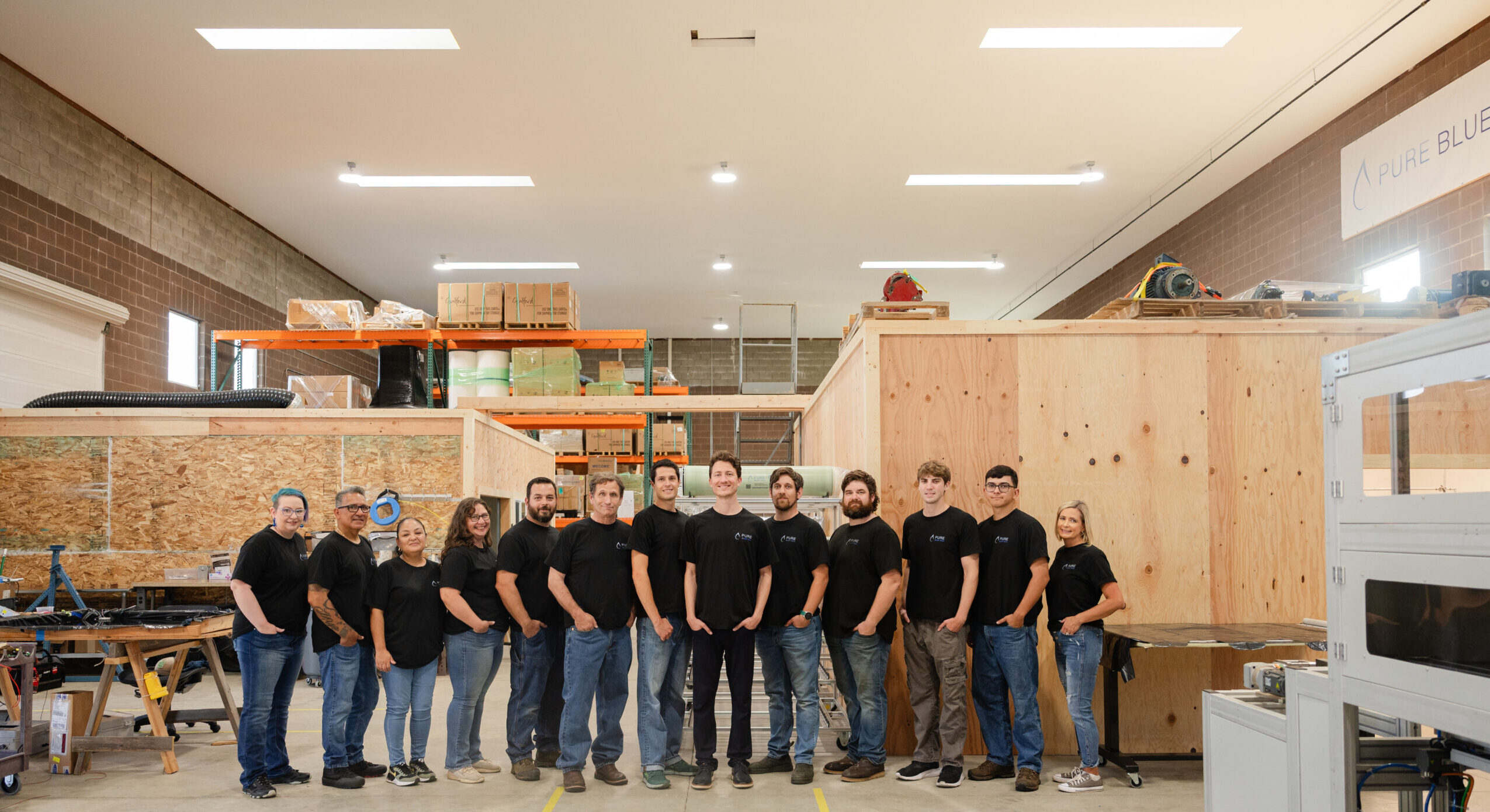
The more revealing commitment may be real estate. In October 2025, Port of Bellingham records described a planned move from an 8,000-square-foot facility to 48,000 square feet at 800 Cornwall Avenue. The seven-year sublease was scheduled to begin in December. Listed monthly rent started above $41,000, with an unusual block of free months early in the term. Port officials said the company then employed 15 people and that the building could accommodate 50 to 75.
A lease is not revenue, and capacity is not demand. But a sixfold increase in floor area is the sort of operational wager that separates membrane manufacturing from a licensing deck. Rolls must be handled, elements assembled, seals checked and output tested. The science has to survive repetition.
Market positionSmall company, large incumbents, deliberately boring form factor
Pure Blue Tech competes alongside membrane suppliers with global factories and entrenched sales channels: DuPont FilmTec, Toray, Hydranautics, LG Water Solutions and others. It also competes with every workaround a plant already understands - more pretreatment, different chemistry, earlier cleanings and conventional low-fouling membranes.
Its difference is active defense. Surface coatings and feed spacers are passive; ultrasound adds energy to disrupt several fouling mechanisms while the element operates. The company argues that one platform can address organic, biological, particulate and mineral buildup rather than one mechanism at a time. The tradeoff is added components and controls inside a product class valued for predictability. Reliability, power use and service life must hold up at scale.
The team is designed to reassure skeptical buyers. Company materials claim more than 250 combined years in the membrane industry. Randy Truby held leadership posts at Toray and Hydranautics. David Paulson led membrane R&D at Osmonics before its acquisition by GE. Jeff Frank brings decades in acoustic engineering. Production director Marcos Mendoza worked across NanoH2O, Hydranautics and Toray. This is a young company staffed with people who remember old membrane mistakes.
The clever bit is not merely making a membrane vibrate. It is making the vibration arrive in a part the customer already knows how to replace.
What comes nextThe seawater test is harder than the river-water story
In 2026, Pure Blue Tech advanced as one of 17 semifinalists in the Novel Materials and Methods track of the $119 million XPRIZE Water Scarcity competition. The next commercial argument is desalination at meaningful scale. Seawater brings high pressure, aggressive chemistry and unforgiving uptime expectations. A technology that performs on Colorado River water still has to establish durability and economics across very different feeds.
Conditions matter. Ultrasound will not rescue a poorly designed plant, a torn membrane or operation beyond chemical and pressure limits. A site with little fouling has little avoided cost. Nor does a drop-in diameter guarantee a drop-in electrical and controls integration. Buyers should demand long tests against a matched conventional train and insist that salt rejection, not only flux, stays within specification.
Still, Pure Blue Tech has chosen a valuable design constraint: give the customer a new capability in a familiar package. The path from nano-grooves to flexible transducers, from a $25,000 student prize to federal field work, and from a small shop to a planned factory has been slow in the way physical infrastructure is slow. Vogel once described the company as building “brick by brick.” For a membrane maker, roll by roll may be closer.