Oil and water are supposed to keep their distance. Anurag Bajpayee found a useful exception. Certain oils could take in a little water while leaving salt behind. Change the temperature, and the water could come back out. A familiar kitchen rule had acquired an engineering footnote. For a doctoral researcher interested in desalination, that footnote was worth following.
During his MIT qualifying exam in 2009, a discussion of soybean oil led to a question about removing impurities from water. The conversation eventually produced a patent application. Most candidates would be pleased to leave such an exam with permission to continue. Bajpayee left with a new direction to investigate.
The discovery became directional solvent extraction, the subject of his doctoral research. By 2012, it had attracted recognition among Scientific American’s ten world-changing ideas. Here was a promising opening for a young engineer: an unusual process, a pressing industrial problem, and public attention before the business had properly begun.
Then came the consequential choice. Bajpayee understood that his own desalination technique was still a long way from commercial viability. He helped build a company that could collect and develop several technologies, with different answers for different kinds of water. Gradiant’s first commercial process came from the research of his co-founder, Prakash Govindan. The inventor was willing to give another invention the first turn.
A good idea has to survive the customer
Bajpayee had graduated from the University of Missouri in 2006 with a mechanical engineering degree, summa cum laude. At MIT, he completed a master’s in 2008 and a PhD in 2012, with a minor in management. His research in Professor Gang Chen’s group brought him into a field where heat, materials and molecular behavior could change the economics of separating water from salt.
The early solvent work explored a membrane-free route to desalination. Some solvents absorb more water when heated, while contaminants remain behind; cooling releases the separated water. The research team included Tengfei Luo, Andrew Muto and Chen. Their 2011 paper described very low temperature desalination using directional solvent extraction. The appeal was a different way to perform a difficult separation.
Govindan worked in the same heat-transfer laboratory under Professor John Lienhard. His research pursued humidification and dehumidification, a process that borrowed from evaporation and rainfall. The two approaches were distinct. That distinction matters to Bajpayee’s story: the business grew from a shared interest in difficult water, rather than an obligation to sell only his own thesis.
The pair approached industrial customers while developing their work. The MIT Deshpande Center helped connect them with investors and reduce the risks of moving technology toward commercial use. Those conversations let the outside world into the design process early. Water samples, costs and operating requirements could interrupt an elegant argument. It was a useful kind of interruption.
By the time the company was ready, there were customers interested in using its technology. Gradiant marks April 1, 2013 as its founding day. The founders were learning a discipline that would recur throughout the business: start with the water the customer actually has, then work toward the water the customer actually needs.
“Because if you don’t want drinking quality water, then why pay for it?”Anurag Bajpayee, on fit-for-purpose treatment
Rain, with a purchase order
The first commercial technology, Carrier Gas Extraction, made an industrial version of the rain cycle. Warm contaminated water meets air in a humidifier. The air carries away water vapor, leaving a concentrated brine behind. In a cooler bubble-column dehumidifier, that moisture is recovered as clean water. The equipment compresses a natural process into a plant that can sit near an industrial operation.
The initial market was oil and gas wastewater. In the Permian Basin of Texas, Gradiant built two plants with capacities of 12,000 barrels a day each. By 2015, two drilling clients were treating about 10,000 barrels daily at those plants. Reusing water meant buying less fresh supply and disposing of less wastewater. The calculation had an environmental consequence and a place on the customer’s ledger.
Some customers then offered a wonderfully inconvenient piece of feedback. The clean water was useful, but their work did not always require that degree of purity. Could Gradiant deliver a cheaper result by removing only certain contaminants? The engineers went back to the laboratory and developed Selective Chemical Extraction. An industrial process need not dress for a dinner it has never been invited to.
This became a recurring principle in Bajpayee’s account of the company. Quality has to be defined by the application. The water required for a manufacturing step can differ sharply from the water suitable for another use. An extra treatment step costs money and energy. Leaving out a necessary one creates a different problem. The engineer’s task is to find the right degree of intervention.
The useful thing about a quiver
By 2019, Bajpayee had been named to MIT Technology Review’s global Innovators Under 35 list. Gradiant had more than 200 employees and operated more than 20 treatment plants around the world. His profile described the deliberate move beyond a business tied to a single invention. A company carrying several tools had more ways to respond when the next water sample arrived.
The semiconductor industry made that flexibility particularly valuable. Chip fabrication demands ultrapure water, while its wastewater presents another set of treatment requirements. These factories need help at both ends of the process. Bajpayee’s company could work on preparing water for manufacturing and on recovering it afterward, keeping more of the same resource in circulation.
By late 2022, Gradiant had built 450 water and wastewater treatment plants and grown beyond 500 employees. Its customers included Micron, GlobalFoundries, Intel and TSMC, alongside businesses such as Coca-Cola and AB InBev. The company had added brine-concentration and selective-treatment capabilities. Bajpayee described its portfolio as a quiver: technologies chosen for the particular problem in front of the team.
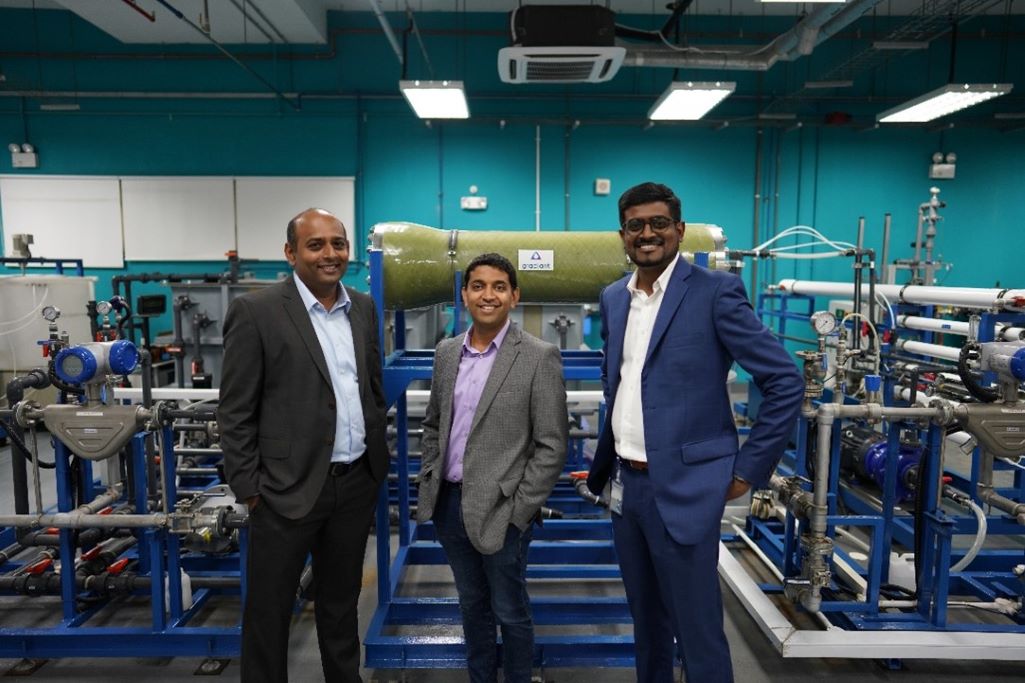
The photograph captures an appropriate setting for this stage of his career. Bajpayee stands between Govindan and Gradiant president Govind Alagappan, surrounded by equipment. There is room for a suit among the pipes. There is also a reminder that the company’s product has to keep working after everyone has finished posing.
His role expanded with the business. A researcher can concentrate on whether a process works. A chief executive has to consider whether it can be delivered, supported and repeated across customers and countries. The customer is buying relief from an operating problem. That makes the relationship longer than the moment a piece of equipment is installed.
The numbers grew; the water stayed particular
In May 2023, Gradiant announced a $225 million first close of its Series D financing at a $1 billion valuation. BoltRock Holdings and Centaurus Capital led the round. The money was intended to support research and expansion, including Europe and the Middle East. By the end of that year, the company reported more than $200 million in sales and more than $500 million in contract backlog.
Expansion also came through acquisitions. Gradiant bought H+E Group, a European water solutions provider with more than a century of experience. It launched Turing, its digital and AI technology business. The combination placed new technology alongside existing engineering experience and delivery capacity. Growing a water business requires people who can make an installation work in its particular place.
In a 2024 conversation with Julia Chatterley, Bajpayee explained how that thinking had carried Gradiant into lithium processing. Concentrating a lithium-bearing brine removes water and makes the material left behind more valuable. The company developed an approach combining extraction, concentration and conversion. Water treatment had opened a route toward recovering something else from the stream.
The connection is instructive. A wastewater stream contains a history of the operation that produced it. Its contents can be an expense to manage or a resource worth recovering. Bajpayee’s work asks engineers and customers to examine both possibilities. That does not make every residue valuable. It makes the composition of the water a question worth asking before it leaves the site.
A different chair, the same partner
On Gradiant’s thirteenth founding anniversary in April 2026, Bajpayee announced his move from CEO to executive chairman. Govindan would take over as CEO. Bajpayee said he would continue working full time with the leadership team while concentrating on long-term strategy, financing and partnerships. The announcement kept the two founders side by side, with their responsibilities rearranged.
A month later, Gradiant announced Series E financing at a $2 billion valuation. Safar Partners and Hostplus led the investment, with participation from ClearVision Ventures and others. The stated priorities included acquisitions, research, operational scale and preparation for a possible public offering. IPO readiness is a preparation, rather than a completed listing. The work described was still about building capacity.
His public writing now addresses the relationship between water and energy. In an April 2026 essay, he argued that industrial operators should manage them together: moving and treating water consumes energy, while cooling and power systems depend on water. Poor decisions in one system can raise costs in the other. The argument takes conservation into the everyday work of designing and operating a facility.
The growing attention to AI infrastructure gives that argument another audience. Behind chips and data centers are physical demands that a digital interface makes easy to overlook. Bajpayee’s career has stayed close to those demands. A chemical surprise led to research; research led to industrial conversations; those conversations helped determine what the company should build.
The distinctive decision remains the early one. He had an invention with his name attached to it and recognition around it. He chose to pursue a wider set of solutions with a partner whose work could reach the market sooner. For someone making a career in water, it was a practical beginning: let the problem decide which tool gets used. Then see how much water can make another trip.