— A YesPress Profile —
The Sprinkler That Reads Your Lawn
Somewhere in Edina, Minnesota, a sprinkler head is rehearsing your yard.
Scene: 6:14 a.m., a Tuesday in June
The lawn doesn't know it's being watched, but it is. A small chrome cylinder, no taller than a coffee mug, has lifted itself out of the dirt and is rotating with the unhurried competence of a maitre d'. It pauses at exactly 38 degrees, exhales a fine arc of water across a strip of fescue, and rotates again. The driveway, three feet to its left, stays bone dry. The mailman's shoes, four feet to its right, do too. The grass gets watered. Nothing else does. This is the entire pitch, and somehow it has taken the irrigation industry forty years to consider it.
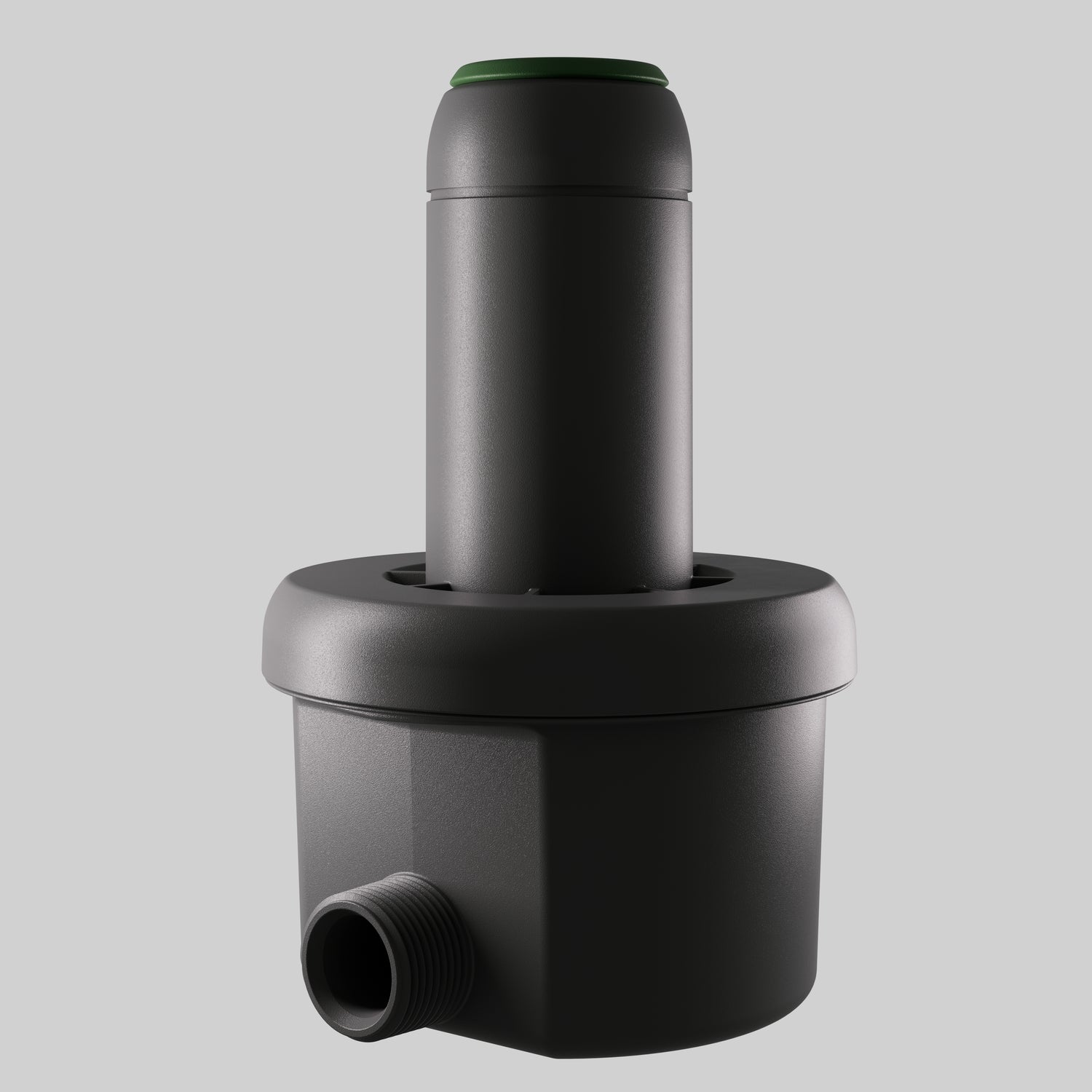
The cylinder is an Irrigreen Smart Sprinkler 3. It is doing something that, in the long history of the lawn, has never quite been done before: it is following a map. Not a mental map, not a "spray everything and hope" map. A real one. Drawn by the homeowner, in an app, with a fingertip. Every blade of grass on one side of the line; nothing on the other. The head obeys.
A printer for water
The reason any of this works is because the co-founder used to design inkjet printers. Gary Klinefelter spent decades making machines that could fling tiny, perfectly-aimed droplets at a piece of paper. Thirty-five patents in. One day he noticed his neighbor's sprinkler painting the sidewalk and thought: what is the matter with us. The same principle that lets a printer put a magenta dot on a photo, with sub-millimeter precision, ought to work for water. Just bigger droplets. Bigger paper. Same idea.
He started prototyping. Then he met Shane Dyer, a serial founder on his third act, and the project acquired a CEO and a roadmap. By 2021, the first commercially viable Irrigreen system shipped. By 2025, the company had eight patents of its own, a $19 million Series A, and a controller on the way to American assembly lines.
The math nobody wants to talk about
Outdoor watering is responsible for nearly half of all residential water use in many American cities. Half. Of the water you drink, bathe in, brush your teeth with, cook with, run through your dishwasher — half its volume, in many neighborhoods, is being thrown at lawns. A meaningful chunk of that volume lands on concrete. Or evaporates before it hits the soil. Or runs into a gutter on its way to the sea.
Irrigreen's bet is that this is not a behavior problem. It's an equipment problem. Conventional sprinklers fire fixed arcs at fixed radii because they are little more than nozzle, gear, and spring. They cannot read a property line. They cannot tell when it has just rained. They cannot draw a kidney-shaped flowerbed around a birch tree. They water the way a fire hose waters: indiscriminately, generously, and with a certain amount of pride.
An Irrigreen head does not. It is a small robot. It rotates. It pauses. It varies the spray distance — from a few feet to thirty — by modulating water pressure through a digital valve, the way an inkjet modulates a droplet. A single Irrigreen head, the company claims, can do the work of roughly six conventional sprinklers. That means fewer heads. Fewer trenches. Fewer broken pipes when the landscaper rents the wrong machine. And, on the customer's monthly bill, roughly 50% less water moved through the meter for the same green yard.
The Series A, briefly
In April 2025, Irrigreen closed a $19 million Series A led by Natural Ventures, with Burnt Island Ventures, Ulu Ventures, MFV Partners, Tamiami, and Sum Ventures along for the ride. That brought total funding to roughly $34 million. The money is, conspicuously, not going into a marketing blitz. It is going into reshoring manufacturing to the United States — a slightly unfashionable choice for a hardware startup, until you remember that shipping precision metal parts halfway around the world is itself a water-intensive activity.
The same year, the company shipped Irrigreen 3.0: a redesigned Smart Sprinkler 3, a new Smart Controller 3 (the controller went on to win the 2025 Green GOOD DESIGN Sustainability Award), and a Smart Drip system for garden beds. The app got smarter about weather. The zone editor got smarter about shape.
Why this is interesting beyond the lawn
Most climate hardware exists in tension with the customer it serves. Solar panels demand a roof. EVs demand a charger. Heat pumps demand an electrician. Irrigreen, by contrast, asks for something the homeowner was going to install anyway: a sprinkler system. The water savings are a side effect of a product that simply works better than what came before it. Which is, historically, how technologies actually scale.
The unit economics also happen to be friendly. Outdoor water bills in drought-affected zip codes can run into the four figures per season. A system that halves that bill is, in a literal sense, paying for itself. Climate VCs noticed. Hardware VCs noticed. Landscape pros — who hate burying twice as many heads as they need — noticed.
The thing about pride
Lawns are, fundamentally, an aesthetic argument. People want them. People are not going to stop wanting them. The interesting environmental questions are not whether to have lawns but how to have them with less waste. Irrigreen's answer is engineering, not guilt. Plant whatever you want, water whatever you want, just stop spraying the driveway. The grass, it turns out, was paying attention all along.
Scene: 6:14 a.m., revisited
The chrome cylinder rotates once more, finishes its line, and lowers back into the dirt. The fescue glistens. The driveway is dry. The mailman's shoes are dry. Somewhere in Edina, a small server logs the morning's water: less than yesterday, exactly enough for today, calibrated to the weather coming tomorrow. The lawn does not know it is being watched. But it is, and finally, by something that can see it.