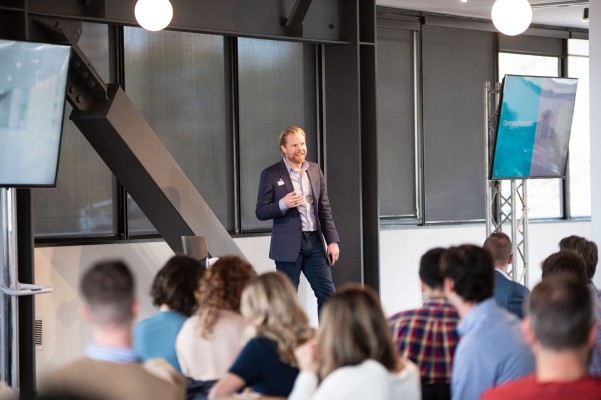
Grant Morgan stood in front of a room full of people who usually lived inside separate rectangles. It was April 2022, and R-Zero had brought its distributed team together in Salt Lake City. More than 100 employees had travelled from nearly a dozen countries. For a company built around working remotely, the gathering was a fairly substantial exercise in being somewhere.
Morgan called those two days his favourite in the company’s history. This is an interesting choice for a founder whose first product had gone from design to manufacture in five months. The milestone he singled out was a room full of colleagues. Shipping a machine had required one kind of coordination. Helping a growing company understand itself required another.
His career offers a useful way to look at that change. Morgan is an engineer who became a product leader, a co-founder who became a chief executive, and, more recently, a partner in a venture studio. At each step the job has acquired more people. The question running through it is practical: how much should he personally do, and how much should he help other people do?
A degree with things attached
Morgan studied mechanical engineering at California Polytechnic State University in San Luis Obispo. He worked as an engineer at Abbott before moving into the technology business. Later he led product and engineering at iCracked, the device repair startup acquired by Allstate in 2019. His experience crossed hardware and software, an increasingly useful combination whenever a physical object has acquired an internet connection and a password.
There is something revealing about the repair business as an entry point. A broken phone is a problem with an impatient owner attached. The owner cares about the result, the time and the bill. Whatever ingenuity happens behind the counter has to survive that encounter. It is a useful setting in which to think about product development: the solution eventually has to fit into somebody else’s day.
Morgan’s public discussions of experimentation have the same practical emphasis. He talks about admitting mistakes, identifying their causes and trying again. That sounds pleasantly uncomplicated until an organisation has to practise it. A failed test is easy to welcome in a speech. It is harder to welcome when the test was your idea and several people remember how confidently you introduced it.
He has described the value of making small, measurable bets before committing substantial resources. The appeal of that approach is its economy. A young company can buy information through a limited experiment. Spending more money before learning more simply produces a more expensive question.
Three people around a whiteboard
R-Zero began in 2020 with Morgan, Eli Harris and Ben Boyer. Morgan remembers Boyer calling with the idea that became the company. Within days, the three were working through it at a whiteboard in Boyer’s office. Their backgrounds gave them different ways into the same discussion: engineering and product development, company building, and venture investment.
A whiteboard is an excellent place for a new business to begin. It accommodates ambition, erases objections and has no purchasing department. The challenge arrives when its tidy arrows have to become components, instructions and deliveries. R-Zero’s first product, Arc, was a connected, mobile UV-C device. Whatever the founders could explain on the board, they still needed to manufacture an object.
They worked with HAX, the hardware programme backed by SOSV. Morgan later described how its team visited manufacturers, inspected early parts, helped negotiate and contributed engineering work when the founders could not visit suppliers themselves. It is a less glamorous account of startup assistance than a cheque and a congratulatory photograph. It also explains more.
From design and development to manufacture of Arc, according to Morgan’s account of the HAX collaboration.
The product took five months to design, develop and manufacture. That is the kind of number which can make a company’s early history look inevitable in retrospect. Morgan’s account points toward a more interesting explanation: a network of people doing work in places the founders could not reach. Speed came with assistance.
Once the team had a prototype, they took it to a hotel for feedback from housekeeping staff. For all the talk of advanced technology, this was a deliberately ordinary test. Would the people expected to use the machine see a place for it in their work? Their response helped shape the product roadmap. A prototype had become a conversation.
The building gets a memory
In July 2021, R-Zero acquired CoWorkr, a company making space utilisation sensors. The transaction added a new dimension to the business: information about how rooms were actually being used. CoWorkr’s technology collected occupancy data without identifying individual workers. That detail matters in an office, where a useful measurement can quickly become an unwelcome feeling of being watched.
The acquisition shows Morgan and his colleagues thinking beyond a single piece of equipment. A building contains activity as well as square footage. People assemble, disperse and leave spaces empty. A system that can register those patterns gives its operators a different picture from the one supplied by a floor plan.
This is where the hardware and software halves of Morgan’s career meet. A device can perform a task. A connected device can also report what happened. Sensors can add context. None of these additions guarantees a good business, but they change the questions a product team can ask. The room becomes something measurable rather than merely somewhere the equipment goes.
A company too large for one head
Growth brought a different engineering problem. Morgan has spoken about the point at which a founder can no longer keep track of everything in the business. In a small team, remembering who is doing what is manageable. Add enough people and the founder’s head becomes an increasingly unreliable filing system, with an unfortunate tendency to attend meetings.
His response was to put more emphasis on direction, shared principles and decisions made close to the work. The attraction is obvious. People who have the relevant information should be able to act on it. The difficult part is giving them enough context to make decisions that fit together without requiring a procession of permissions.
This creates a demanding version of autonomy. A colleague has to judge what matters, decide without perfect information and accept responsibility for the result. A founder has to tolerate decisions made without his presence. There is a quiet loss of status involved in building an organisation which no longer needs you in every conversation.
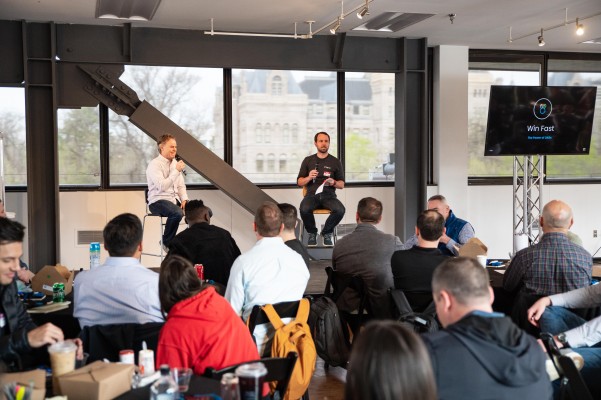
The summit made some of that work visible. Sessions addressed objectives and key results, decision making and communication. The Second City took part in workshops. A comedy organisation is an agreeable addition to a company meeting: it at least introduces the possibility that someone will acknowledge the absurdity of what everyone else is taking seriously.
R-Zero also presented its first Full Spectrum Awards, recognising colleagues for contributions to the company’s culture. Morgan’s reflections on the event lingered on people greeting each other, working together and celebrating. Those are modest details compared with a funding announcement. They are also the details through which a company becomes more than a collection of employment contracts.
“There’s no substitute for meeting in-person.”
Grant Morgan, reflecting on R-Zero’s first team summit
His support for remote work was explicit. He argued that capable people would not all live in one place, so the company should recruit accordingly. The gathering did not abandon that decision. It supplied something distance made harder to arrange: a shared experience that colleagues could carry back to separate locations.
Another start, with a familiar partner
R-Zero announced Jennifer Nuckles as its next chief executive in October 2022, with her appointment effective October 10. Morgan’s place in the company’s history is as a co-founder and former CEO. That distinction keeps the story honest. Founding a company and running its later chapters are separate jobs, even when they once appeared on the same business card.
In 2024 he and Harris launched One Dream Ventures. Their announcement described a climate technology venture studio intended to build businesses supporting the energy transition. They introduced Shaw McKean as their first entrepreneur in residence, with Zohar Ziv and Jonathan Gartner as advisers. The practical concerns were familiar: test ideas, reduce uncertainty and reach customers.
The studio’s current description is more specific: building enterprise software and AI startups for the global real estate and construction industries. It is an area in which software has to negotiate with physical circumstances. A construction project cannot be rearranged as casually as a presentation. An office has bills, equipment and occupants. The digital product must earn its place among them.
In an October 2024 podcast appearance, Morgan discussed opportunities in the energy transition and technology deployment serving energy users and utilities. The subject extends the interest in buildings that ran through R-Zero. It also changes his position in the process. A studio creates a setting in which other founders can develop businesses, drawing on experience they have not yet had time to acquire.
On the other side of the pitch
By May 2026, Morgan was sitting on the judging panel at UC Santa Barbara’s New Venture Competition. The winning team, LegalTime AI, was developing timekeeping software for law firms. Its founders had spoken with more than 80 firms during their research. The finals included pitches, judge feedback and questions from the audience.
That is a fitting place to leave him for now. The engineer who helped take a prototype into a hotel was listening to students describe what they had learned from prospective customers. Different product, familiar discipline. Someone must ask the people who will eventually have to use the thing.
There is an appealing continuity here without the need to turn a career into a fable. Morgan has built products, led a company and returned to the beginning through a venture studio. Along the way, he has discussed uncertainty with rather more interest than certainty. A good idea still has to meet a supplier, a colleague and a customer. Each is entitled to complicate it.
The photograph from Salt Lake City shows him addressing a room, with colleagues listening in the foreground. It captures a brief, visible part of leadership. Much of the rest happens afterwards, when those people leave the room and decide what to do. Building a company includes building the conditions for that moment. Then the founder has to let it happen.
Keep following the work
Company updates, public conversations and Morgan’s own posts.