In 2014, California was in the worst stretch of a five-year drought. Cities rationed water, neighbors reported neighbors for watering lawns, and everyone was told to use less. The problem was that almost nobody could answer a basic question: less than what? The water bill arrived every other month, a single number with no story attached. There was no gauge, no dashboard, no feedback loop at all.
Three engineering students at California Polytechnic State University in San Luis Obispo looked at that gap and treated it as a senior project. Eric Adler handled the mechanical side, James Fazio the software, Jeff Hufford the electronics. Their insight was almost annoyingly simple: every home already has a precise water meter sitting in a box by the curb. Nobody needed a new meter. They needed a way to read the one that was already there and put it in a pocket.
That project became Flume, incorporated in 2015. A decade later the company has shipped more than 200,000 self-installed sensors, works with 100+ water utilities, and has convinced one of the world's largest reinsurers that a rubber-banded gadget is a serious tool for cutting insurance claims.
01 / THE DEVICERead the meter, don't touch the pipe
The whole Flume system is a sensor, a bridge, and an app. The sensor is a battery-powered puck that straps to the outside of your existing water meter with a strap - no tools, no plumber, no cutting into a pipe. It reads the tiny magnetic spin inside the meter as water passes through. The bridge plugs into a wall outlet and forwards that data over Wi-Fi. Most people finish the install in about ten minutes.
This is the design decision the entire company rests on. Competitors like Flo by Moen and Phyn cut into your plumbing to install an in-line valve. That gives them a superpower Flume lacks - they can automatically shut off the water - but it also means a plumber, a permit conversation, and a much higher barrier to getting the thing on the wall. Flume traded the shutoff valve for an install that a renter could do on a Saturday. In a market where the hardest step is getting the device deployed at all, that trade has aged well.
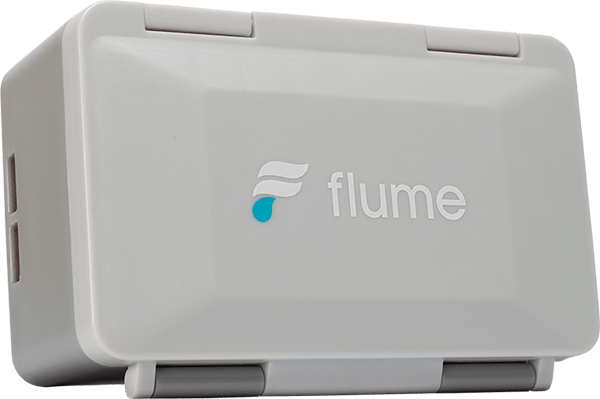
Strap on the sensor
The puck clips to your existing meter and reads the magnetic dial. No plumbing.
Plug in the bridge
It relays minute-by-minute flow from the yard to your home Wi-Fi.
Watch on the app
Machine learning sorts flow into showers, toilets, irrigation - and flags leaks.
02 / THE PRODUCTTurning a spinning dial into "your toilet is running"
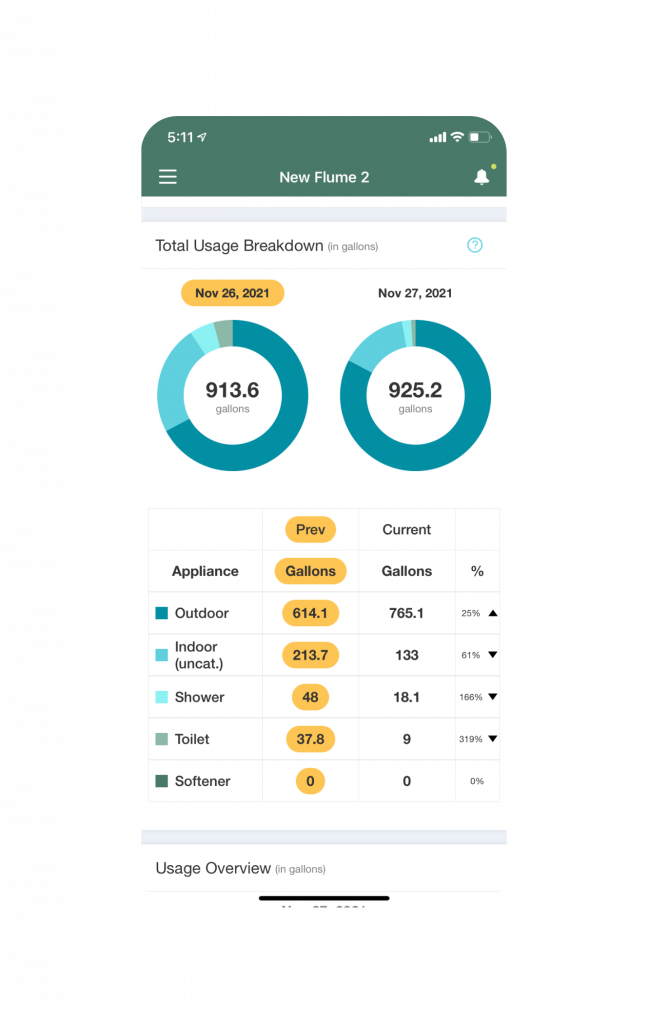
Raw flow data is not that useful on its own. The interesting part is what Flume does with it. The app shows water use minute by minute, breaks it down by fixture type - shower, toilet, dishwasher, sprinklers - and lets you set a budget and get nudged when you blow past it. When the software sees a pattern that looks wrong, like a steady trickle at 3am that never stops, it sends a push notification.
That last feature is quietly the killer one. More than 70% of users get a leak alert within the first month, and roughly one in ten homes turns out to be wasting more than 90 gallons a day - usually a running toilet or a failed irrigation valve nobody ever noticed. The company's founding quote, borrowed from W. Edwards Deming, is stenciled on the whole product: you can't manage what you don't measure.
03 / THE BUSINESSOne sensor, three customers
Flume's most interesting trick is not the hardware. It is that the same little puck sells to three completely different buyers. Homeowners pay about $249 for the device, no subscription. Water utilities license an analytics platform - "Flume for Utilities" - that turns consented, aggregated household data into real-time demand insight, and they often subsidize or give away the device through rebate programs to get it. And insurers, who bleed billions to burst-pipe claims, pay to refer the leak-detection service to their policyholders.
Direct to homeowner
~$249 device sold on flumewater.com, Amazon, and retail. No subscription.
Water utilities
SaaS demand analytics + rebate programs that put devices on meters. 100+ agencies.
Insurers
Referral deals with HSB, Amica and Mercury to cut water-damage claims.
The insurance angle is the newest and maybe the largest. Non-weather water damage - the slow leaks, the failed supply lines - runs to more than $8 billion in U.S. claims a year. In March 2025, HSB, the specialty insurer owned by Munich Re, agreed to refer Flume's flow-based Home Water Protection Service to its network of carriers. For an insurer, a $249 sensor that catches a leak on day two is dramatically cheaper than a flooded kitchen on day thirty.
Illustrative split; outdoor use is where Flume's leak alerts and irrigation partners save the most. Figures approximate.
04 / THE MOATWhy utilities and Rain Bird would rather partner than build
A water utility could, in theory, build its own metering software. So could a sprinkler company. Almost none do, because the hard part is not the dashboard - it is the messy work of reading thousands of different meter types reliably and getting a device onto the wall. Flume did that work, so partners plug into it instead.
Rain Bird, the irrigation giant, partnered with Flume in 2023 to connect its smart sprinkler controllers to Flume's usage data; a 70-home pilot cut outdoor water use by more than 25% and irrigation by up to 40%. Los Angeles's LADWP runs a discount program that can drop the device to around $24. Utilities from Otay to Napa give it away. The pattern repeats: distribution beats invention.
There is a data flywheel underneath all of this. Flume says it captures trillions of data points a year and digitizes millions of gallons of daily flow. Every leak the software correctly flags, and every false alarm it suppresses, sharpens the models that separate a normal dishwasher cycle from a slab leak. The company also won the Alliance of Water Efficiency's Business Innovation Award in 2023, an industry nod that matters more to a utility procurement officer than any consumer review.
05 / THE TEAMThree engineers who stayed put
The founding split was almost too neat for a hardware company: Adler on mechanical, Fazio on software, Hufford on electronics and firmware. They took the idea through Cal Poly's Innovation Quest competition and the HotHouse accelerator, then did the thing most technical founders are told not to do - they kept the company in San Luis Obispo instead of moving it to the Bay Area. The team calls it staying "SLOcal." For a company whose core skill is patiently making old infrastructure legible, a slower, quieter home turned out to be a feature, not a compromise.
Today Flume runs lean at around 36 people, funded across several rounds since a 2017 angel raise through a 2023 growth investment from HCAP Partners. That is a small team for a device on 200,000 walls - which is only possible because the hard engineering is front-loaded into the sensor and the models, and the last mile is a customer with a rubber strap.

06 / THE MARKETA very large gap behind a very small device
Water infrastructure in the U.S. is old and almost entirely un-instrumented. Most homes still have a meter that a human reads a few times a year. Flume's entire company is a wedge into that gap - a way to make dumb meters smart without replacing a single one. That is a large addressable market hiding behind a device the size of a hockey puck.
Flume is not the only player. Flo by Moen and Phyn are well-funded rivals with the auto-shutoff feature Flume lacks, and utility-grade AMI meter vendors sell to agencies directly. Flume's counter is reach and simplicity: the largest self-installed base, no plumber, no subscription, and a foot in three revenue doors at once. In 2024 it was tapped to lead California's largest residential water-use study in North America - a sign the data itself, not just the hardware, has become the asset.
What can a reader actually take from this? The playbook is transferable. Find a measurement people are forced to care about but can't see. Attach to the infrastructure that already exists instead of asking anyone to rip it out. Make the install so easy the customer completes it. Then sell the same data to everyone with a stake in it. It works cleanly for water. It would not work where there is no existing meter to read, or where the customer has no reason to look at the number - the feedback loop only changes behavior if someone is watching it.