The skincare device had a software problem. Its companion app was meant to help people build routines, track use and order products. But the original app could not reliably connect to the device. According to Yeti’s account, it had been out of operation for more than a year. Before anyone could worry about a better dashboard, the phone and the machine needed to hold a conversation.
Droplette brought in Yeti to rebuild. The team examined the hardware and existing code, established connectivity, then put basic onboarding and device controls into a beta. The published case study stops before a full launch. What matters here is the sequence: test the connection, put a small working version in users’ hands, expand from there.
That sequence is a useful way into Yeti LLC. A custom software studio can sound like an abstract business until you meet the particular thing that refuses to cooperate. For Yeti, that thing might be a skincare device, a shopping-mall directory or a dartboard in a bar.
A dartboard with three opinions
For Punch Bowl Social, the assignment was to keep ordinary steel-tip darts and a regulation board while making scoring automatic. Yeti used three cameras to estimate where darts landed. Each camera effectively voted; the software handled disagreement and uncertainty. A tablet managed play, and a television displayed the score.
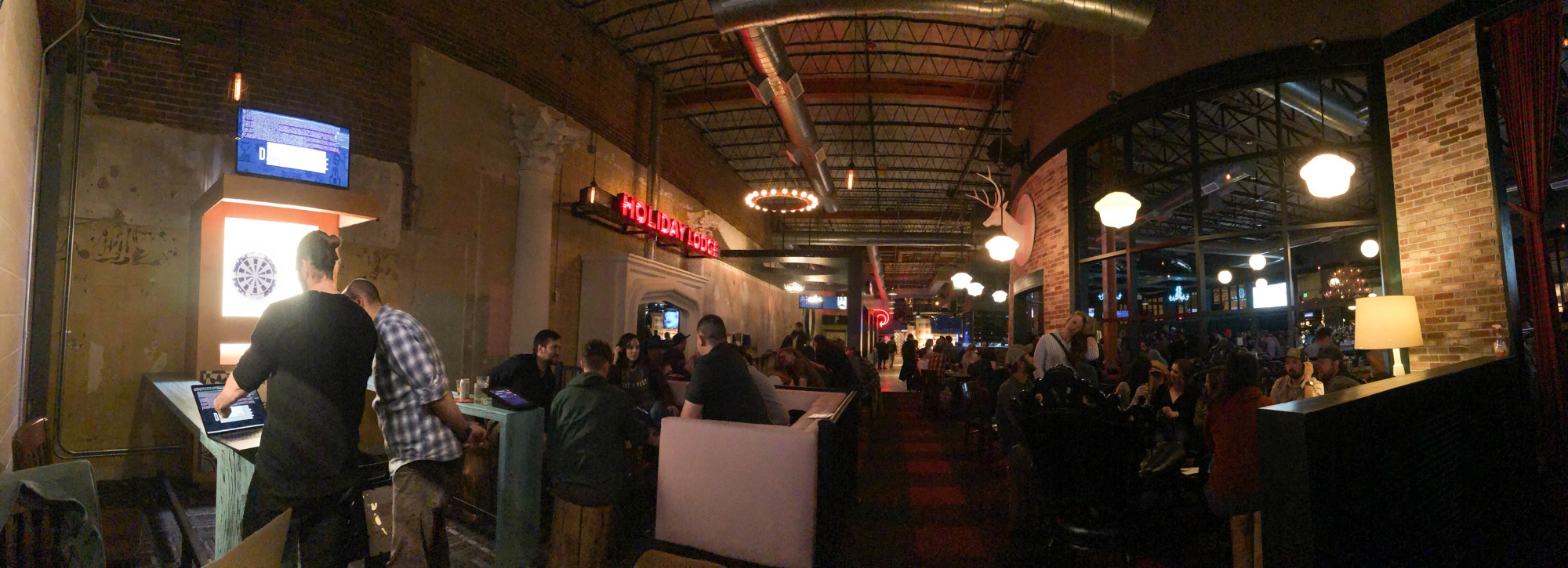
The initial detection target was at least 80% accuracy, a development milestone rather than a claim about final performance. Installation in Denver brought another test: the actual lighting. Yeti adjusted its algorithms on site. It also provided staff controls for checking cameras, connectivity and updates.
There is a practical definition of product design hiding in those details. It includes the person who plays, the room where they play and the employee who gets called when something stops working. The maintenance interface belongs in the product discussion as much as the animation celebrating a good throw.
From two laptops to a little more structure
Tony Scherba and Rudy Mutter founded Yeti in 2010. Scherba is its CEO; Mutter is its CTO. In their origin-story podcast, they describe building the agency from early client work and bootstrapping. Scherba had already been making websites and working on musicians’ marketing campaigns while in school, as he recalled in an IdeaMensch interview.


The founders’ ten-year retrospective is unusually useful agency reading. Scherba describes enthusiasm for a completely flat organization in which everyone would organize themselves around company goals. Growth exposed the limits. They also learned to delegate and to question projects that promised future business while losing money at the start.
“This works when your company is 6 people, as it grows it becomes impossible.”
Tony Scherba, on the completely flat organization, 2020
The change of mind is specific: structure could help people do their work. It offers a more useful account of company culture than a list of cheerful adjectives. Yeti’s stated values include empathy and adaptability; the founders’ reflections show those ideas colliding with the practical demands of running an agency.
The mall directory becomes a platform
Westfield’s kiosk project presented a different constraint. Yeti joined an existing effort with a mall opening only months away. The team judged the old frontend framework a hindrance and rebuilt in React, using reusable components. That decision served an immediate deadline and a longer ambition: directories that could adapt to different centers.
After the early launches came configuration tools, mapping integration and the patient work of maintaining a shared codebase. The case study reports more than 100 kiosks across four centers, including locations in London, Century City and New York’s World Trade Center. That is a reported deployment snapshot, not a live installed-base count.
The lesson for a buyer is about repetition. If the second location requires rebuilding the first location’s software, expansion becomes another development project. Configuration changes that equation. It also creates an obligation: improvements for a new site must preserve what already works elsewhere.
The invoice behind the interface
Yeti sells research, design and engineering services, followed where needed by continued development and support. Clients bring a business problem and pay for the work of turning it into software. Its services span mobile and web applications, connected devices, commerce and AI. This puts it among boutique development agencies that can work across product decisions and implementation.
There are a few public numbers. Clutch lists a minimum project size of $25,000 and hourly rates of $150-$199. Those are directory figures, not a proposal. In interviews published in 2014, a legal consultancy described a $50,000 website budget; EKM Metering reported spending close to $70,000 on its application at that point. Neither figure should be mistaken for today’s cost to recreate the work.
The reviews also contain friction. A nonprofit client criticized timeline clarity and project management. That is one historical customer’s experience, not a verdict on every engagement. It does explain why buyers should ask what will be delivered, when they can inspect it, and who decides when the scope changes.
Yeti’s published process starts with workshops on users, journeys and priorities, then moves into two-week cycles with client reviews and user testing. That requires participation. A client has to make decisions and supply feedback; a service relationship cannot manufacture agreement about the product’s purpose.
Sometimes the product is an orderly inbox
Consider ProCraft Equipment, part of Truebeck. Construction crews sent equipment requests by email. Staff checked inventory in Acumatica and coordinated orders manually. Yeti built an internal Shopify storefront, integrated ordering with the inventory system and added project selection, status views and employee sign-in.
The team tested the platform with a pilot construction project before launch. Yeti’s case study estimates that order intake time fell by more than half. The figure is a company-reported estimate, but the intervention is concrete: replace repeated interpretation of emails with a consistent ordering flow. Familiar shopping behavior can be useful even when no one pays at checkout.
Encompass, built with EKM Metering, addresses another kind of translation. It turns electricity, gas and water meter data into configurable dashboards. Users can group meters, manage access and choose visualizations. A homeowner and someone managing an apartment building can need different views of the same underlying kind of information.
These projects help explain the breadth of Yeti’s clientele. The common ground is a difficult connection between systems or between a system and its user. The hardware manufacturer, property operator and construction business each have a different reason to commission that work.
Find the dependency before buying the features
Yeti’s December 2025 review describes an internal AI hackathon and client work ranging from HR tools to personal styling. Through its Evolution Fund, the studio also worked with media-law specialists on ClearDraft. That engagement explored manuscript risk analysis, prototypes and the infrastructure costs of future video processing. It extends the company’s work into AI-assisted professional workflows.
What can another team copy? Begin with the assumption that could stop the whole product. Try it in the environment where people will use it. Give someone responsibility for responding to what the trial reveals. Then decide which features deserve the next investment.
Custom development makes less sense when an existing product already handles the job, or when the organization cannot maintain the result. A configurable storefront can be a better answer than inventing a commerce system. A working prototype can also be a reason to narrow a plan. The attractive thing about Yeti’s portfolio is how often the interesting work happens before the feature list gets longer: a phone connects, a camera sees, an order reaches the right system. Then the rest of the product has somewhere to stand.