The road was about to be repaved. For a water utility, that creates an awkward invitation: replace the pipe underneath now, or risk digging through fresh asphalt later. Tucson Water had been letting paving schedules influence replacement decisions. Then it introduced another consideration - the modeled condition of the pipe. According to VODA.ai’s published case, that change avoided $5.4 million in unnecessary replacements.
- Rank buried assets by failure risk, rather than age alone.
- Send inspections and replacement dollars where evidence points.
- Count the work avoided, as well as the work completed.
There is something pleasingly unfashionable about selling artificial intelligence that tells people to buy less infrastructure. A replacement project has photographs, invoices and a ribbon to cut. A sound pipe left underground offers none of those satisfactions. VODA.ai’s proposition asks utilities to make that invisible decision visible enough to defend.
A birthday is a poor diagnosis
Nob Hill Water Association encountered a smaller version of the same problem. During road repaving, it relied on pipe age and spent $300,000 replacing mains that were still in good condition, VODA.ai’s case study says. The utility subsequently used the company’s remaining-useful-life insights to focus on actual risk. What failed first was the selection rule.
Age is convenient. It fits in a spreadsheet column. Condition is troublesome: the asset is buried, inspection costs money, and similar-looking mains can have different histories. A utility can be diligent, hardworking and still replace the wrong pipe. That is the space VODA.ai occupies: between knowing an asset exists and knowing what to do with it.
A health prediction, under the pavement
The company’s origin makes that emphasis understandable. George Demosthenous had worked in the water industry and heard utilities’ frustration with pipe failures and complicated planning. While studying at Harvard, he took an innovation course taught by Jim Fitchett, who had previously run a business using technology to predict human health events. Over coffee, they discussed applying predictive methods to pipe health.
They founded VODA.ai in 2017. The useful analogy is triage. A prediction helps allocate attention among many assets when examining every one would be expensive. Pipes, like patients, require more than a birthday to explain their prospects. Soil, material, pressure, weather and previous failures can help reveal which assets deserve attention sooner.
A map that has to become a work order
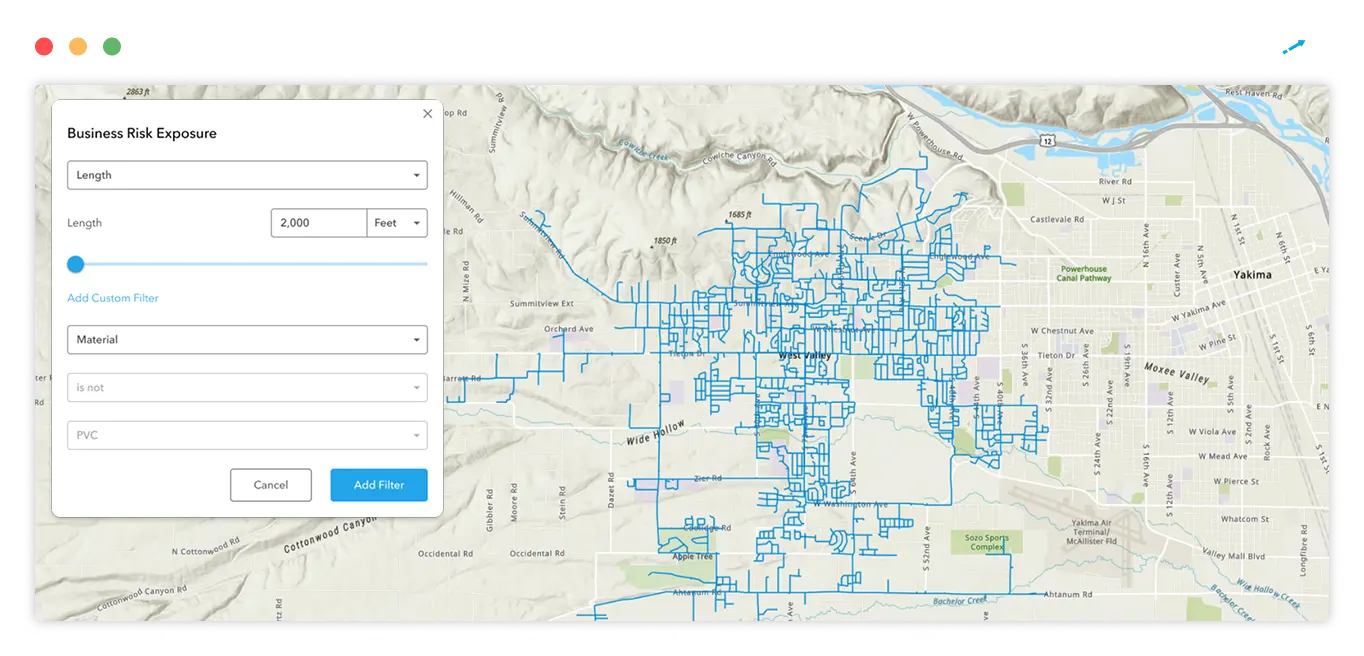
VODA.ai’s proprietary engine, daVinci, uses utility records and other data to identify patterns associated with failures. Pipe Risk Management distinguishes likelihood of failure from consequence of failure. The first concerns the chance that an asset breaks. The second considers the disruption, surrounding infrastructure and community impact if it does. Together, they inform business risk exposure.
That distinction matters. A pipe’s physical vulnerability and its importance to a community are different questions. The software gives engineering, operations and leadership teams a common basis for deciding whether to replace, rehabilitate, inspect or monitor an asset. It supports both water and wastewater networks.
A decision workflow, not a guarantee of an individual failure.
Planner then turns ranked pipes into connected project scopes. Users can set budget limits and operational constraints, compare alternatives, and export plans to GIS. Separate tools prioritize condition assessments and acoustic logger placement. The attraction is a shorter path from analysis to something a crew can execute.
Fracta also offers machine-learning water-main risk prediction, so predictive AI alone is hardly a moat. VODA.ai’s pitch combines that analysis with planning, lead management and revenue protection. Its everyday alternatives include spreadsheets, age-based rules and consultant assessments. For a buyer, the meaningful comparison is how each approach changes the next funded project.
Proving an absence can be expensive
Lead service lines present a different uncertainty. Las Vegas Valley Water District did not have widespread lead, VODA.ai’s case says, but demonstrating that required evidence. The company reports that the district inspected about 1,100 service lines, exceeded Nevada’s 95% confidence threshold, and avoided seven months of fieldwork. The case headline reports 90% fewer inspections and $5 million saved.
LeadFinder and LeadZero support investigation and inventory workflows. Modeling can narrow the field; acceptance depends on the relevant regulator. The distinction between predicting a material and establishing an acceptable inventory remains essential. A useful model helps assemble evidence that a public authority can evaluate.
“We’re using VODA.ai to avoid unnecessary assessments.”
Drew Zaeske, Public Works CIP Manager, Plano
Following the quiet money
VODA.ai sells software as a service to utilities and engineering consultants. Its April 2026 pricing guidance describes risk-analysis costs in tens to hundreds of dollars per mile, depending on scope. System size and selected modules affect the quote. Those figures describe analysis costs; Tucson’s $5.4 million describes avoided capital expenditure.
Distribution matters in this market. Ferguson announced an investment and exclusive US distribution relationship in September 2023. CRH Ventures led a Series A investment in June 2025, with L-Stone Capital participating. VODA.ai also lists engineering partners such as Arcadis and Brown and Caldwell. These relationships connect software recommendations with organizations already involved in utility projects.
In June 2026, VODA.ai launched Meters, which prioritizes meters suspected of under-registering consumption by volume and revenue at risk. It guides testing rather than performing it. The following day, the company announced Advisor, a natural-language planning assistant, with customer availability planned later that year.
The records come before the revelation
The lesson readers can copy starts with bookkeeping: consistent pipe identifiers, reliable material classifications, and break records with dates and locations. VODA.ai’s guidance warns that fundamentally wrong GIS data and missing failure histories undermine predictions. Excavation damage also sits outside the deterioration patterns a model learns.
A sensible first use is a defined decision with field validation and a budget attached. Compare the ranking with what inspections reveal. Record the replacements deferred and the risks addressed. Tucson’s story makes that discipline tangible: the paving schedule still mattered, but the pipe finally got a say.