The washing-machine hose does not care that you are in Lisbon. It splits on a Tuesday, keeps drinking from the main, and turns the laundry room into a shallow indoor pool. A cheap sensor can squeal once the puddle reaches it. FloLogic's proposition is more severe: install a valve where water enters the property, measure flow all day, and give the building authority to cut itself off.
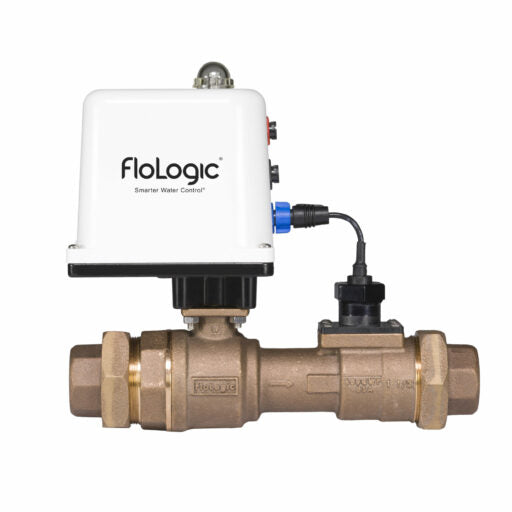
That proposition is neither subtle nor cheap. FloLogic's complete one-inch Gateway Connect system lists for $2,190, before a plumber opens a toolbox. The 1.5-inch version is $2,765; the two-inch system is $3,340. The hardware includes a cast-bronze valve, actuator, flow sensor, power supply, backup battery and connected modules. It is building equipment wearing a smart-home badge.
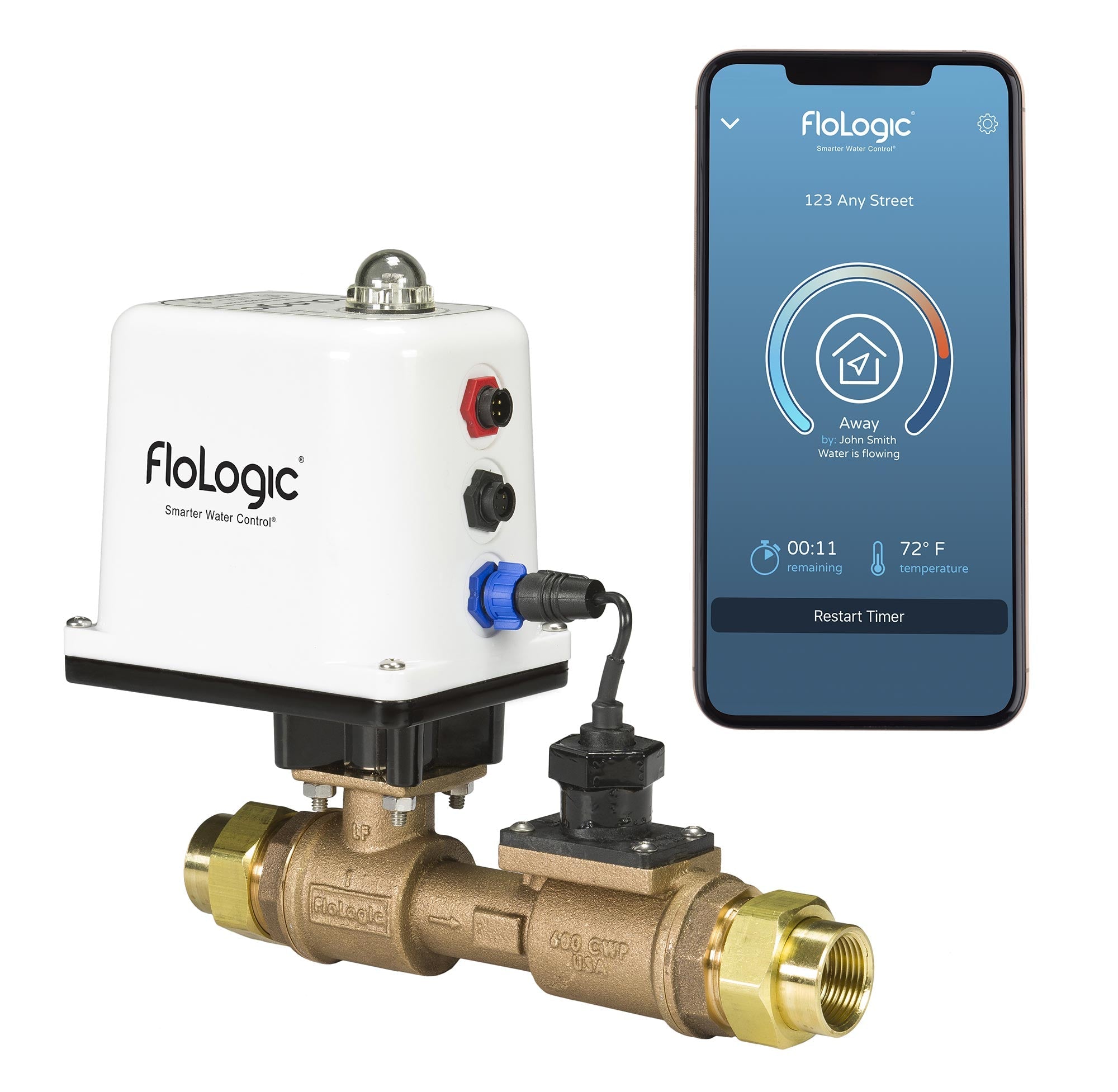
This is precisely what makes the Morrisville, North Carolina company interesting. FloLogic spent three decades resisting the gadget industry's favorite trick - making hardware cheaper by moving judgment into a cloud service. Its system can operate locally when the internet disappears. Users set plain Home and Away rules. Continuous water movement beyond the permitted time triggers a shutoff. The app delivers news; the valve delivers the consequence.
The product is a rule with a valve attached
FloLogic founder Chuck DeSmet began the company in 1996. The idea was straightforward: every plumbing-supply leak shares one trait, water moving through the incoming line. Put the sensor there and the system does not need to predict whether the failure will happen under a sink, inside a wall, at a toilet, beside a water heater or behind the refrigerator.
The system watches duration and rate. In Away mode, the factory setting allows 30 seconds of uninterrupted flow. In Home mode, it allows 30 minutes, enough for ordinary showers and household routines. Flow sensitivity is adjustable from half an ounce to 48 ounces per minute, so a property can decide whether to notice a pinhole trickle or ignore the deliberate drip of an evaporative humidifier.
The three-step control loop
This rule-based approach is less glamorous than an algorithm claiming to learn the spiritual identity of every faucet. It is also legible. If a bathtub crosses the Home timer, the owner knows why. If a leak crosses the Away timer, the same logic closes the valve. FloLogic says actual water movement is required for a shutoff. The practical risk is not a fictional flow reading; it is legitimate long-running water use that was never integrated or allowed for.
What changed the buyer's mind
A product can exist years before its market understands the invoice. DeSmet has described a turning point around 2000, when a landmark lawsuit raised the cost of remediating mold after household floods. Insurers started viewing water damage as more than wet drywall. Their phones began reaching FloLogic. The avoided claim was suddenly easier to price than the unfamiliar valve.
“We developed a flow sensor that detects virtually all leaks, at flow rates as low as a tablespoon a minute.”Chuck DeSmet, founder of FloLogic
That observation shaped a useful distribution triangle. Property owners suffer the disruption. Insurers pay many of the claims. Plumbers control the pipe. FloLogic sells direct online, but also through contractors, builders, security integrators and plumbing wholesalers. Its installer program offers training, referrals and dealer pricing. Insurer programs can discount the purchase, and some carriers may reduce premiums after installation.
This is what readers can copy: find the person who absorbs the customer's failure and turn that party into a channel. An insurer does not need a smart-home toy. It needs fewer severe losses. A plumber does not need another mystery box. It needs documented fittings, live support, a five-year warranty and a product with enough margin to recommend. The owner wants a dry house. One piece of hardware lets all three buy a different outcome.
The diameter tax · current online list price
Hardware only. Professional installation varies with pipe access, material and required integrations.
What fails first is usually the plan
FloLogic's weakest moment is not dramatic. It is the installer forgetting that a water softener backwashes at 2 a.m. Intentional long flows can resemble leaks. Irrigation systems, pool auto-fill lines, recirculation pumps, well pumps and treatment equipment need correct placement, overrides or relays. Municipal supplies require a spring-check valve before the FloLogic valve to keep pressure fluctuations from appearing as flow.
The fire-suppression warning is more serious: the system must not be installed on or before a fire line. The valve, power supply and communications modules also need suitable locations and cabling. None of this makes for seductive retail copy, but it is the difference between a product and a liability. FloLogic publishes integration diagrams because the boring edge cases are the business.
Power and connectivity expose another category fault. A cloud-only valve becomes impressively dumb during an outage. FloLogic includes battery backup, and local sensing and shutoff continue without internet service. Remote notifications and app control still depend on connectivity, but the essential loop - measure, judge, close - remains at the property. That architecture costs more in components and earns its keep on exactly the day the router does not.
From single sentry to plumbing network
Flow sensing covers leaks fed by the plumbing supply, but it cannot identify water that never crosses the main: a seeping roof, a backing drain or groundwater near a sump. FloLogic's newer PinPoint sensors acknowledge that boundary. The $95 wireless units detect standing water and monitor temperature and humidity. Connected through the Gateway's local Thread network, they can command the central valve or operate as alert-only sensors.
The Gateway Module, listed at $195, is the communication hub; a $65 extender stretches the network in large homes and light-commercial buildings. The architecture also accommodates security systems, irrigation controls, water softeners and third-party moisture sensors through local connections. FloLogic is becoming less like one stern valve and more like a plumbing operating system, though the mechanical shutoff remains the part that matters.
Bradford White recognized the fit. The Pennsylvania manufacturer of water heaters, boilers and storage tanks acquired FloLogic in July 2024 for an undisclosed amount. FloLogic brought IoT expertise and automatic leak control; Bradford White brought trade relationships and a much larger route into buildings. DeSmet remained publicly enthusiastic, saying the new resources would help the company grow and serve customers. Existing contacts continued handling sales and support.
The premium lesson
FloLogic occupies an awkward but defensible section of the market. It competes with Flo by Moen, Phyn Plus, Grohe Sense Guard, Leak Defense and a shelf full of spot sensors. Several alternatives cost less or promise learned behavior. FloLogic instead emphasizes bronze construction, multiple pipe sizes, very low adjustable flow thresholds, local control, battery backup and professional integrations.
The pitch works best for expensive homes, seasonal properties, managed buildings and insurance situations where one bad leak dwarfs the equipment bill. It is harder for a renter, a small apartment owner or anyone who mainly wants a notification under the sink. Installation makes the product sticky, but also slows the sale. Exact rules are explainable, but ask more of the owner than “let the AI learn.” Premium hardware is a filter as much as a feature.
- Control the failure, not the notification.
A message is useful; an automatic intervention is the product customers remember. - Recruit the person who already pays.
Insurers can make prevention economical, while plumbers make it credible and installable. - Publish the ugly constraints.
Fire lines, check valves and softener cycles are not footnotes. Handling them well creates trust. - Keep the critical loop local.
If the product protects a building, its basic judgment should survive a missing router.
There is something pleasantly old-fashioned about FloLogic. It does not pretend software repeals physics. Water enters through a pipe. A sensor measures it. A bronze valve can stop it. The app is useful because the plumbing is decisive, not the other way around. The price is real, the installation is fussy, and the conditions matter. That makes FloLogic less magical than the average smart-home promise - and considerably easier to believe.