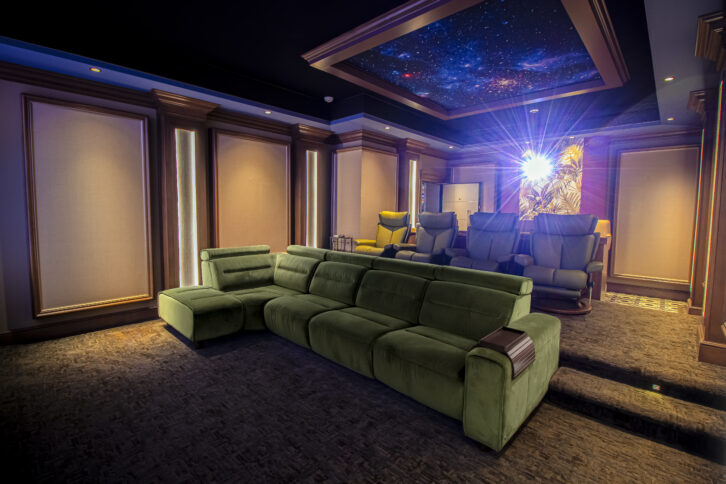
A bank vault is an awkward place to change your mind. The walls were built to discourage that sort of thing. Jeff Galea turned one into a home theater anyway. At Boca Tech and Automation’s Boca Raton showroom, the room called The Vault gives visitors a rather different reason to sit quietly behind thick walls. The valuables are now on the screen.
It is a fitting room for an electrical engineer who has spent his career making different systems cooperate. Before the theaters came factory networks, operating systems and software businesses. His working materials have changed. The underlying puzzle has remained recognizable: how do you take a collection of complicated things and make the result usable by someone else?
That question is particularly unforgiving in a house. A factory can employ specialists. A living room generally has to make do with the people living in it. The person reaching for a remote wants a film, not a small promotion to systems administrator. Much of Galea’s work occupies the distance between those two experiences.
The engineer before the theater
Galea earned his electrical engineering degree at General Motors Institute, now Kettering University. His thesis concerned local area networking and led to a broadband coaxial network at GM’s Fisher Body plant in Syracuse, New York. An academic assignment became something a factory actually used.
He spent 15 years with GM/EDS, including work with IBM in Boca Raton. Operating systems were part of his territory; so was the problem of making computing environments work together. His company biography credits him as a co-inventor on a patent involving OS/2 and Windows integration.
Silicon Valley supplied the next chapter. At Aurum Software he worked in consulting and engineering leadership, then continued at Baan after its acquisition of Aurum. He subsequently co-founded Cybrant, developing browser-based guided selling and product configuration software. Cybrant was acquired by Blue Martini Software.
There is a useful thread here. Product configuration asks which pieces belong together and which combinations will cause trouble. Home integration asks a surprisingly similar question, with the added inconvenience of walls. A software architect can redraw a diagram. A homeowner is less enthusiastic about redrawing the kitchen.
A hobby acquires a payroll
In 2003, Galea left Blue Martini to launch Boca Theater and Automation. He had already spent two years on research and development before incorporation. The distinction matters: this was a business taking shape around a longstanding interest, with work underway before the formal starting gun.
By his February 2021 conversation with Ron Callis on Automation Unplugged, he described 20 direct employees and a network of partners. The scope extended from lighting and shades to outdoor entertainment, irrigation controls and motorized pergolas. A theater business had acquired a considerable amount of territory beyond the theater.
That expansion creates a practical management problem. Each new category adds products to understand, people to coordinate and interfaces to explain. Someone still has to decide whether the entire arrangement makes sense for a particular customer. The business depends on judgment as much as installation.

During that interview, Galea also described how a look behind the scenes at BTA’s own operations grew into seminars for business colleagues. Explaining the company became another part of running it. The engineer’s work now included making the reasoning accessible to people outside engineering.
Before the movie, keep the lights on
One of Galea’s more revealing stories concerns electricity. In 2016, he described maintaining roughly 120 batteries across more than 30 individual uninterruptible power supplies at an earlier facility. Keeping the company running during an outage had become a maintenance exercise with too many possible points of failure.
He considered assembling a larger power conditioning and backup system himself. His conclusion was cautious. Building something for an immediate need was one undertaking; making it economical, repeatable, supportable and ready for future battery and solar developments was another. Engineering confidence included knowing when to buy somebody else’s engineering.
Galea became the first buyer of RoseWater’s Residential Energy HUB, installing it at the new location in 2015. In his written account the following year, he was composing answers during a power outage that had already lasted 37 minutes. His office equipment was still running.
The anecdote has a pleasing lack of spectacle. Nobody needs a demonstration of a computer abruptly switching off. The useful demonstration is work continuing. For a business selling complex electronics, ordinary continuity can be a persuasive exhibit.
Concrete makes an exacting client
The vault also supplied engineering problems more literal than any marketing metaphor. During an earlier theater installation, the room narrowed toward the back, the projector position was constrained, and the image had to fit the screen despite the geometry. Galea used Barco’s optical and image processing capabilities to work within those limits.
Another project involved an oceanfront home with an existing rear-projection cabinet the owner wanted to keep. The replacement projector had to operate vertically, send its image toward a mirror and compete with ambient light. The furniture was staying. The technology would have to learn some manners.
Galea brought the same problem-solving approach home. In his own media room, he placed a projector off center to address noise and heat concerns, working with Barco’s team on the image geometry. The resulting picture measured 125 inches diagonally.
These are useful glimpses of his craft because the constraints are so specific. A product specification cannot tell you whether a client will accept a different cabinet. An elegant calculation cannot persuade concrete to move. The successful design has to accommodate both the equipment and the room’s stubborn facts.
A yacht changes the question
A 200-foot yacht presented Galea with another constraint: entertainment had to remain available when internet connectivity did not. A media server’s ability to record streaming content had previously struck him as an extra layer of complexity. Offshore, the same capability had an obvious purpose.
The installation described in December 2020 used two Modulus M1 servers and ten MX1 clients. Content could be recorded while the vessel was connected in port, then played back at sea. BTA worked with Modulus on capabilities including batch recording and recording multiple channels.
Guests introduced another consideration. A charter vessel keeps receiving people who have never used its controls. The engineering teams developed a simplified interface called hotel mode, integrated with the yacht’s existing touchpanel system. The system needed to be approachable without making stored content vulnerable to an accidental deletion.
This is where Galea’s software past feels close to the surface. The hardware solves access to entertainment. The interface determines whether a new arrival can enjoy it. A boat can carry a remarkable collection of equipment and still disappoint someone who cannot find the play button.
The room has to explain itself
By 2024, the former bank had become an 8,600-square-foot experience center. Its old drive-up area had been enclosed for loading trucks under cover. The showroom doubled as a place to test products and give employees daily experience of the systems customers would use.
Galea put the reasoning plainly: “We can see the problems before the clients see them.” The building gives that principle somewhere to operate. A demonstration becomes more useful when the people presenting it have also lived with its awkward moments.
“We can see the problems before the clients see them.”Jeff Galea, 2024
For a prospective buyer, a working room also changes the conversation. Sound, lighting and controls become things to try. Preferences have something tangible to attach to. A visitor can discover a dislike before it becomes an installed feature, which is a considerably more agreeable moment to discover it.
Build the picture before the room
In a June 2026 conversation with Connected Design, Galea and marketing director Marcio Gomes described using scans and digital twins to visualize proposed work. Gomes captures spaces with a handheld scanner; the team processes the data and develops models that help clients inspect possible designs.
The processing brought Galea back to a familiar computing question. Rather than purchase another powerful local machine, he described using a Microsoft Azure virtual machine, turning it on for the demanding work and shutting it down afterward. The software engineer had found another household application for infrastructure decisions.
- 01 / ScanCapture the existing space.
- 02 / ProcessTurn measurements into a digital model.
- 03 / ExploreReview design options before installation.
He also offered a small correction to the familiar image of the extroverted founder. He prefers technical work and has had to learn the public-facing part of his role. Finance, he freely acknowledged, is work he delegates. His version of leadership leaves room for knowing what somebody else should handle.
The digital model and the old bank vault serve a related purpose. Each gives a customer something concrete to consider before committing to a complicated system. Galea’s career has taken him through factories, software companies and rooms built for films. At the customer’s end, the desired experience is pleasantly modest: sit down, understand the controls, and get on with the evening.