Aaron Emigh wanted to renovate his house. He ended up reconsidering the light switch. Connected devices promised more control over the rooms around him, but operating them meant reaching for a phone and negotiating separate apps. The person who installed everything might understand the arrangement. A guest coming over for dinner could hardly be expected to allow time for a software induction.
Emigh wanted anyone in any room to adjust the lights, music, and temperature. He had spent years working on complicated technology. Here was a problem that could be stated in a sentence, by someone standing in the dark.
The company that emerged from that frustration was Brilliant. Its control panel replaced an existing light switch, gathering several household functions onto a touchscreen in the wall. Emigh co-founded it with Steven Stanek and Jeremy Hiatt in 2015. He would lead it through product launches, venture financing, builder partnerships, and a financial crisis before supporting its handover to new leadership in 2024.
His story is interesting partly because the original observation remains persuasive after the business becomes complicated. A house is shared. A phone is personal. Building a bridge between those two facts would require considerably more than finding room for a screen.
A house with too many instructions
When Brilliant introduced its control in February 2017, Emigh described wanting an alternative that worked for guests and children. That choice of audience mattered. The keen buyer of a connected device has already agreed to learn something. Everyone else in the house encounters the consequences of the purchase, often while trying to do something else.
A switch has a useful social quality: it makes itself available. It stays in a known place, requires no charged battery in your pocket, and offers a fairly clear invitation to the hand. Emigh’s idea gave that location more responsibilities while trying to preserve its accessibility.
The early product combined touch, motion, and voice. It included a camera with a privacy cover and a microphone, allowing intercom functions as well as control of connected equipment. The company offered it for preorder, then announced commercial availability in September 2018. There was software behind the glass, but the proposed change in domestic behavior was deliberately modest.
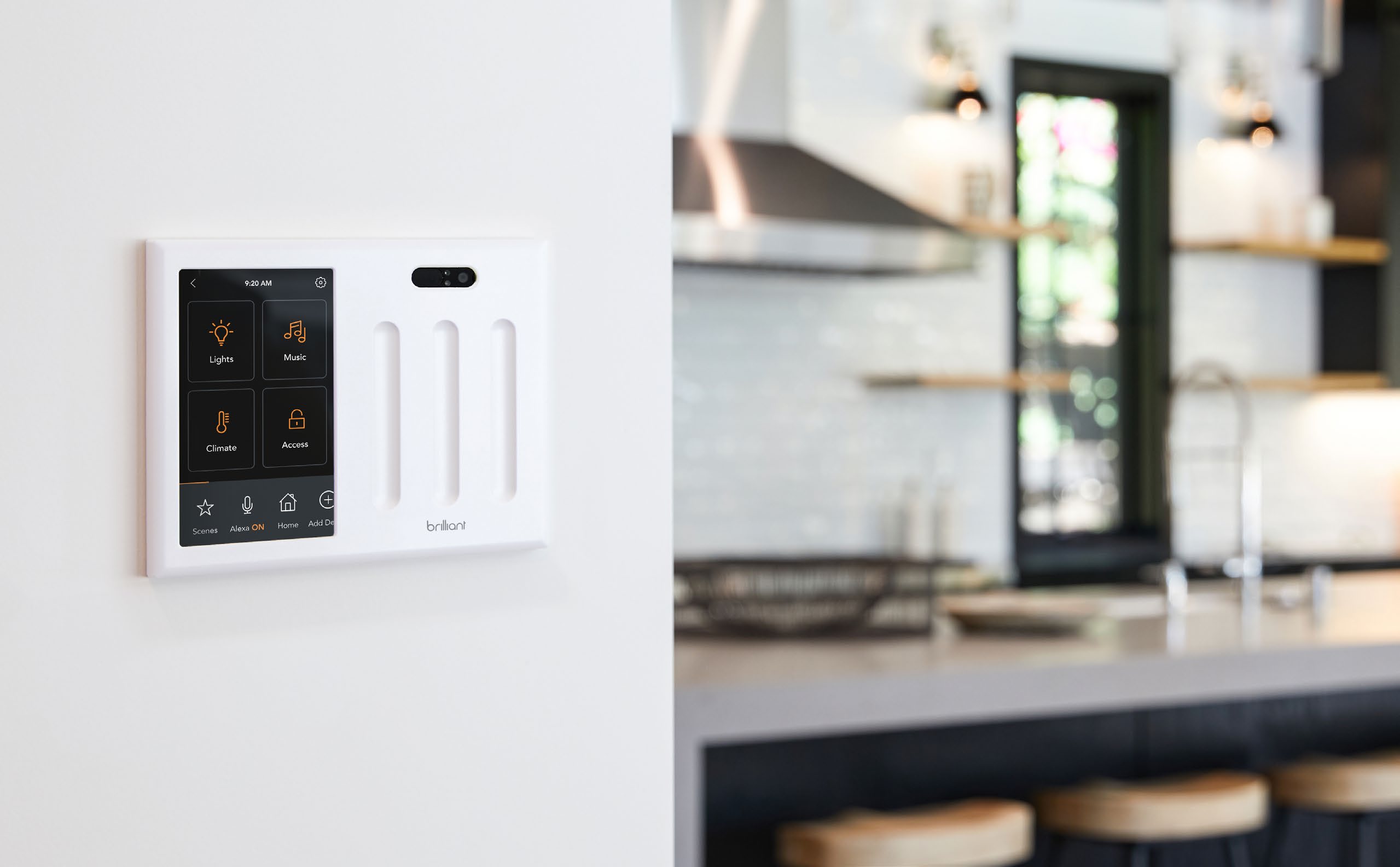
Consider what the placement asks of someone. A phone-based system asks the person to bring the interface into the room. A wall panel puts an interface there in advance. That distinction helps explain why Emigh kept returning to the architecture of the home, even when discussing software.
Before the wall, the network
His technical education began a long way from kitchen lighting. Emigh attended the University of California, Santa Cruz from 1987 to 1991, graduating summa cum laude. His undergraduate thesis concerned SWIFT, a distributed filesystem. His research interests included operating systems, machine learning, language processing, and computer vision. The breadth was present early.
Later roles carried him through CommerceFlow, where he served as CEO, and Radix Labs, where he was managing director. At Rojo Networks he became CTO. When Six Apart acquired Rojo in 2006, Emigh moved into responsibility for core technologies at a company associated with blogging tools and services.
There was also a security strand. A January 2005 anti-phishing report produced in conjunction with the US Secret Service’s San Francisco Electronic Crimes Task Force named Emigh, at Radix Labs, as its contact. His professional biography records work with the Anti-Phishing Working Group and technical advisory organizations. Long before the wall panel, he was working on systems whose usefulness depended on whether people could trust them.
In 2009 he co-founded Shopkick with Cyriac Roeding and Jeff Sellinger, serving as CTO. The company brought mobile software into physical stores, rewarding shoppers for activities including entering participating locations. A location-triggered rewards patent names Emigh and Roeding as inventors. SK planet announced its acquisition of Shopkick in September 2014.
Shopkick and Brilliant occupied different markets, but both put computing into places where people were already doing something ordinary. Walking into a store. Entering a room. The engineering could be elaborate; the action it supported was familiar. Read together, those ventures suggest a recurring interest in the meeting point between digital systems and physical habits.
at Six Apart
Shopkick
Brilliant
advisory role
The finger casts its vote
By 2017, voice assistants offered an appealing picture of the connected home: speak, and the room responds. Brilliant included voice control, too. Emigh nevertheless had reason to resist making conversation the only route to the lights.
In an early pilot, his company analyzed thousands of interactions in households with voice services enabled. He reported that touch accounted for 81% of use, voice for 14%, and motion for 5%. Those were results from a particular company pilot, with its own devices and participating households. They offered a useful design clue, rather than a universal verdict on talking to machines.
How people actually reached for control
His explanation was practical. Touch made it easy to choose between playlists, adjust a slider, and see the result. Voice had a place, but a spoken instruction could be cumbersome when someone wanted a small adjustment or a choice from several possibilities. The interface needed to suit the task.
In 2018, his larger ambition was a home where intelligence became ordinary enough to lose its special label. “They’ll just be better homes,” he said. There is a pleasing restraint in that destination. The household would receive the benefit without having to think constantly about the apparatus delivering it.
That attention to the immediate task gives his design argument its force. Choosing music involves looking through possibilities. Dimming a light involves judging a result. Either can become awkward when the interface insists on one kind of instruction. Providing several controls lets the person in the room choose. It also places the burden of coordination on the product’s makers, where Emigh had decided it belonged.
The other side of the switch
The apparatus required a business, however. In October 2017, Brilliant announced a $21 million Series A led by August Capital. It also hired Kostas Reissis, a sales executive with 13 years at Sonos. Distribution experience was joining the engineering effort.
Emigh’s company pursued several routes into homes. It launched a national builder program in 2019. A year later, it introduced a multifamily platform that paired resident controls with software for property managers. A developer could consider an entire building’s operation alongside the experience inside each apartment.
That expanded the audience for Emigh’s original question. A homeowner might be willing to experiment with settings. A builder needs an installation process that fits construction. A property manager needs to deal with residents arriving and leaving. A renter wants the lights to work. Ease has different meanings on different sides of the same front door.
In August 2021, Brilliant announced a $40 million Series B led by Next47 and Celesta Capital, bringing its announced funding total to $61 million. The planned expansion emphasized builders, multifamily developers, property managers, and professional integrators. In late 2023, the company announced availability through more than 75 US Costco locations and online.
One switch could simplify a room. Keeping it useful meant coordinating a much larger world.
There were constraints that a touchscreen could not smooth away. In 2018, Emigh took Brilliant’s manufacturing concerns to a US tariff hearing. In written comments, he described the costs and practical difficulty of relocating production. A small company with American intellectual property still depended on manufacturing arrangements that could not be changed with a software update.
Integration created another continuing obligation. Brilliant’s proposition involved products made by other companies. The panel’s value depended partly on the equipment it could work with, and that required maintaining relationships and technical connections. During Emigh’s tenure, Brilliant also joined the Connectivity Standards Alliance and announced plans to support Matter. The work of simplifying the customer’s view continued behind it.
Leaving the lights on
By 2024, the company’s finances had become untenable. Sales stopped, staff were laid off, and Brilliant sought a buyer. Emigh pointed to slower-than-expected market development and business pressures. The product’s cost and the breadth of its integrations also figured in accounts of the difficulties. An appealing design proposition had encountered the economics of selling and supporting hardware.
Private investors acquired the business, which reemerged as Brilliant NextGen. Lisa Petrucci, previously its sales and business development leader, became CEO. Existing products continued operating during the transition. The continuity mattered: customers had installed these devices in their walls, making the company’s future part of the fabric of their homes.
Emigh publicly supported the new arrangement. He said he would continue assisting as an advisor and take on a new day job after some adventures abroad. He praised Petrucci and the continuing team. The language allowed for both attachment to what he had built and a change in who would run it.
His public professional profile now connects him with Verkada, and professional listings identify him as Vice President, Product. In February 2025, he also recommended the StartX entrepreneurial community to prospective applicants. The record continues beyond Brilliant, as it had continued beyond Shopkick and Six Apart.
The light switch remains a useful way into his story. Emigh took an object people barely notice and asked it to absorb the complications accumulating around it. Making that work involved invention, colleagues, investors, factories, and eventually a handover. Behind the promise of an easier evening at home lay years of work that the person reaching for the wall should never have to consider.
Follow the conversation
Interviews, original writing, and the next chapters.
Aaron Emigh on LinkedIn ↗Brilliant’s website ↗His 2017 essay on touch and voice ↗Watch: Emigh with Paul Amadeus Lane ↗YouTube: Brilliant’s “All Together Now” ↗Listen: Mainstreaming technology in new homes ↗Emigh on Brilliant’s 2024 transition ↗Read: Brilliant’s subsequent chapter ↗