Consider the refrigerator and the swimming pool. In an ordinary house, both draw electricity without much discussion. During an outage, with a battery supplying a finite reserve, they become competitors. Somebody has to decide which gets served. A house can contain every fashionable connected device and still be remarkably unprepared for that small argument.
Savant has made the argument part of its business. Known for putting lights, music, shades and home theaters under coordinated control, it now sells systems that monitor and manage individual electrical circuits. The same company that helps stage an evening can help ration the electricity required to get through one. Luxury has acquired a spreadsheet.
- One control experience: lighting, climate, entertainment, security and power can share an app.
- A professional backbone: integrators design, install and service the core home platform.
- A wider front door: acquiring GE Lighting added retail lighting and DIY smart products.
- A new decision: circuit control helps direct limited backup power toward selected loads.
The house has too many managers
A connected home is easy to assemble badly. Buy a thermostat, a speaker, some bulbs and a camera, and you have acquired several small administrations. Each knows its own job. The homeowner becomes the person who negotiates among them.
Savant sells coordination. Its software and hardware let an integrator connect compatible systems, then give the owner controls organized around rooms and activities. A movie scene can adjust the lighting and start the theater. Shades and temperature can follow schedules. Access permissions can differ between residents and guests. The benefit grows when the home has enough moving parts to make separate controls tiresome.
This helps explain its place in the market. Savant’s professional platform belongs in the conversation with Crestron Home and Control4. A lighting-focused project might also consider Lutron. DIY households have a different set of options in Apple Home, Google Home or Alexa. The dividing question is often how much coordination the owner wants someone else to design and maintain.
Borrow the gesture, build the machinery
Savant began in 2005 with telecommunications engineers and business leaders, including co-founders Robert Madonna and Jim Carroll. Its early Apple orientation gave the company an unusually useful shortcut: a control surface people could already recognize.
At a 2010 dealer conference, Madonna encouraged installers to embrace the iPad. The tablet brought familiar swipes, menus and consumer acceptance into a trade accustomed to dedicated touchpanels. He was willing to put Savant’s own panels on the losing side of that comparison.
“I don’t believe the legacy touchpanels of our industry can compete, including our own.”
Robert Madonna · 2010 dealer conference
There is a portable lesson here for anyone building a complicated product. Customers may welcome new capabilities while resenting new rituals. A familiar interface lets them spend their attention on the house. Savant’s present software supports iOS and Android, but the early instinct remains legible: make the command feel ordinary, even when the equipment behind it is elaborate.
The machinery still needs expertise. Integrators specify hardware, connect third-party devices, configure behavior and handle service. That work is part of what the buyer purchases. For a large residence, a vacation property or a home with distributed entertainment, having an accountable installer can matter as much as having an attractive app.
The remote was a detour
In September 2014, Savant announced a $90 million investment from KKR affiliates and Madonna to support innovation and expansion. Reaching a broader audience was an explicit ambition. One route was a retail remote product under CEO William Lynch.
The route did not endure. Madonna returned as CEO in September 2016. In January 2017, CE Pro reported layoffs and a renewed commitment to the custom installation channel. Savant’s support knowledge base subsequently listed a June 2017 discontinuation notice for its 1.x Remote, Host and Blaster products.
The visible sequence is a retail push, a leadership change and a return toward professional integration. It is evidence of a course correction; it does not establish a private moment when management changed its mind. The practical lesson is narrower and more useful: making a product easier to buy does not remove the work required to install, support and sustain it.
$90m investment
Expansion capital
GE Lighting acquisition
Retail + engineering
VPP capabilities
Home battery + utility
The light bulb opens another door
Savant’s 2020 acquisition of GE Lighting was a different way to widen the market. GE’s announcement described the combination in concrete terms: lighting expertise and retailer channels meeting smart home technology and professional installation channels. The transaction’s financial terms were not disclosed.
The resulting company spans two buying habits. A homeowner can buy consumer lighting through GE Lighting and Cync. Another can commission an integrated Savant home through a dealer. These customers may never have the same installation experience, though their purchases belong to the same corporate family.
The professional portfolio includes lighting controls and fixtures, automated shades, audio and video distribution, remotes and keypads. Savant Music adds personalized dashboards and cross-service search and playlists. These are different ways of reducing the small negotiations of domestic life: which room plays which music, which lights remain on, which shade should move.
Savant says its reach exceeds two million homes, with connectivity across nearly 10,000 protocols, devices and music services. Those are company-reported measures with broad scope. Reading them as two million professionally installed Savant systems would give the numbers a precision they do not possess.
The breaker panel joins the conversation
The energy business brings that coordination closer to the physical constraints of a house. Savant Power Modules can monitor and control selected circuits in major electrical panel formats. The company offers versions for QO, Eaton CH and one-inch load centers. Its modular approach lets projects begin with selected loads rather than treating every circuit as an equally urgent purchase.
Monitoring can show consumption and signal a tripped breaker. Control adds the ability to manage which loads receive available power. Paired with suitable backup equipment, the system can change priorities during an outage. The modules themselves do not supply electricity: that requires a battery, generator or other properly configured source.
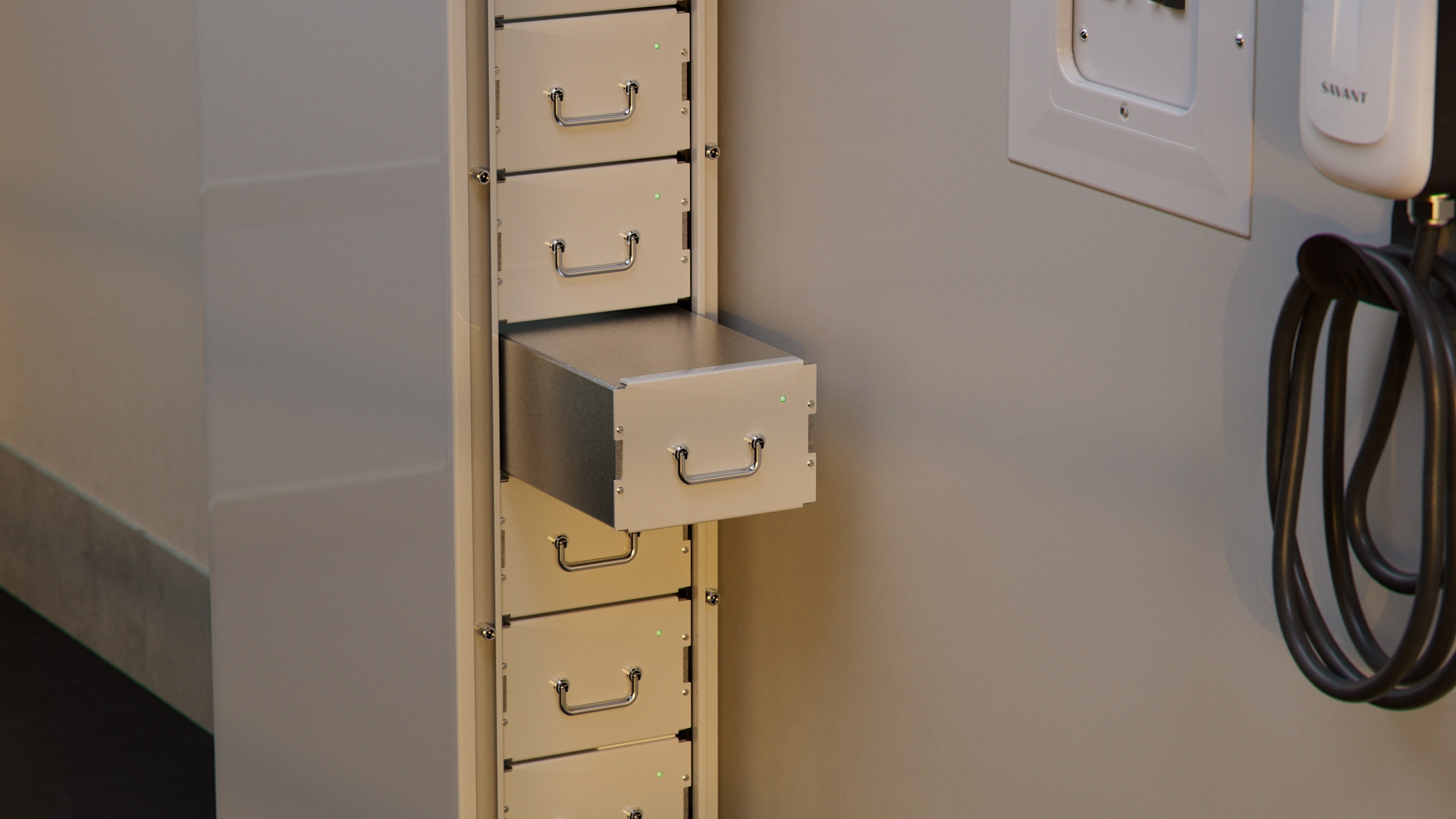
Illustrative arithmetic using 20 kWh, a published Savant storage size. Actual runtime depends on usable capacity, losses, reserve settings, load changes and generation. These are not product performance claims.
The arithmetic explains why storage and control belong together. A larger battery buys capacity. Reducing demand buys time. Savant’s PS20 and PS50 storage offering supports systems with different service sizes; its published range runs from 20 to 500 kWh across configurations. Those sizes require a designed system, not a shopping-cart assumption.
The practical payoff depends on conditions. Peak-rate savings require a tariff and operating schedule that reward shifting consumption. Backup duration depends on the loads selected and the energy available. A household with little automation, steady electricity prices and no backup requirement may have far less reason to commission this machinery.
The invoice keeps a calendar
Savant’s business combines equipment sales with recurring software revenue. Essentials, introduced in late 2021, packages updates, integrations and configuration backup and restoration. Its launch sheet listed annual prices from $75 for S2/Embedded hosts to $1,100 for Super Pro. Those historical figures illustrate the spread between system classes; a current project needs a current quote.
Buyers can copy a simple discipline: ask for separate figures for hardware, installation, subscriptions and service. Ask what an upgrade requires and who will restore the configuration after a hardware failure. An integrated home is an asset that needs stewardship. The cheapest line on the opening proposal does not necessarily determine the cheapest ownership experience.
A battery with a second customer
In August 2025, Savant added virtual power plant capabilities through SavantOS 11.1 and Virtual Peaker. Participating home batteries can respond to utility demand and contribute stored energy at busy times. Savant’s announcement named Green Mountain Power’s Vermont program and rebates of up to $10,500, subject to program conditions. Geography and eligibility govern whether that proposition reaches a particular homeowner.
The more recent expansion reaches into construction and everyday access. An April 2026 Timber Block partnership brings controls into its Signature Home designs. Schlage Encode integration followed that month. In August, Savant announced Sol-Lux patio awnings for its partner program, with integrator access planned for the fourth quarter.
Its August software announcement also described a forthcoming SavantOS 12 and subscription-based Savant AI. The meaningful test for those plans will be whether they reduce setup and ownership effort. Savant has spent years making a house easier to command. Its energy turn asks a more consequential question: can the house make the owner’s priorities work when there is less electricity to go around?
Take the controls for a spin
Explore Savant, find an integrator, browse the energy blog or follow company news.
Watch Savant’s YouTube demos and energy scenes in action. Follow LinkedIn, Instagram, X and Facebook.