The Home-Theater Company That Built Its Best Room Inside a Bank Vault
A former GM operating-systems engineer turned an old Boca Raton bank into a smart-home laboratory - vault theater included - and now sells the finished picture before the first cable is run.
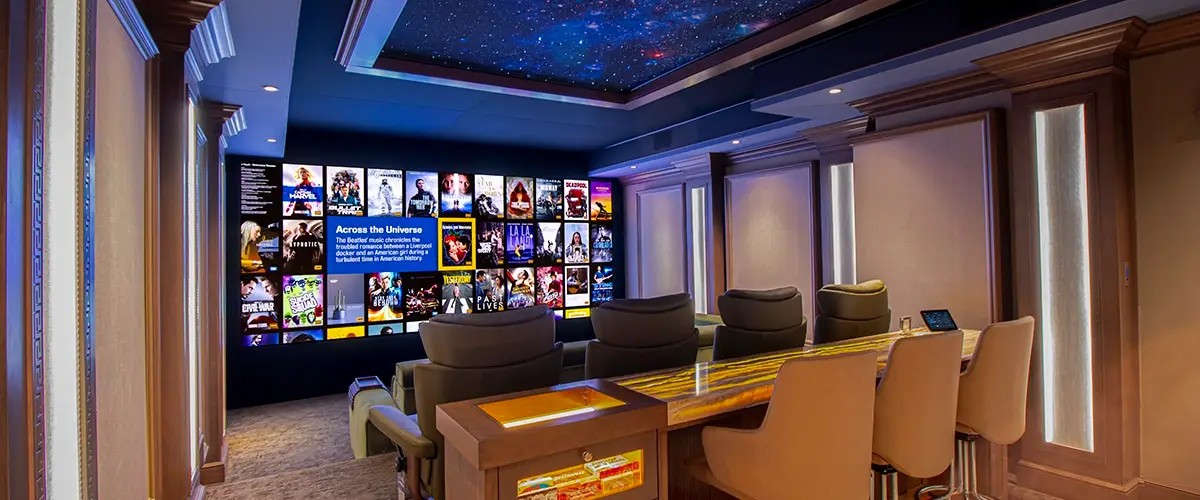
In 2015, Jeff Galea bought a bank. Not to store money - to store his company's own future in it. The 8,600-square-foot building on Kimberly Boulevard in Boca Raton came with an acre of parking, a drive-up teller window, and a vault built to survive a heist. Galea kept all three. The parking is still parking. The drive-up window became a climate-controlled garage for rolling equipment in and out. And the vault, with its 18 inches of solid poured concrete, became the best-sounding room in the building: a reference home theater that Boca Tech and Automation now uses to show clients exactly what "no compromise" means.
That is a useful way to understand Boca Tech and Automation. It is a smart-home integration company - lighting, audio, video, security, climate, networking - but it treats its own headquarters as the product. Almost everything the firm sells has been installed, lived with, broken, and fixed inside that former bank first.
What they actually doA house that runs itself, quietly
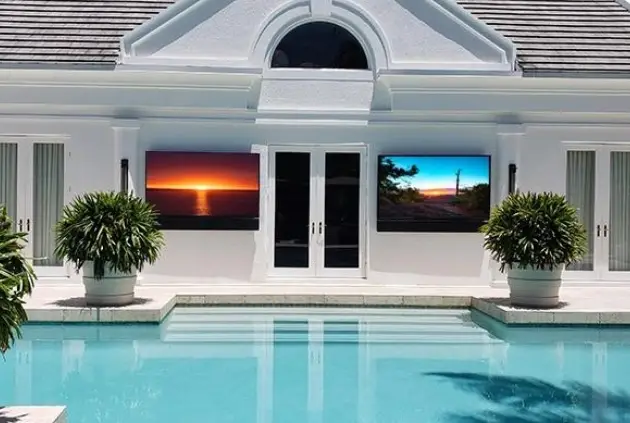
The company designs and installs integrated systems for high-end homes, condos, yachts and businesses across South Florida. On the indoor side that means dedicated home theaters, whole-house audio and video, Lutron and Ketra lighting, motorized shades, smart climate control and voice control. Outdoors it extends to landscape lighting, motorized pergolas and screens, outdoor cinema and audio zones, hardscapes and even artificial-turf putting greens. Underneath it all runs the unglamorous but essential layer: structured wiring, whole-home WiFi, IoT moisture and temperature sensors, video surveillance, access control and custom security doors.
The pitch is not "more gadgets." It is subtraction. Galea's stated philosophy is that clients should live with technology, not around it - the systems recede, and what is left is a home that dims its own lights, closes its own shades before the afternoon glare, and lets an aging homeowner stay independent a while longer.
The founderFrom operating systems to Fisher Island
Boca Tech is not the story of an AV hobbyist who scaled up. Galea trained as an electrical engineer at General Motors Institute (now Kettering University), and his student thesis on local-area networking led to GM installing its first broadband coaxial network at a Fisher Body plant. As a chief technologist for GM/EDS he co-invented US Patent 6,118,428, covering the integration of OS/2 and Windows. He later went to Silicon Valley, helped build one of the first entirely browser-based sales-force applications, and co-founded a guided-selling company that grew to 150 people across nine countries before it was acquired. Along the way he picked up a second patent, for a browser-based product-configuration engine.
Then, in 2003, he pointed all of that at houses. The firm launched as Boca Theater and Automation, wiring luxury A/V and control into homes on Fisher Island, Palm Beach, South Beach and Chicago's East Lake Shore Drive. In 2025 it rebranded to Boca Tech and Automation to signal how far past "theater" the work had gone.
The differentiatorSelling the picture, not the invoice
The line item is the enemy. Galea's argument is that a spreadsheet of components tells a homeowner nothing about how a room will feel, and that ambiguity is where deals stall. So the company changed what it hands people. Marketing director Marcio Gomes now walks a property with a handheld LiDAR scanner roughly five inches square, capturing more than 200GB of data per home. Combined with 360-degree cameras and Gaussian-splat rendering, that becomes a navigable digital twin - a 3D model a client can walk through to see the finished design, "layers of light" and all, before anyone drills a hole.
The processing runs on Azure virtual machines; the output is shared with the sales team, the installers and the client at once. The point is less about the technology than the psychology: it collapses decision paralysis by replacing an itemized proposal with a thing you can see.
The showroomAn R&D lab wearing a house costume
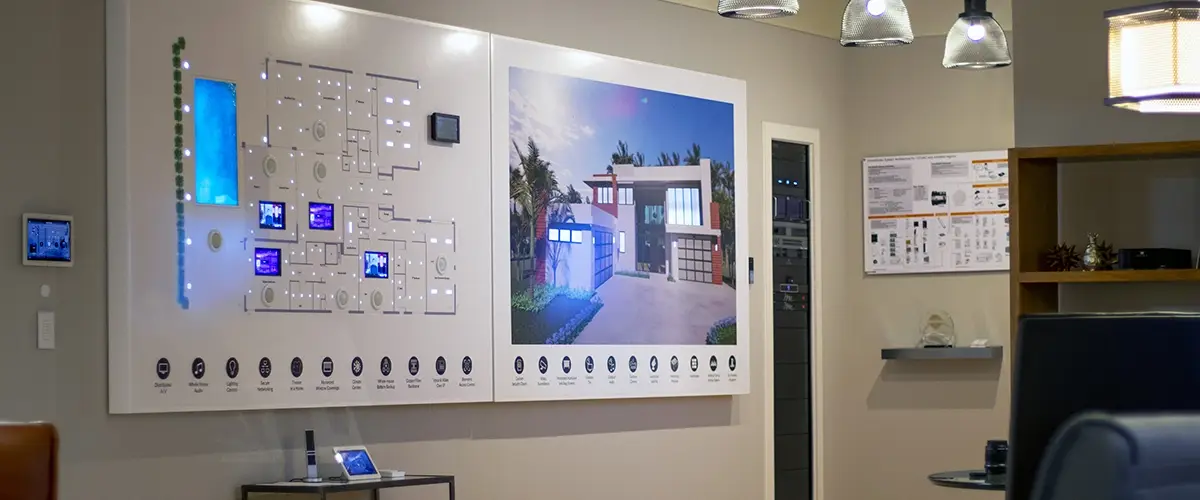
Walk into the old bank and it is organized like a home: kitchen, family room, library, conference room, bathrooms, media rooms. Every employee desk has a touchpanel and a television, because the staff are meant to use the systems the way a client would. Four handmade ballistic doors - rated to resist assault rifles - guard the entrance, and there is a Control4 video doorbell if you find one locked. The bathrooms are a small, memorable trick: Ketra lights glow green when a room is empty and switch to red when someone walks in, so nobody knocks.
The building runs on solar and, according to the firm, an early RoseWater Energy HUB power system. Galea frames the whole thing as insurance: "We build out what we're giving to our clients and live with it here so that when we have a problem, we have firsthand experience on how to fix it." It is R&D, staff training and showroom folded into one address.
Who buys itThe Palm Beach County client
The customer base is concentrated: mostly owners of large custom homes and condos in Palm Beach County and the broader South Florida corridor - Miami, Fort Lauderdale, West Palm Beach, Boca Raton, up through the Fort Myers and Cape Coral area - with some commercial and marine work. These are projects where the automation budget is a rounding error against the property, and where the deciding factor is trust rather than price. That is the market a 13-person shop can win: not on volume, but on taste and on not getting surprised on site.
The marketCompeting on certainty
South Florida is thick with integrators - Definitive Electronics, IntegrateIT, Om Wave and any number of Crestron, Savant and Control4 dealers all chase the same coastline. The category commoditizes fast, because most firms sell the same brand logos off the same line-item sheet. Boca Tech's wager is that the differentiation is upstream of the hardware: in showing a client the finished room, in having already lived with the gear, in being able to fix a problem because someone on staff broke it first. It is a slower, more capital-heavy way to run an integration business. The bank building alone is a standing bet on it.
Track recordRecognition, and a few concrete numbers
- On CEPro's Top 100 integrators list for more than a decade (an honoree since 2008).
- Two projects featured on HGTV's Top Ten Luxury Home Theaters.
- CEPro Best Project Award, Gold, in 2019.
- Recognized for a Best Ketra Lutron Showroom in 2022.
- Estimated annual revenue around $27M, on a team of roughly 13.
The through-lineAn engineer's idea of hospitality
Strip away the ballistic doors and the vault cinema and Boca Tech is a fairly simple proposition: a company run by someone who spent a career making complicated systems disappear behind a screen, now doing the same thing for living rooms. The patents, the browser software, the digital twins - they are all versions of one habit, which is to figure out how the whole thing works and then hide the wiring. The bank vault is just the most literal expression of it. The concrete was already there. They only had to fill it with sound.