The house had no way to complain. In 2011, Alex Hawkinson’s family house in Colorado suffered damage after a power outage. By the time the trouble was discovered, the repairs would cost tens of thousands of dollars. A building full of ordinary objects had produced an expensive piece of information: something was wrong. It had simply failed to deliver the message.
- SmartThings connects compatible devices from different brands in one app, then lets users build routines around them.
- Samsung bought the company in 2014 and put its software within reach of phones, TVs and appliances.
- Supported automations can run locally. Compatibility, hub hardware and cloud dependence still matter.
- The consumer app remains free; paid developer API access is planned for October 2026.
The expensive silence
SmartThings emerged from that failure of communication. Hawkinson and his co-founders built a way for sensors and household devices to send information to software that could do something with it. Their 2012 Kickstarter campaign raised about $1.2 million. Commercial products followed in 2013, as did a $12.5 million funding round led by Greylock Partners and Highland Capital Partners.
There is something pleasingly unglamorous about this beginning. The founding problem was a house with damage, rather than a shortage of gadgets. A moisture sensor had a job to do. So did a notification. The value lay in getting the warning to a person while a person could still act.
That distinction remains a useful test for home automation. A remotely controlled lamp is convenient. A lamp that responds to another device is part of a system. SmartThings’ business occupies the space between those two purchases.
An app for the argument between devices
Today, SmartThings is a Samsung-owned company and smart-home platform. Its app gives users a common place to control compatible lights, locks, sensors, televisions and appliances. Routines join conditions to actions: when something happens, something else follows. A motion reading might turn on a light. A moisture reading might trigger an alert. A scheduled routine might switch off selected devices.
The customer could be an apartment resident with a few bulbs, a homeowner monitoring an empty property, or a household already surrounded by Samsung appliances. Developers and manufacturers are another constituency. They need software interfaces, integration tools and a route into a customer’s existing home. Hotels and offices enter through the business offering, SmartThings Pro.
Illustrative workflow. Device support and notification delivery depend on the setup.
The technical vocabulary can obscure the household bargain. Matter is an interoperability standard. Thread is networking technology. Zigbee and Z-Wave are other ways compatible devices communicate. SmartThings supports multiple approaches, but the radios and functions available depend on the hub. Buying a box with the right brand name is insufficient homework.
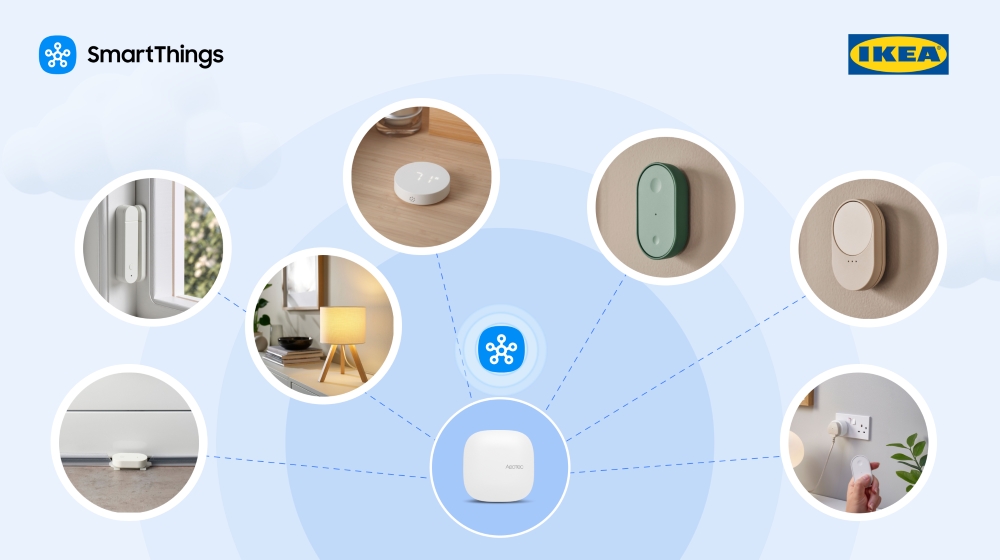
Consider IKEA. In April 2026, Samsung announced enhanced integration with 25 IKEA Matter-over-Thread products, including bulbs, plugs, remotes and sensors. These devices could connect directly to a compatible SmartThings hub, avoiding the additional IKEA hub required by the earlier integration. Cooperation had acquired a tangible benefit: one fewer box to configure.
Samsung buys a route into the house
Samsung acquired SmartThings in August 2014. Contemporary reporting put the price at roughly $200 million; Samsung did not disclose the consideration. The company had raised $15.5 million in venture capital by then, separately from its Kickstarter backing. The acquisition figure belongs in a different column from money raised to run the startup.
Samsung brought a distribution advantage that a young hub maker could scarcely manufacture for itself. It already sold the objects people were placing in their kitchens, living rooms and pockets. SmartThings could become part of those purchases. Under the later Hub Everywhere strategy, selected Samsung TVs, soundbars, monitors and refrigerators gained hub capabilities alongside dedicated hardware.
“It has always been our goal to create a totally open smart home platform”Alex Hawkinson, announcing the Samsung acquisition, 2014
That promise explains both the appeal and the complication. Samsung wants its own products to work well together. SmartThings also needs other manufacturers’ products to belong. A home rarely renews every appliance at once. The platform has to accommodate the uneven accumulation of possessions that constitutes an actual household.
Reported by SmartThings in June 2026. Registrations measure reach; they do not establish daily or monthly active use.
Competitors approach the same house through different doors. Apple Home, Google Home and Amazon Alexa offer alternative consumer ecosystems. Home Assistant explicitly prioritizes open source software, local control and privacy. SmartThings’ particular position combines Samsung appliance access with third-party device support and a consumer app. The best fit depends on the devices and the degree of control a household wants.
The cloud comes down to earth
In 2021, SmartThings introduced Edge, an architecture allowing supported device commands and automations to execute on the hub. Processing a local event locally reduces dependence on a trip through the cloud. It also gives eligible routines a chance to keep working when the internet connection is unavailable. Remote access and cloud-connected integrations still need their online services.
The engineering change had a human cost. SmartThings began migrating away from its legacy Groovy technology in October 2022. Its support guidance warned that unsupported devices without equivalent Edge drivers could become placeholders, unable to participate in automations. Other custom Groovy SmartApps lost support. Some configurations could be rebuilt as routines or scenes; preserving everything was never a sound assumption.
This is the awkward property of a connected home: the physical object may outlast the software arrangement that makes it useful. SmartThings’ published reasoning emphasized speed and reliability through local processing. The transition shows the tradeoff clearly enough without inventing a private moment when executives changed their minds.
The electricity bill joins the conversation
SmartThings Energy adds another practical job. It monitors energy use for compatible devices and offers controls such as AI Energy Mode on eligible Samsung products. It has also received ENERGY STAR certification for smart-home energy management. A dashboard can help a household understand consumption; supported controls can help change it.
The Tesla integration announced in January 2024 broadened the picture to solar generation, Powerwall storage and charging equipment. Electricity Maps provides information about electricity sources and associated carbon emissions. Demand-response programs introduce a further possibility: adjusting participating devices when the grid is under pressure, with rewards where programs are available.
Those benefits are conditional. Savings depend on equipment, settings and behavior. Rewards depend on geography and eligibility. A connected plug appearing in an app does not establish that it participates in every energy feature. The interesting achievement is joining information and action; a universal promise of cheaper electricity would go further than the evidence permits.
Open doors, metered access
The core SmartThings app is free. The household still buys its hardware, and optional services can carry their own terms. For Samsung, the platform also makes connected products more useful together. SmartThings announced an expanded Aeotec hardware partnership in 2020, letting a specialist manufacture and distribute compatible equipment while SmartThings concentrated on the platform.
Business customers have different needs. SmartThings Pro, announced in 2024, applies device management to commercial environments, including displays, climate equipment and appliances. A hotel operator needs repeatable control across rooms. A developer building property-management software needs dependable access to device states. These are commercial uses of the same underlying expertise: connecting equipment and coordinating what it does.
In June 2026, SmartThings announced paid commercial API tiers and a $4.99 monthly plan for individual, non-commercial developers, targeting October availability. It said ordinary app use would be unaffected. For someone maintaining a custom dashboard or external integration, the distinction is consequential. An open ecosystem can welcome other people’s products while charging for a particular route into its infrastructure.
Start with the puddle
There are quieter applications, too. Family Care combines shared activity signals, reminders and location alerts to help caregivers check on loved ones. The recipient chooses what information to share. Device support and account-region rules apply. A door opening is an activity signal; interpreting it still requires knowledge of the person behind the door.
For a reader considering SmartThings, the most useful thing to copy is the original sequence. Name a problem first. Choose compatible equipment second. Build one routine, test it under ordinary conditions, and check what happens when connectivity changes. Leave manual control available. Expand only when the arrangement earns its place.
The Colorado house supplies a better shopping brief than any futuristic showroom. Put a sensor where water would first appear. Make sure the alert arrives. Decide who will act on it. A house does not need an elaborate personality. Sometimes it needs a reliable way to interrupt yours.