Pick up a cheap smart plug, pet feeder or LED strip and the logo on the box may tell only half the story. The brand chose the plastic, the price and the retail shelf. Somewhere underneath, Tuya may have supplied the connective tissue: a module in the device, software at the edge, a cloud account, an app template, remote controls, logs, updates and a path through certification. Tuya's product is the work its customers do not have to do.
That is why the company can be enormous in reach and oddly invisible at breakfast. By the end of 2025, its platform had helped create more than 1.2 million smart-device SKUs in roughly 3,200 categories. It served about 5,900 paying business customers and more than 3,800 brands, with over 1.8 million registered developers spread across more than 200 countries and regions. Yet most consumers would struggle to draw its purple logo.
The product is a shortcut through the swamp
Connected hardware is a parade of tedious decisions. Which radio: Wi-Fi, Bluetooth, Zigbee or Thread? Which cloud region stores the data? How does a phone discover the device? Who keeps the app working after Apple changes iOS? How does a bulb from one factory share a scene with a sensor from another? Matter has reduced some friction, but it has not made product engineering disappear.
Tuya bundles those decisions. A manufacturer can start with TuyaOS or an MCU SDK, choose a connectivity module, configure functions on the developer platform, generate a branded app, test the device and move toward mass production. A property operator can buy industry software for hotels, apartments, lighting or energy. A brand that does not want to coordinate several factories can buy a finished smart solution sourced from qualified OEMs, with Tuya's software already aboard.
Modules + TuyaOS
Embedded software, chips and protocol support give a physical product an identity and a route online.
PaaS + device brain
Provisioning, commands, logs, updates, security and data services keep fleets running after shipment.
Apps + MiniApps
SDKs and white-label apps let brands keep their own name on the consumer relationship.
Agents + spatial AI
One development layer connects multimodal models to cameras, speakers, sensors, appliances and robots.
The customer is not merely a gadget startup. Tuya names Philips, Schneider Electric, Sharp, ABB, Panasonic, TCL and Midea among brands and enterprises its platform empowered in 2025. Its paying base also includes OEM factories, telecom operators, systems integrators, hotels and real-estate managers. They share a blunt constraint: rebuilding a global IoT stack is expensive, slow and irrelevant to what their buyers think they are purchasing.
Tuya's best feature is subtraction. It removes protocols, clouds, app maintenance and certification queues from a customer's to-do list.YesPress analysis
Then every smart bulb arrived at once
The pandemic made Tuya look like a pure cloud rocket. Revenue climbed from $105.8 million in 2019 to $179.9 million in 2020, then leapt 68 percent to $302.1 million in 2021. People were at home, retailers wanted connected things, factories ordered components and the channel filled. Tuya went public in New York that March, bringing in $904.7 million of net proceeds including the over-allotment.
The first thing to fail was not the code. It was the forecast. Consumer demand weakened, inflation rose and distributors were stuck with too many devices. In 2022, Tuya's revenue fell 31 percent to $208.2 million. The company recorded a $3.7 million inventory allowance for slow-moving IoT chips and raw materials. A platform that charged largely according to products deployed discovered how closely its software revenue still followed the hardware supply chain.
THE BOOM, THE BULBS, THE BILL
Annual revenue / US$ millions
Fewer customers, on purpose
The downturn changed what management counted. Tuya had roughly 8,400 customers in 2021. It ended 2025 with about 5,900. The decline was deliberate as well as cyclical: starting in late 2021, the company concentrated sales, support and product work on larger customers with stronger market positions and more staying power. The usual startup reflex says more logos equal more momentum. Tuya learned that a long tail of small accounts can consume attention without surviving the next inventory shock.
It also tightened spending and broadened what it could sell. Smart Device Distribution became Smart Solutions in 2024, a revealing rename. Instead of simply moving boxes, Tuya targeted higher-value products that carry more of its own software - energy systems, AI companions, residential products and robots. Industry SaaS and cloud extras, including camera storage and app customization, provide recurring fees. The core remains deployment-based PaaS, which supplied about 72.5 percent of 2025 revenue.
What did the rebuild cost? In 2025 alone, research and development consumed $89.7 million, or 27.9 percent of revenue. Of 1,441 full-time employees, 1,026 worked in R&D. That is the toll for maintaining the neutral layer across chips, clouds, protocols and countries. It is also why the platform is difficult for a midsize appliance brand to reproduce.
The high
$302.1M revenue, 8,400 customers and a New York listing.
The hit
Revenue falls 31% as consumer demand fades and inventory backs up.
The proof
Revenue returns to $298.6M and non-GAAP operating profit reaches $22.7M.
The new peak
$321.8M revenue, $33.7M non-GAAP operating profit and a larger AI product surface.
The follow-through
Revenue rises 16% to $92.9M and operating margin reaches 10%.
AI leaves the chat window
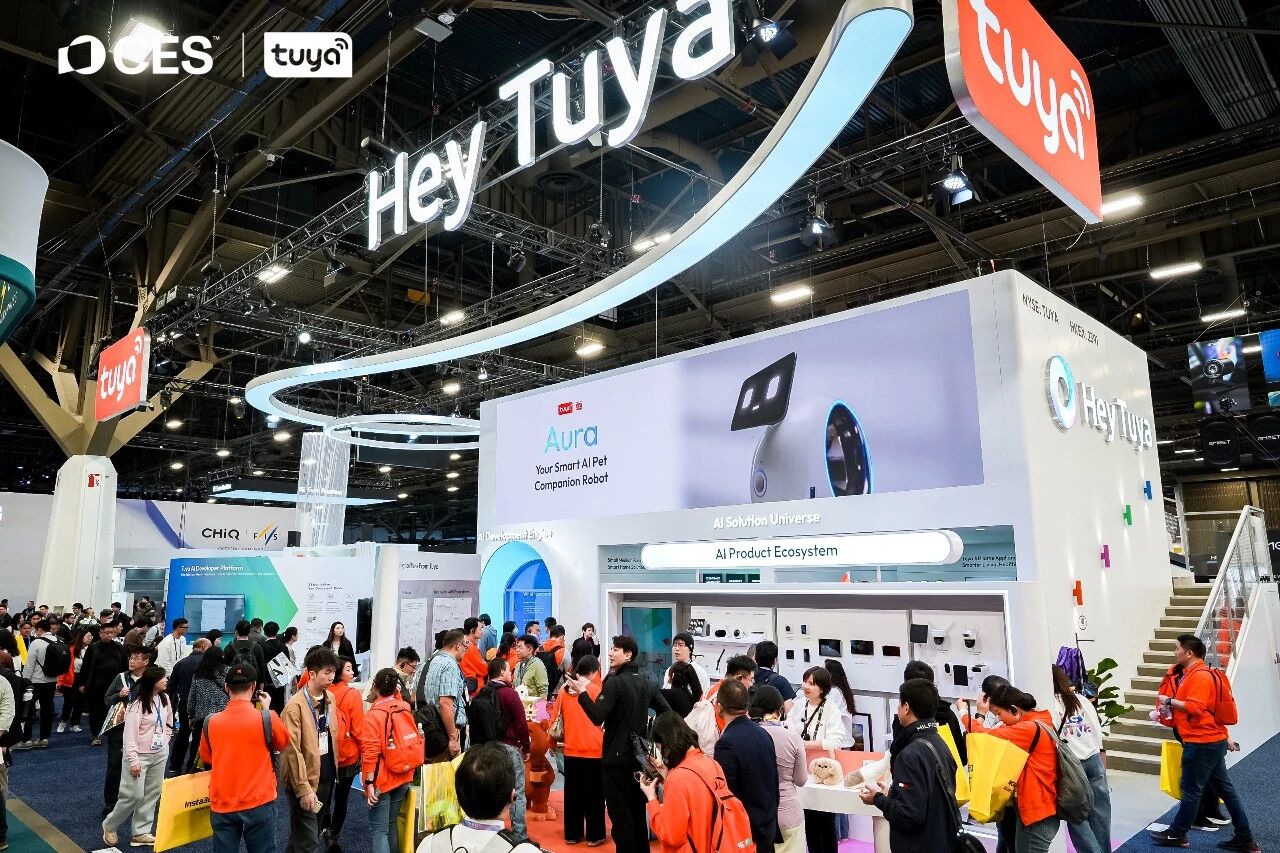
Tuya's latest bet is that artificial intelligence becomes more useful when it can touch the room. Its AI Agent development platform offers developers access to major models through a common toolkit for audio, video, images and text. TuyaOpen brings an open-source route onto supported boards and chips. In late 2025, the company launched Hey Tuya, a multi-agent assistant designed to coordinate home security, energy, office work and everyday devices rather than wait inside one speaker.
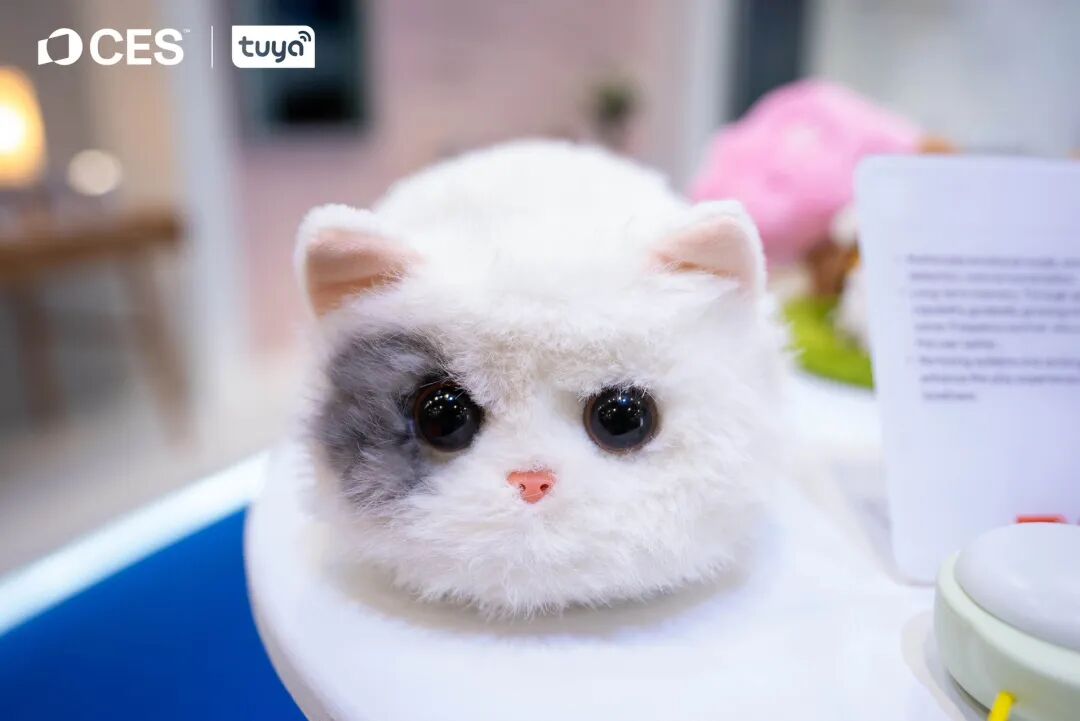
The exhibits are cheerfully strange: a pet collar that interprets animal sounds, an emotional companion that reacts to touch, cameras with AI analysis and a fitness coach represented by a moody cat. The serious idea underneath is coordination. A model can reason; Tuya wants to supply the permissions, device states, sensors and actuators that let it act. The company is organizing this work around AI Home, AI Robot and AI Energy.
This is where Tuya sits in the market. AWS and Microsoft offer deep cloud primitives. Apple, Amazon, Google, Samsung and Xiaomi fight for the consumer control surface. Smaller IoT platforms offer narrower developer stacks. A manufacturer can also build everything in-house. Tuya's difference is the packaged middle: cloud-agnostic, chip-agnostic, protocol-friendly and designed for somebody else's logo. Partnerships with AWS, Apple, the Matter ecosystem, Home Assistant and regional telecom operators extend that neutral position.
The catch hiding in the convenience
Neutral does not mean frictionless. A brand gains speed but accepts dependence on an outside cloud and development roadmap. Privacy rules vary by region. Some enthusiasts insist on local control when the internet goes down. Deeply unusual products can collide with the limits of a standardized template. Large manufacturers may eventually decide the customer data, app experience and recurring service revenue are too strategic to rent.
The economics have another wrinkle. Tuya looks like SaaS, but most revenue still moves with physical unit deployments. That creates lovely operating leverage during a device boom and a nasty echo when retailers stop ordering. Finished smart solutions diversify the offer, but carry lower margins than PaaS. AI can increase value per device, yet model usage adds a fresh cloud bill and consumers have not proved they will subscribe to every talkative appliance.
What another builder can copy
- Find the ugly integration layer customers repeatedly rebuild and turn it into a configurable product.
- Let customers own the front-end brand while your infrastructure compounds quietly underneath.
- Measure account durability, not logo count. A smaller base can produce a stronger platform.
- Add adjacent services only where the shared plumbing gives you a real cost or speed advantage.
The pattern works when a market has many manufacturers, common technical chores, fragmented standards and buyers who value launch speed over total control. It works less well when devices must run offline, data cannot leave a private environment, customization is extreme, volumes are tiny or the customer has enough scale to own the whole stack. The lesson is not “be a platform.” It is narrower: own the boring work that remains boring even when the gadget changes.
Tuya survived its own lesson. Being everywhere did not protect it when everybody had ordered too much. The recovery came from admitting that reach was not the same as quality, then putting more engineering behind fewer relationships. Now it is trying to make the invisible layer visible to AI. Whether Hey Tuya becomes a household phrase matters less than whether thousands of other brands can use its machinery to make physical products noticeably smarter. In Tuya's business, the best outcome may still be that somebody else's name gets the applause.