The first Nanoleaf pitch did not need a studio. Gimmy Chu crawled under blankets, recorded narration on an iPhone, then lip-synced it for a borrowed camera. He and his two co-founders still had day jobs. Their company mostly existed because Kickstarter required a legal entity. The prototype in front of the lens, though, was harder to dismiss: an angular $35 LED bulb that used dramatically less energy than an incandescent. In early 2013, backers pledged $273,278 against a $20,000 goal.
That origin can sound like a familiar crowdfunding fairy tale. It is more useful as a story about changing the question. Chu, Tom Rodinger and Christian Yan met on the University of Toronto solar-car team. They initially worked on a solar product, then faced an awkward commercial fact: they did not know where to sell it. Retailers were unmoved by a clever prototype. They wanted a final price, manufacturing lead time and evidence that the thing would keep working.
The team switched to the object attached to the solar idea. Everyone needed a light bulb. The resulting NanoLight, later called Nanoleaf One, used LEDs mounted on a folded circuit board, giving it the look of a small white jewel. A second Kickstarter in 2014 funded Bloom, a bulb that dimmed from an ordinary on-off switch. Together, the campaigns supplied cash, orders and the answer retail buyers had requested: strangers would pay.
Crowdfunding turned prototypes into receipts
Amounts are Kickstarter pledges, rounded to the nearest thousand. A full bar equals the first campaign's $273,278 total.
The real pivotFrom saving watts to broadcasting taste
The bulbs proved Nanoleaf could design and manufacture hardware. They did not yet make the company culturally distinct. Bulbs disappear into lampshades and price-comparison grids. The original triangular Light Panels, launched as Aurora in 2016, reversed that logic. The source of light became the object on display: an arrangement customers could design, animate, tap, synchronize to music and photograph.
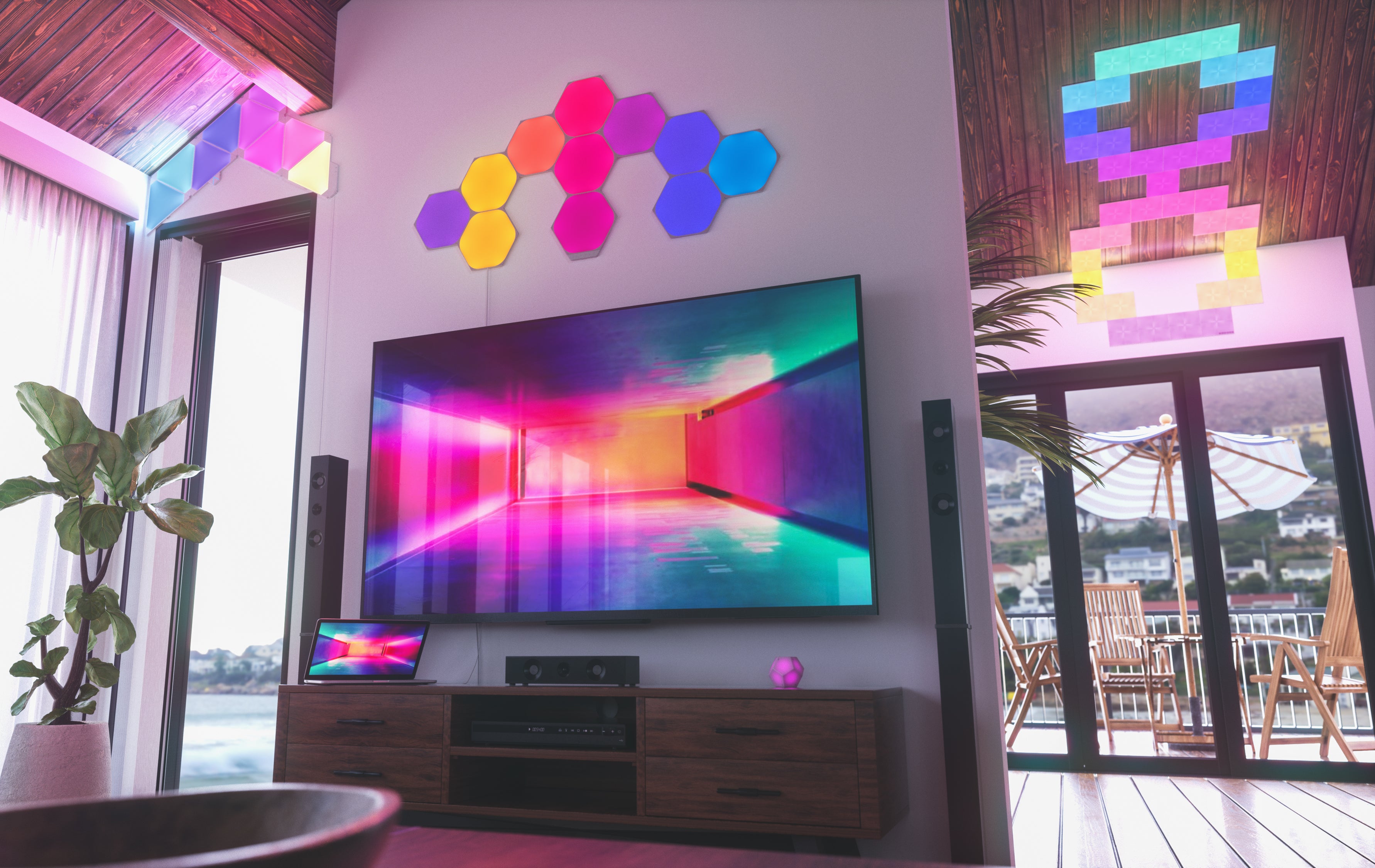
This is the idea worth stealing. Nanoleaf stopped selling only a functional improvement and designed a product that carried its own distribution. A distinctive panel layout appears in gaming streams, desk tours and room makeovers without an explanatory caption. Customers publish their arrangements because the arrangement says something about them. Expansion packs then turn that expression into repeat revenue.
“We just wanted to make cool products.”Gimmy Chu, co-founder and CEO
The company also learned by losing. Nanoleaf aimed to release the first Apple HomeKit smart bulb, but Philips arrived about a month earlier. Chu had found Tim Cook's email on Quora and sent a cold note before CES; Apple's response eventually routed Nanoleaf into the HomeKit partner process. That relationship mattered, but the missed first-place finish did not define the company. The panels did. A founder can lose the obvious feature race and still win a more ownable design position.
What it sells nowA lighting company with increasingly loose borders
Nanoleaf still makes the products people recognize: Shapes in hexagons and triangles, square Canvas tiles, wood-look Elements and backlit Lines. It also sells ordinary bulbs and lightstrips through Essentials; the 4D camera and strip that mirror a television; Skylight panels that move the modular idea onto the ceiling; outdoor strings and permanent exterior lights; lamps, switches and desk hardware.
In 2025, it entered wellness with an LED light-therapy face mask, wand and red-light panel. In 2026 came a Matter-compatible ceiling fixture for everyday rooms and a wooden monitor stand made with Fantaqi, with separate task and ambient light. The portfolio looks unruly, but the shared capability is legible: package LEDs into an attractive object, divide the output into controllable zones, then connect those zones to software and routines.
Its customers range from homeowners automating a hallway to streamers making a background react to a game. Renters buy a starter kit as decor. Families use bulbs and switches for schedules. More recent buyers are being asked to trust the same brand near a mirror or recovery routine. Nanoleaf says its community has more than 2.5 million members and its products reach over 100 countries through more than 200 retail partners.
The business model is mostly straightforward hardware commerce. Nanoleaf sells through its own Shopify store and retailers, with starter kits establishing the controller and expansion packs increasing the layout. Accessories, additional rooms and adjacent product families create repeat purchases. The apps, scene library and integrations make switching less attractive, even when the software itself is free.
The price ladder reveals the design. On Nanoleaf's Canadian store in August 2026, a bulb started around C$25, Shapes starter kits around C$60 and larger arrangements climbed through expansion packs. In the United States, the new ceiling light launched at $79.99 and the monitor stand at $169.99. These are purchases, not subscriptions. Growth depends on turning one useful light into a system: another panel to finish the pattern, a strip behind the screen, a switch across the room. The strategy works when the first product remains enjoyable enough to earn the next socket.
Where it fitsBetween the reliable bulb and the expressive room
Philips Hue remains the premium smart-lighting reference, with a mature ecosystem and a broad catalog. Govee presses hard on colorful ambience, gaming features and price. Lifx offers capable hub-free bulbs; Twinkly owns a share of decorative strings; Ikea, Wiz, Aqara and a growing field of Matter brands make basic compatibility cheaper. Nanoleaf's defensible territory is not simply “16 million colors.” Almost everyone can print that on a box.
| Buying question | Commodity smart bulb | Nanoleaf's answer |
|---|---|---|
| What is the object? | A bulb hidden in a fixture | The fixture, wall composition or illuminated surface |
| Why add more? | Another socket needs one | The layout can grow or another space can join the scene |
| How does it spread? | Search, retail shelf and price | Room tours, streams, layouts and community effects |
| What keeps it useful? | Schedules and voice control | Those basics plus touch, music, screen mirroring and an OpenAPI on supported devices |
The harder part lives behind the color. Nanoleaf must maintain industrial design, optics, power systems, controllers, firmware, mobile and desktop apps, cloud services and connections to Apple Home, Google Home, Alexa, SmartThings, Homey, Razer Chroma, Corsair iCUE and others. Matter and Thread reduce some ecosystem fragmentation, but they do not make the entire customer journey automatic. A Thread product may still require a compatible hub and border router. One update can cross several companies' software.
That complexity explains the sharpest criticism around the brand. Reviews and owner forums contain recurring complaints about pairing, unreachable devices, firmware updates and support. The pattern does not mean every setup fails; many owners report years of reliable use. It does mean the emotional promise of effortless ambience can collide with the unromantic work of resetting a light that has stopped answering.
When the playbook does not work
A visual hardware wedge is weaker when installation is permanent, customers do not enjoy arranging the object, expansion adds little value, or connectivity friction overwhelms the delight. It also breaks when crowdfunding demand is mistaken for manufacturing readiness. A photogenic prototype earns attention; tolerances, firmware and support earn the second purchase.
The 2026 turnA $40 million answer, with a new question attached
In May 2026, OneRobotics, the parent company behind SwitchBot, agreed to acquire Nanoleaf. Reporting based on public filings put the transaction at roughly $40 million over two years. Nanoleaf framed the combination as access to more manufacturing capacity, supply-chain reach and resources. SwitchBot brings a wider connected-home catalog, from locks to robot vacuums; Nanoleaf brings lighting design and years of work with Matter and Thread.
The deal gives the founders' project a new industrial base, but it also sharpens the strategic question. Does Nanoleaf become the lighting layer for a broader automated home, or does a widening list of wellness, AI, robotics and decor products blur the visual idea that made the company memorable? A capability can travel across categories. A brand cannot always do so without explanation.
For another hardware builder, the parts to copy are modest and testable. Start with a demonstration that makes the benefit obvious. Use preorders to answer the commercial questions a prototype cannot. Find the moment when a functional product can become personal. Design an expansion path before launching the starter kit. Open enough of the system that enthusiasts can invent uses. Then budget for the invisible product - setup, updates and support - with the same seriousness as the object in the photograph.
Nanoleaf did not escape a hard market by making a slightly better bulb forever. It moved the light out of the lampshade and onto the wall, where customers could finish the design themselves. The solar idea had no shelf. The panel gave the company a stage.