The modern smart home contains a peculiar sort of magic. A lamp obeys a voice. A thermostat notices the hour. A lock speaks to an app built by a different company on a phone designed by another. When everything behaves, the machinery disappears. There is no applause for the protocol, no toast to the cloud, no family gathering around the router to thank it for its service. The light simply comes on.
Eva Na has made a career of explaining that invisible middle. As Vice President of Marketing and Strategic Cooperation and Chief Marketing Officer at Tuya Smart, she represents a company whose product is less a single object than the connective tissue among objects. Tuya supplies cloud services, development tools and interoperability to brands, manufacturers and developers. Na's task is to make that technical arrangement intelligible across languages, industries and continents.
Her public biography is unusually tidy about the work and discreet about nearly everything else. She is based in Hong Kong and has been at Tuya since 2017. Before that came public communications at Alibaba Cloud, marketing and public relations leadership at retail technology company China Youzan, and consulting at Scapital. Her education ranges cheerfully across film and television art, law, finance and business administration. If the degrees look like a committee designed them, the career makes the committee's logic plain: she learned to frame a scene, parse an argument and speak the language of value.
The first marketer gets every brief
In a 2025 reflection, Na supplied the detail that turns a corporate résumé into a story. Ten years earlier, she wrote, she had effectively become a CMO because she was the first marketer in a SaaS startup and remained the only marketer for two years. The arithmetic is comic and unforgiving. One marketer means every launch is yours, every awkward sentence is yours, every event badge and positioning debate and last-minute slide is yours. Titles become less important when there is nobody to delegate the nouns to.
Tuya was young when Na arrived. It had been founded in 2014, and its proposition required explanation: help other businesses make products smart without forcing each one to build an entire cloud, application and connectivity stack. The result might appear on a shelf as a bulb, camera, socket or appliance carrying somebody else's brand. Tuya's contribution lived underneath, simultaneously essential and easy to overlook.
“IoT technology innovation requires the collective wisdom of thousands of developers.”Eva Na, welcoming developers at CES 2024
Na's answer has been to describe Tuya less as a fortress than a meeting place. Her announcements recur to an “open ecosystem,” and her partnership history gives the phrase some substance: work with Google around smart-home actions, with AWS around cloud infrastructure, with Gartner on a global AIoT developer white paper, and with manufacturers and distributors carrying products into Europe and Southeast Asia. In 2020, she and Gartner China Vice President Guo Lei jointly announced a report that drew on interviews across 35 enterprises and 15 industries. The point was not merely that devices were multiplying. It was that no one company could make the whole room intelligent alone.
How the invisible layer reaches a room
This is where marketing begins to resemble diplomacy. The platform must reassure a manufacturer that it can move quickly, a developer that the tools will hold up, a retailer that the category makes sense, and a consumer that a device from one brand will not become a lonely electronic island. Every partner has a different definition of simplicity. The CMO's work is to create a sentence broad enough to hold them all without turning into soup.
A global stage, measured in rooms
Na's public appearances trace Tuya's expansion by geography and by use case. At a 2021 conference focused on Latin America, she offered an unlikely conversational door: smart-home technology using Zigbee had been deployed on a Mars mission. It was a deft bit of stagecraft. A protocol most people would never discuss at breakfast suddenly had a planetary anecdote.
The work soon became more terrestrial. In 2022, announcing a deeper partnership with Thailand's T3 Technology, Na connected Tuya's platform to products and services planned for Thailand, Vietnam, Malaysia, Indonesia and the Philippines. In 2023 she opened an innovation roundtable in Thailand with media visits to local partners. Her line remained consistent: technology travels through collaboration, and global scale is built region by region.
The recurring Na vocabulary: developers, partners, standards, openness, practical adoption. Her public language treats the ecosystem as the product's route into daily life, rather than decorative corporate scenery.
That approach suits Hong Kong, where her current profile is based: a city fluent in crossings, between markets and systems, spectacle and logistics. Yet Na's career also runs through Hangzhou and Beijing, and through stages from Bogotá to Bangkok, Las Vegas to Baku. Her job is not to flatten those places into a single “global market.” It is to show how the same underlying tools can produce different local answers.
At COP29, the cloud met the meter
In November 2024, Na stood at a COP29 side event in Baku with a green slide behind her and a tablet on the lectern. The photograph catches a telling contrast. The setting promises civilization-sized ambition; her subject is the ordinary discipline of using energy better.
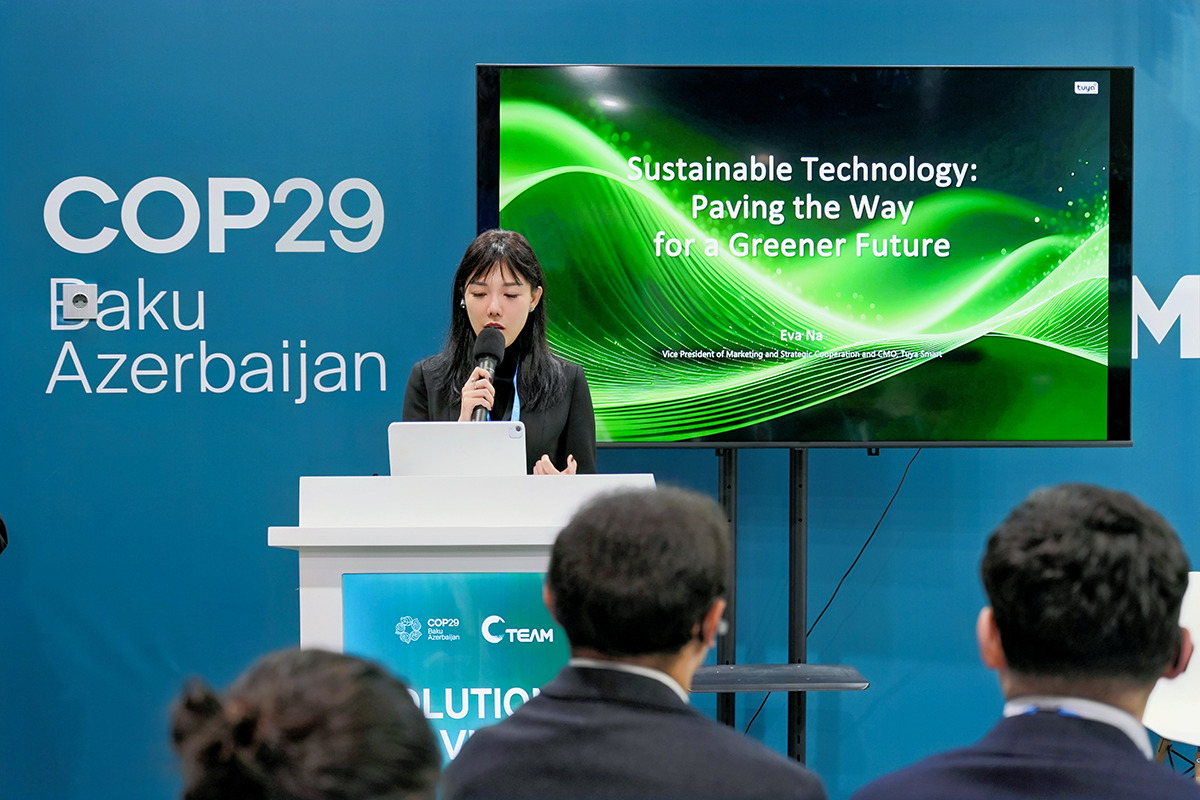
Na introduced Tuya's Smart Decarb initiative there. The premise avoided the usual temptation to make climate technology sound like a chrome-plated prophecy. Connected systems can collect information about energy generation and consumption, make those flows visible, recommend changes and automate adjustments. A building or household can then respond to what is happening rather than what last month's bill vaguely suggests happened.
“AI-driven smart algorithms can automatically optimize energy consumption in real time, creating transparency and efficiency across industries.”Eva Na at COP29
Energy is a shrewd proving ground for Na's larger argument because it gives AI something consequential to do. The system is not composing a limerick about the washing machine. It can observe device states, anticipate demand, coordinate storage and adjust consumption. The intelligence becomes useful when it is attached to the physical facts of voltage, weather, occupancy and time.
By 2026, Na was describing large models as increasingly sensitive to physical changes and energy patterns. She argued that general language abilities could strengthen smaller specialized models and their decision chains. Beneath the technical phrasing sits a very old marketing question: can the product notice what matters, and can it do something about it?
AI gets a body - and a job description
Late in 2025, Na began publishing a concentrated run of essays on LinkedIn. The subjects included AI hardware, the overseas advantages and mistakes of Chinese companies, energy systems, “intuition” in AI, and the effect of automation on marketing. Her most vivid phrase was “physical AI.” The future of AI's imagination, she wrote, was not on a mobile screen but in the way AI transforms the physical world.
It is easy to hear that phrase and picture humanoid robots promenading through a trade show. Na's examples are more useful: a home energy cabinet that learns patterns, devices that understand context, hardware that can be improved through software, and agents that coordinate actions across a system. The phone does not vanish. It simply stops being the only place where intelligence gets to perform.
Her writing about work turns the same lens inward. When AI enters marketing, she asks who is really threatened and what seniority means. In April 2026, she rejected the easy junior-versus-senior contest and moved the question toward judgment and systems. Earlier, she had described “system delivery” as distinct from merely shipping devices. The phrase is inelegant but important. Once intelligence connects components, somebody must own the whole result.
Na's own extracurricular choices add a small wink. In late 2025, amid all this writing about AI systems, she completed Fudan University courses in directing, shooting and editing. The first degree on her public educational timeline was in film and television art. Two decades later, the technology marketer returned to the grammar of scenes and cuts. Clouds may be invisible, but a good story still needs a frame.
The useful thing is the whole thing
Across Na's work, one idea keeps resurfacing: the customer experiences systems, not org charts. A person does not care which partnership made the voice command possible or which development kit connected the sensor. They care that the light turns on, that brands cooperate, that energy use becomes understandable, and that the device does not require a minor in network engineering.
This is also why Na's aspiration to lower barriers to AI adoption deserves attention. Lowering a barrier is less cinematic than unveiling a machine, but often more valuable. It means a developer can start sooner, a manufacturer can avoid rebuilding infrastructure, and an ordinary user can benefit without studying the layer beneath. Good platforms remove work. Good marketing makes the removed work visible just long enough to earn trust.
Na has spent nearly a decade standing at that boundary. On one side are clouds, models, protocols and partnerships. On the other is a room where things should simply work. Her role is to keep the first side rigorous and make the second side feel human. The reward is not that everyone learns to say AIoT. It is that nobody has to.