Matthew Webster keeps the shortest version of his career on a one-page personal website. Beneath his name and a list of formidable brands sit five words and two arrows: “London > LA > Atlanta.” It reads like a flight itinerary. It is really a theory of work. London was where he learned to market culture across markets. Los Angeles was where he learned what happens when the audience is counted in hundreds of millions and launch day resembles a global weather event. Atlanta is where he has accepted a more complicated assignment: helping a public-safety technology company explain what it does, why it matters and how power should be handled.
In September 2025, Flock Safety named Webster its chief marketing officer. The appointment placed a career built in guitars, tickets, music streams, game streams and blockbuster releases inside a civic argument. Flock sells an interconnected mix of cameras, software and other tools to law enforcement agencies, cities, neighborhoods, schools and businesses. Its products promise useful evidence and faster response. They also invite hard questions about privacy, access and accountability. A game launch wants attention. Public-safety technology needs understanding, permission and trust. The second job makes the first look almost innocent.
A résumé through modern attention
Webster's list of former employers doubles as a pocket history of how culture reached people over the past two decades. Fender made the instrument. Ticketmaster sold the seat. SoundCloud and Spotify moved listening onto platforms. PlayStation and Twitch turned play into a connected, participatory spectacle. Activision made the annual release feel like a season in its own right. At each stop, the marketing object changed. So did the clock.
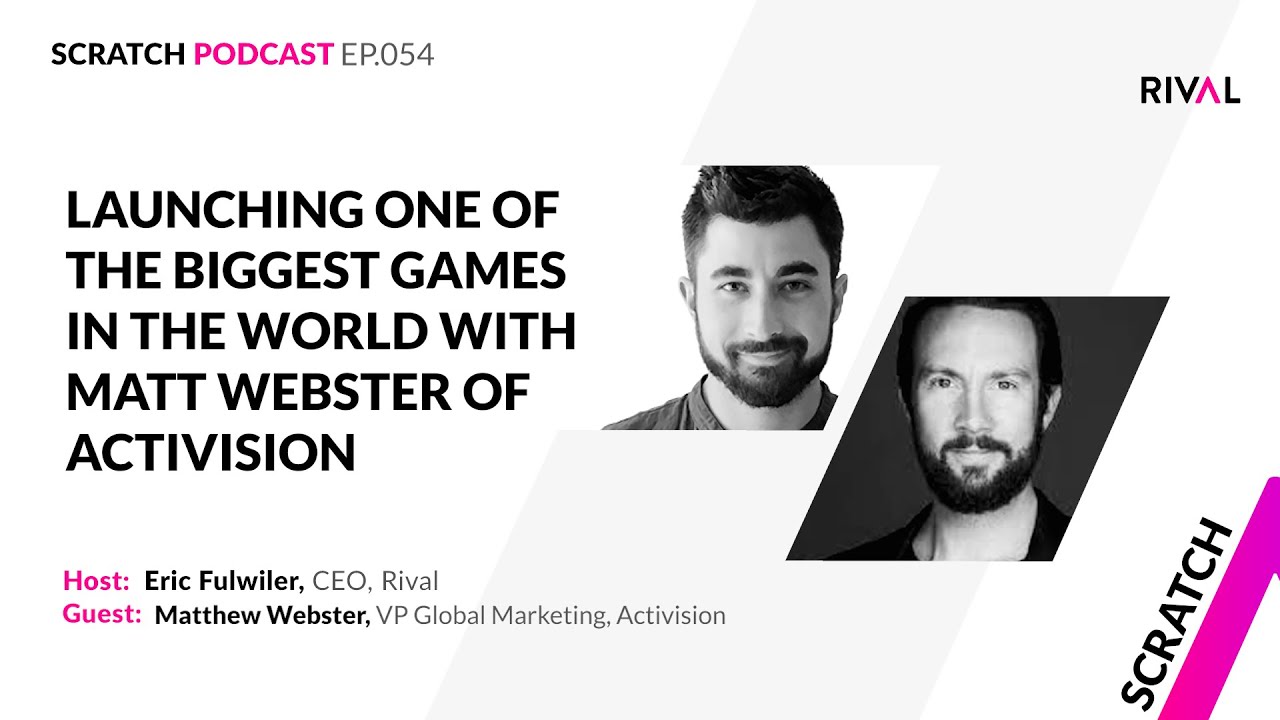
That last difference matters to him. In a 2023 conversation on the Scratch podcast, Webster contrasted the two-to-three-year production horizon of a major Call of Duty title with the three-to-six-month planning window that might surround a software product update. Marketing advice often arrives as if every company moves at one universal speed. Webster's experience argues otherwise. The calendar is part of the product. A campaign must learn the rhythm before it can improve the dance.
His education gave him a conventional starting point: business at the University of Surrey, specializing in marketing. His career then became less conventional by accumulation. He developed digital capability at PlayStation, worked on new-market launches at Spotify and built a mantra at Twitch that he later summarized in three brisk nouns: “speed, scale, and efficiency.” The phrase sounds like something an operations chief might stencil above a warehouse door. In Webster's telling, however, speed was not frenzy. It was the ability to execute, learn and apply the learning without letting a large organization turn to stone.
“Speed, scale, and efficiency.”Matthew Webster on the operating idea he developed at Twitch
The good sense to arrive quietly
Webster moved from London to Los Angeles in the spring of 2022 to join Activision. The instinct of the newly hired executive is to create evidence of arrival: a reorganization, a declaration, perhaps a deck with an alarming number of arrows. He described choosing a quieter opening. Call of Duty already had a deeply engineered launch system and a community capable of detecting inauthenticity before breakfast. He spent his early months learning the product, following community conversation and studying the established sequence of reveals, artwork, preorders, beta access and release.
He also sat with the organization. In his podcast interview, Webster acknowledged the temptation to put a stamp on a new job as quickly as possible. His lesson was to “sit tight, adapt, absorb,” then build trust with internal partners before imposing change. It is not the sort of counsel that makes a dramatic first hundred days. It is more useful than that. He was entering a franchise with a 20-year memory, where novelty had to coexist with ritual.
The result was measured in numbers usually reserved for national economies and very ambitious movie studios. Modern Warfare II generated more than $800 million in sell-through during its opening weekend and crossed $1 billion within ten days. Webster offered a comparison at the time: that opening weekend exceeded the combined box-office openings of Top Gun: Maverick and Doctor Strange in the Multiverse of Madness. Call of Duty's live service had more than 125 million players, while its mobile edition was pushing toward 650 million downloads. Even his language briefly surrendered to the scale. He called it humbling and anxiety-inducing.
Yet the revealing part of the story is not the billion. It is his refusal to treat scale as permission to become generic. Coming from regional and new-market roles, he brought a local eye into a global American hub. Historical revenue could tell the team where the audience had been. It could also encourage the company to keep feeding established markets while underinvesting in the next ones. Webster wanted resource planning to include audience opportunity, cultural context and growth potential. “Global” in quotation marks was not enough. A worldwide campaign still had to land somewhere specific.
Data with a human witness
Webster is plainly a data-minded marketer, but his version of the craft is not a spreadsheet wearing a clever hat. He has described data permeating the work: media-mix modeling to understand where spending changes outcomes, creative testing to compare territories, and weekly iteration across digital channels. He learned from Spotify, whose annual Wrapped campaign turns personal listening data into creative material people volunteer to share. At Activision, quantitative evidence helped choose media and refine creative. Qualitative research kept the player in the room.
He spoke admiringly of Activision's player-insights team and its deep interviews with the community, work that could inform games several years away. The distinction is easy to lose. Data can report behavior at magnificent scale. A conversation can reveal the reason underneath it. Webster's stated starting point at Call of Duty was “the product itself and the community.” Put less politely, there is no dashboard setting for affection.
“The key thing to Call of Duty ... was, firstly, the product itself and the community.”Matthew Webster, Scratch podcast, 2023
His taste in other brands follows the same logic. Asked in 2023 which challengers interested him, he named Athletic Brewing, Duolingo and Airbnb. The selections reveal an appetite for companies that remake category expectations through product positioning, cultural fluency and strong design. He praised Duolingo's distinctive social presence and Airbnb's organizational alignment and consistently high creative bar. These were not obscure selections designed to prove fashionable intelligence. They were businesses whose marketing behavior could be observed, tested and borrowed from carefully.
The product now includes the argument
At Flock Safety, careful borrowing will be essential. The company announced Webster by emphasizing his history of turning brands into trusted household names. Household recognition, though, is not the same as household trust. Public-safety technology is encountered by people who are not conventional customers. Residents do not all sit through a sales demo before a camera appears on a road. Law enforcement may value the speed of an investigative lead while a community asks who can search the data, how long it remains available and what happens when access is misused. Those questions do not interrupt the brand story. They are the story.
Webster's own statement upon joining was ambitious: “Very few companies change how society works.” He called Flock a once-in-a-generation opportunity to change how communities protect and connect with one another. The line carries both promise and burden. A company that claims social consequence also accepts social scrutiny. The marketer's task is not simply to make the technology legible when it succeeds. It is to make the rules, limits and accountability around it legible all the time.
This is where his route becomes useful. Spotify taught him that data can become a creative language. Twitch taught him to move at the speed of an active community. Call of Duty taught him respect for a practiced playbook, the value of regional nuance and the necessity of listening before editing. None of those categories supplies a ready-made answer for public safety. Webster has said as much about marketing lessons generally: they cannot simply be slapped onto a different product. Principles travel. Playbooks pay excess baggage.
The next visible chapter will therefore be less tidy than the arrows on his website. Flock operates where hardware meets software, municipal procurement meets public debate, and evidence meets policy. Its chief marketing officer must speak to institutions without forgetting individuals. He must make complex systems understandable without sanding away the complexity that deserves attention. The work will be judged not only by growth, but by whether the public conversation becomes clearer.
There is a neat irony in Webster leaving an entertainment launch built for enormous attention for a job that may reward a better quality of listening. At Activision, he learned not to barge into a beloved franchise and declare the past obsolete. At Flock, the listening circle is wider and the stakes are less playful. London gave him range. Los Angeles gave him scale. Atlanta has given him consequence. The route is short enough for a homepage. The assignment at the end of it is anything but.