A lawn is a strange place to put a computer. It has rain, mud, tree cover, toys, slopes, dogs and the occasional person who forgot that a robot was coming around the hydrangeas. BESTMOW’s answer is a low green machine with four cameras, RTK positioning and a charging station. The sales pitch is wonderfully plain: draw virtual boundaries in an app, set a schedule and stop spending Saturday behind a mower.
That puts Philadelphia-based BESTMOW in the lively middle of consumer robotics - somewhere between appliance, autonomous vehicle and lawn service. Its T-100 does not need the buried perimeter wire associated with older robot mowers. Instead, it combines satellite-based RTK correction with camera vision, maps the property and follows planned stripes. It returns to charge itself and resumes the job later. The company is not really selling sharper blades. It is selling the disappearance of a recurring chore.
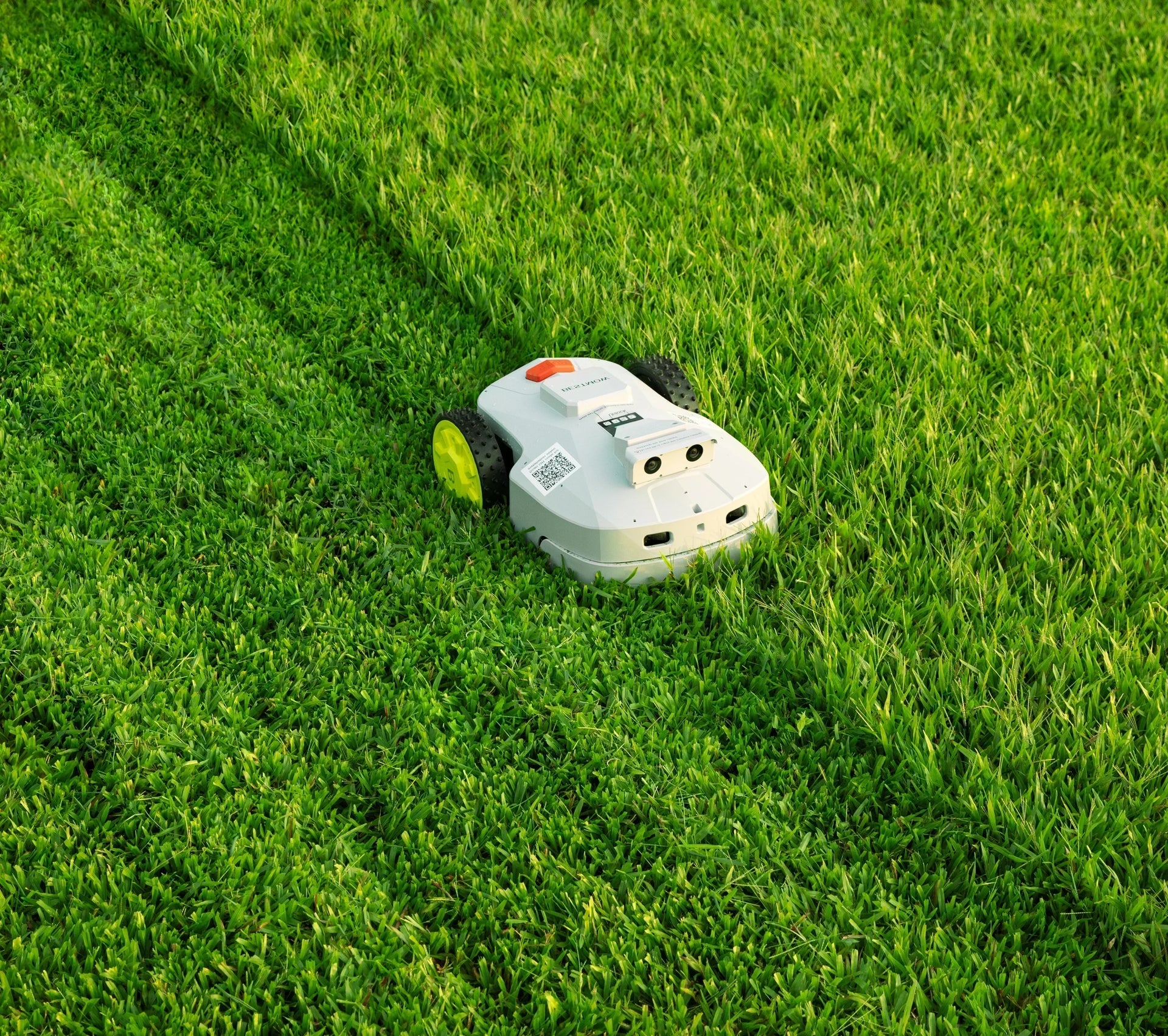
The machine in the grass
The current product is the T-100, advertised for lawns up to 1.5 acres across repeated mowing and charging cycles. BESTMOW says the mower can physically cut as much as 26,000 square feet in a day, though it recommends roughly 8,600 square feet for routine daily maintenance. That distinction matters. “Maximum” is the number for the box; “recommended” is the number for the backyard.
The 41-pound mower cuts an 8.7-inch path with three pivoting blades. Its height adjusts from one to four inches, it can climb a stated 25-degree slope and it is rated IP66 against weather. A 7.5 Ah battery is specified for 210 minutes of mowing, followed by roughly 180 minutes of charging. At 20 percent, the machine heads home; at 80 percent, it can return to work. Its listed 60-decibel noise level is closer to a normal conversation than the roar of a gas mower.
Up front, a stereo camera pair reconstructs depth. Two side cameras expand the field of view to about 270 degrees. The software uses those images for obstacle avoidance, boundary detection and visual localization, while RTK supplies precise positioning. Notably, the April 2026 technical sheet says the mower has no LiDAR, ultrasonic or infrared sensors. It also says there is no 4G connection - only 2.4 GHz Wi-Fi and Bluetooth - despite older promotional copy mentioning cellular control. Buyers should read the current specification, not the ghost of a campaign.
BESTMOW’s sharpest line is six words long: “No Wires. No Weekend Lost.”
Who pays to make mowing disappear?
The obvious customer is a homeowner with enough grass to resent mowing but not enough appetite for a weekly lawn crew. Multi-zone properties are particularly attractive: the app can define no-go areas and schedules without asking the owner to bury wire around every bed. BESTMOW also talks to property managers and commercial operators, where predictable routes and quieter operation can matter. But the T-100 remains primarily a residential machine, and the most persuasive benefit is domestic - fewer hours spent maintaining an object you mostly look at through a window.
As of August 2026, BESTMOW’s U.S. store listed the mower at $879.99, marked down from $1,599, with blades and installation tools included. That is the clean answer to “what did it cost?” The complicated answer is a history of plans. In 2025, BESTMOW offered purchase, 12-month and 24-month ownership plans, loyalty coverage and paid remote mapping. In January 2026, it retired legacy Appstle plans for new customers and shifted U.S. financing to Plaid. By July, Plaid was retiring too. The support site now tells new U.S. and Canadian customers to buy outright through Shopify, Amazon or eBay.
Whatever drove the change, the destination is plain. A direct sale is easier to explain than multiple leasing, financing and ownership tracks. It also moves more risk toward the buyer, who now owns a connected machine whose usefulness depends on firmware, app access, spare parts and support.
What failed first
For several owners posting reviews in summer 2026, the first weak point was not the mower’s ability to cut. It was the system around it. Reports described machines that worked well for a few weeks before app resets, boundary errors, power or charging problems and mismatched equipment. The sharper complaints concerned long waits for human help, delayed replacement parts and repeated troubleshooting. One reviewer captured the divide neatly: the unit worked very well when it worked, but software and support made recovery painful.
These are individual accounts, not a measured failure rate, and BESTMOW’s overall review history includes people who praise the clean cut, battery life, sturdy build and patient support representatives. Still, a cluster of recent complaints matters because it identifies the real product boundary. The mower does not stop at its plastic shell. It includes the base station, correction signal, mobile app, cloud services, warehouse, replacement inventory and the person who eventually answers the ticket.
This is where BESTMOW differs from a simple electric mower and where it competes with Husqvarna Automower, Segway Navimow, Mammotion LUBA, Ecovacs Goat, Worx Landroid and the local lawn service. Wire-free navigation lowers installation friction. Camera-plus-RTK positioning can produce deliberate stripes instead of random wandering. The app makes zones and schedules editable. Yet competitors increasingly offer similar ingredients. The durable advantage will be how reliably the whole loop works, especially after weather, a firmware update or a damaged part interrupts the routine.
The playbook worth stealing
BESTMOW gets the customer psychology right. First, sell back time rather than lead with sensor jargon. Second, make the improvement visible: a robot crossing the grass and leaving stripes is its own neighborhood billboard. Third, remove a hated installation step. “No boundary wire” is valuable because it deletes the afternoon spent trenching cable, not because virtual boundaries sound futuristic. Fourth, make setup a tiny narrative - place the antenna, connect Wi-Fi, map the lawn. A complicated product feels possible when the first three actions fit on a card.
The company also understands credibility by association. Its site highlights a core R&D team with roots in the University of Pennsylvania’s GRASP robotics laboratory and says six PhDs are involved. Founder and CEO Yulai Weng studied robotics at Penn and has discussed how an internship at DJI Enterprise pulled him toward autonomous machines. BESTMOW’s LinkedIn page says the business has $18 million in backing, though it does not publish round details. In February 2026, Weng received a Rising Star Award from the Greater Philadelphia Asian American Chamber of Commerce; the company also opened a Boston “4S” center intended to combine sales, service, spare parts and property surveys.
That service-center idea is more consequential than an award. Outdoor robots encounter local conditions: tree canopies, retaining walls, slopes, patchy Wi-Fi and oddly shaped side yards. A nearby operator who can diagnose the property or swap a component may be more valuable than another percentage point in an AI benchmark. BESTMOW also lists community partners across 18 states, an attempt to give a direct-to-consumer machine some human geography.
When the robot is the wrong answer
This approach will not work everywhere. The RTK antenna needs an open location with roughly a 120-degree sky view. Dense tree cover, tall structures and radio interference can complicate satellite positioning, although vision is meant to help. Slopes beyond the stated 25 degrees are out of bounds. A yard dominated by narrow passages, loose debris or constantly changing obstacles may demand more supervision than the owner expects. The base equipment needs compatible 2.4 GHz Wi-Fi for connected functions, and a lawn larger than the mower’s repeat-cycle capacity changes the economics.
It is also a poor fit for a buyer who wants an appliance with no software dependency. An autonomous mower may save labor when healthy, but troubleshooting can consume the same weekend it was supposed to return. Anyone comparing it with a lawn service should count installation time, blade changes, connectivity, winter storage and the cost of downtime - not just the promotional purchase price.
BESTMOW sits in an appealing market position: below the price and scheduling burden of recurring human lawn care, above the manual labor of a push mower, and alongside a growing class of boundary-free robots. Its mission - quieter, electric, less hands-on maintenance - is sensible. The product can help people who have compatible lawns and value repeatable upkeep more than the ritual of mowing. But the company’s next proof point will not be another cinematic pass across perfect turf. It will be a boring one: when a real machine on a messy lawn has a problem, how quickly does the whole system make it boring again?