The smartest object in a luxury house may be the television you cannot find. In one South Carolina home, it waits in the ceiling. Speakers retreat into plaster and garden beds. Roller shades sleep inside pockets. A rack of blinking electronics sits somewhere sensible and unseen. When the owners want a film, light, shade, sound and screen arrive together - less command center than stage cue.
This is the work of Advanced Integrated Controls, a founder-led company in Bluffton with showrooms there and in Palmetto Bluff. Curt Hubner started AIC in 2006. The firm designs, sells, installs, programs and supports the nervous system of a modern house: lighting, climate, audio, video, security, networking, pool controls, shades and the interface expected to keep all of it civil.
The business is small. LinkedIn places it in the two-to-10-employee band. The 2023 CE Pro 100 recorded an average of 10 full-time employees for 2022, 30 residential installations, one commercial installation and $3.725 million in revenue. That put AIC at No. 92 among the industry's ranked integrators. It is a useful portrait of a local specialist: not a venture-backed platform, not a national retailer, but a compact crew selling judgment by the room, the rack and the wire run.
The product is orchestration
AIC does sell recognizable products - Lutron lighting and shades, Nice control systems formerly branded ELAN, Sonos audio, Sony displays, Leon speakers, Séura outdoor televisions and Kaleidescape movie servers. But a catalog is the least interesting way to understand it. Homeowners can buy plenty of those boxes elsewhere. AIC earns its place in the connections between them.
A published 2017 Palmetto Bluff project shows the density behind the calm. ELAN control joined eight zones of 4K video, 12 audio zones and 45 zones of security, fire and water detection. The Lutron design included 84 centralized lighting zones, 24 local zones, three landscape zones and 17 shades. Outside were three televisions and sound mostly hidden in the ceiling. The machinery was extensive because the interface was meant to be spare.
A complicated house, drawn honestly
The problem is not whether each subsystem can work. It is whether the whole house still makes sense to a guest, a child or an owner returning after six months away. The integrator must choose compatible equipment, plan wire before walls close, coordinate with the builder and interior designer, program scenes, train the household and answer the phone when an update changes something. The hardware comes with a warranty. The experience comes with an accountable human.
“Today everybody wants the best electronics, but nobody wants to see them.”Curt Hubner, founder and owner
A geography disguised as a strategy
The Lowcountry gives AIC a clear customer and a clear set of constraints. Its service area includes Bluffton, Hilton Head, Palmetto Bluff, Beaufort and Savannah. Here are custom estates, second homes and outdoor rooms exposed to glare, humidity, storms and salt air. Owners may travel frequently. Architects care about long sight lines, woodwork and uncluttered walls. A black speaker or a stack of remotes can feel less like technology than an interruption.
That makes concealment practical, not merely theatrical. Motorized lifts protect televisions and preserve rooms when screens are off. Centralized lighting removes banks of switches. Automated shades manage glare and heat. Landscape speakers spread sound without turning the garden into an electronics aisle. Enterprise-grade Wi-Fi and power management support everything that quietly stopped being optional.
The customers are homeowners, but the working audience is broader: custom builders, architects, interior designers and property managers. AIC says it enters new construction, renovations and retrofits, then stays for support and upgrades. That last part matters. In a normal retail sale, the relationship ends at the register. In a connected house, every firmware update, internet outage and changed television source can reopen the project.
What did it cost?
AIC does not publish fixed packages, which makes sense for work whose price moves with square footage, construction stage, finish level and the number of systems being joined. Its Houzz profile lists a typical job cost from $2,500 to $150,000. Treat that as a historical public range, not a current quote. The lower end might cover a focused installation. A large new-build automation system can involve design labor, miles of cable, lighting panels, shades, racks, programming and repeated site visits.
The business model combines design fees and labor with equipment resale, installation and programming, followed by maintenance and upgrades. CE Pro reported recurring monthly revenue at only about 1 percent of AIC's 2022 total. This is still mostly a project business. Revenue arrives in sizable chunks; capacity is constrained by skilled people and calendars; a mistake on site can consume the margin from an otherwise elegant design.
What failed first?
Not every public account is glowing. A one-star Houzz reviewer described difficult scheduling, crooked plates, dangling cables, a promised date missed because the team lacked the right parts, and an expectation that a licensed electrician would attend. Other reviewers describe on-budget work, persistence and responsive service. Together they reveal the actual risk in this category: integration can fail before programming begins.
The first brittle layer is logistics. Custom systems depend on accurate surveys, complete parts, clean handoffs and coordination among trades. A brilliant rack diagram cannot rescue the wrong mount arriving at the house. Premium pricing also raises the standard for ordinary details. A cable left visible becomes an argument against the entire promise.
AIC's own 2025 account of a regional internet outage offers a more technical failure. A degraded primary connection remained technically online, so the router did not switch automatically to Starlink. The backup existed but the trigger misunderstood reality. Physical disconnection forced failover. AIC said forthcoming router firmware should allow more precise controls. It is the kind of edge case that changes an integrator's mind: redundancy is only real when tested against partial failure, not merely a clean outage.
A smart home is a chain of promises. The least glamorous promise - that the correct part and person arrive on Tuesday - can be the most important.
The attic changed the pitch
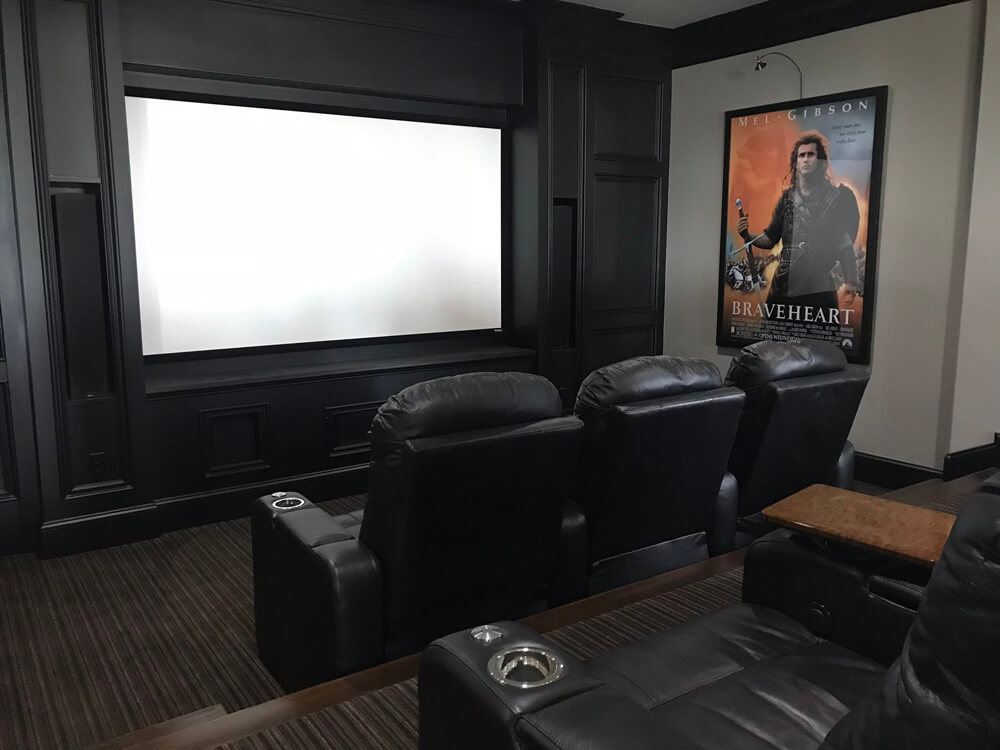
AIC's 2024 “From Attic to Atmos” project turned an attic mechanical space into a family cinema and gaming room. Ketra color lighting reacted to content; a backlit screen worked with Lutron scenes; Kaleidescape, Apple TV and PlayStation shared the system. The company announced three first-place gold honors in that year's CE Pro Home of the Year awards, including recognition for the unusual space.
The useful change is conceptual. A theater is no longer a sealed, burgundy room reserved for movies. It can be a flexible family space, built from square footage that looked awkward on the plan. AIC applies the same thought outdoors, where hidden subwoofers and distributed speakers make a pool, porch and fire pit behave like one audio zone without shouting their presence.
What a reader can copy
Five moves worth stealing
- Sell the outcome, not the inventory. “One button” is clearer than a wall of model numbers.
- Turn local constraints into expertise. Glare, salt, outdoor living and seasonal ownership shape a Lowcountry-specific offer.
- Work upstream. Meet the builder and designer before drywall turns cheap decisions into expensive repairs.
- Standardize the invisible layer. Deep vendor knowledge and repeatable rack, network and power practices reduce surprises.
- Design the bad day. Test internet failover, label manual overrides and leave a path for service after handoff.
There is also a pricing lesson. AIC spans small jobs and six-figure projects, but the promise remains consistent: fewer visible boxes, fewer competing interfaces and somebody responsible for the result. A service company can broaden scope without becoming vague when it keeps one customer outcome fixed.
When it will not work
Professional integration is not automatically better. It is excessive for a renter, a single television and soundbar, or a homeowner who enjoys swapping devices every year. It can disappoint when the budget covers premium hardware but not design, networking and support. A retrofit with no practical wire paths may require compromises. A client who wants every brand regardless of compatibility is buying a science experiment.
Good conditions
- New build or planned renovation
- Several systems must cooperate
- Architecture matters
- Long-term support has value
Poor conditions
- One-room, plug-and-play need
- Very tight budget
- Frequent DIY hardware changes
- No access for wiring or service
The model also strains if an integrator grows faster than its field operations. Custom work resists perfect repetition. Every house contains another trade's decision, an unusual finish or a network condition that looked fine yesterday. The winning system is not the one with the longest feature list. It is the one documented well enough that a technician can diagnose it later and simple enough that the owner does not have to.
That is where AIC fits in the market. Consumer brands make capable devices. Electricians run power. Security firms monitor alarms. Interior designers protect the room. A custom integrator sits in the uncomfortable middle, translating among all of them and accepting blame when the movie has sound but no picture. The moat is not a secret technology. It is accumulated coordination.
AIC's best work makes that coordination vanish. The shades lower, the projector wakes, the lights find their scene and the family presses play. Years of certification, wiring and troubleshooting collapse into a gesture. Expensive technology disappears. The value, finally, becomes visible.
Keep exploring