Hudson Gilmer had a product that could help utilities carry more electricity over the wires they already owned. He also had a problem familiar to anyone who has sold something to a cautious institution: everybody was interested in trying it. Getting them to use it was another matter. LineVision spent its early years moving through research-funded pilots, collecting feedback and improving its equipment. The waiting room had a name. Gilmer called it “pilot hell.”
There is a certain cruelty in selling efficiency to a business whose first obligation is to avoid surprises. Electricity customers rarely send thank-you notes when the lights come on. They do notice when they don’t. Gilmer understood the caution. His job was to make a new way of operating transmission lines dependable enough to belong in that world.
In 2022, National Grid gave LineVision a contract to bring its technology into utility operations. For a founder who had spent years asking for a chance to prove the idea, the question was finally changing: how would it work as part of the everyday grid?
A second career in networks
Gilmer had already watched one network industry change its habits. Earlier in his career, he worked at AT&T on expert systems for planning data networks. He saw circuit switching give way to packet switching and the internet, with consequences far beyond the equipment itself. Networks could carry information differently. New businesses could grow around them.
Energy interested him as another place where information might change what infrastructure could do. At Genscape, the business sold data and analytics to wholesale energy traders. Electromagnetic-field sensors could reveal power flows without touching the lines. Devices placed near rights of way gave customers a view of activity on the grid.
That was valuable to people deciding what to buy and sell. Gilmer and his future co-founders became interested in a different customer: the utility responsible for running the assets. Could similar monitoring help that customer use the network more efficiently? The distinction mattered. Selling intelligence to traders and selling operational tools to regulated utilities brought different expectations about access, security and ownership of data.
Gilmer’s formal route into energy ran through an MBA at MIT Sloan. His subsequent commercial roles included EnerNOC, EnvaPower and Genscape, where he became vice president of commercial markets. The job titles describe a career spent bringing technical work to customers. In a company selling unfamiliar equipment to utilities, that experience would have plenty of use.
The ski club came first
His entrepreneurial practice began on a smaller scale. Growing up mostly in northern New Jersey, Gilmer started a landscaping business with a friend. With another friend, he incorporated a ski club after the school declined to get involved. The paperwork, apparently, was no reason to miss the snow.
He was born in Virginia and went to the University of Toronto. His father worked as a physicist and materials scientist at Bell Labs. Modeling was part of the family background; it became a recurring interest in his own career. Later, at MIT, Gilmer used the freedom to take classes outside his MBA curriculum to explore electric networks and energy policy.
His account of the attraction to energy is refreshingly practical. Waste bothered him. Climate became a stronger motivation later. That starting point helps explain a company whose central proposition is to find usable capacity in equipment already standing outside.
What can an existing network do when its operators have better information?
Leaving the nest, bringing the relationships
In April 2016, Gilmer appeared with scientist Nathan Pinney at a University of Tennessee CURENT seminar. Their subject was Genscape’s monitoring and forecasting work. Pinney covered the technical material; Gilmer presented the commercial side. The program described non-contact transmission monitoring and applications including dynamic line ratings. The division of labor was already visible before LineVision had a company name of its own.
The seminar biography credited Gilmer with helping Genscape expand transmission monitoring to more than 5,000 lines worldwide. It also listed his Toronto honors degree in economics and computer science. The combination is useful context: understanding a network’s behavior and finding a market for that understanding were intertwined in his work.
LineVision spun out of Genscape in June 2018, raising an initial $1 million. By January 2019, it had closed a $2 million Series A led by Clean Energy Ventures. David Brewster, the EnerNOC co-founder, invested and joined the board alongside Clean Energy Ventures’ Daniel Goldman. A connection from an earlier chapter had become part of the next company’s foundations.
The team moved into Greentown Labs in late 2018. A young business selling to established utilities could use more than a desk: the incubator’s network included General Electric and National Grid. Gilmer’s company was entering an ecosystem where potential collaborators, customers and backers were already in conversation.
“We believe passionately that adding monitoring makes the grid more efficient, safer, and cleaner.”
Hudson Gilmer · 2019
By 2019, the ambition had acquired an acronym: METL, for “monitor every transmission line.” At the time, LineVision had 15 people and customers on three continents. Its plan involved reducing the cost and size of its systems so utilities could install them more widely. Even the grand ambition came with a manufacturing problem attached.
How a breeze becomes usable capacity
A transmission line’s capacity depends partly on the conditions around it. National Grid describes the traditional static rating as a calculation using conservative, fixed weather assumptions. A dynamic rating takes account of changing conditions. The wire remains in place; the information used to operate it becomes more specific.
Wind matters because it cools the conductor. Temperature, the conductor’s properties and operating limits matter too. An allowance based on assumptions can leave capacity unused when conditions are favorable. Better information lets an operator judge the available room with greater precision.
A conceptual guide to dynamic line ratings, not a live grid reading.
LineVision’s current approach combines weather forecasts, computational fluid dynamics and field validation. Its models account for terrain, vegetation and structures that affect wind. The apparently simple question of whether a line has spare capacity turns into a local problem: what is the air doing along this particular stretch?
The installation question is equally practical. Today’s RS-1 devices mount on towers and gather environmental and visual data. They use solar power with battery backup. Installation requires hand tools and avoids contact with energized wires. Those details speak to the daily realities of maintaining a network that customers expect to remain available while improvements are made.
The moment the data reached the control room
In May 2024, LineVision announced that its deployment on four National Grid transmission lines in western New York had been integrated into grid operations. The equipment had been deployed in 2022 on 115-kilovolt lines in a region with substantial renewable generation. Automated, condition-specific ratings were now reaching the utility’s transmission control room.
That is a more useful milestone than a ribbon cutting. Installing equipment creates the possibility of a benefit. Integrating its information into the place where operating decisions happen gives that possibility a route into practice. For Gilmer, whose early years involved repeated trials, this was the sort of institutional adoption the company had been working toward.
AES offered another setting in which to learn. Its utilities in Indiana and Ohio worked with LineVision on a deployment across varied transmission lines. In April 2024, the companies published a case study covering the ongoing demonstration. Their work included choosing different kinds of lines and assessing what the technology could contribute to operations and planning.
The collaboration made a point that can get lost in a capacity percentage: utilities need evidence across the conditions they actually encounter. A technology intended for broad use has to survive the particularities of individual networks.
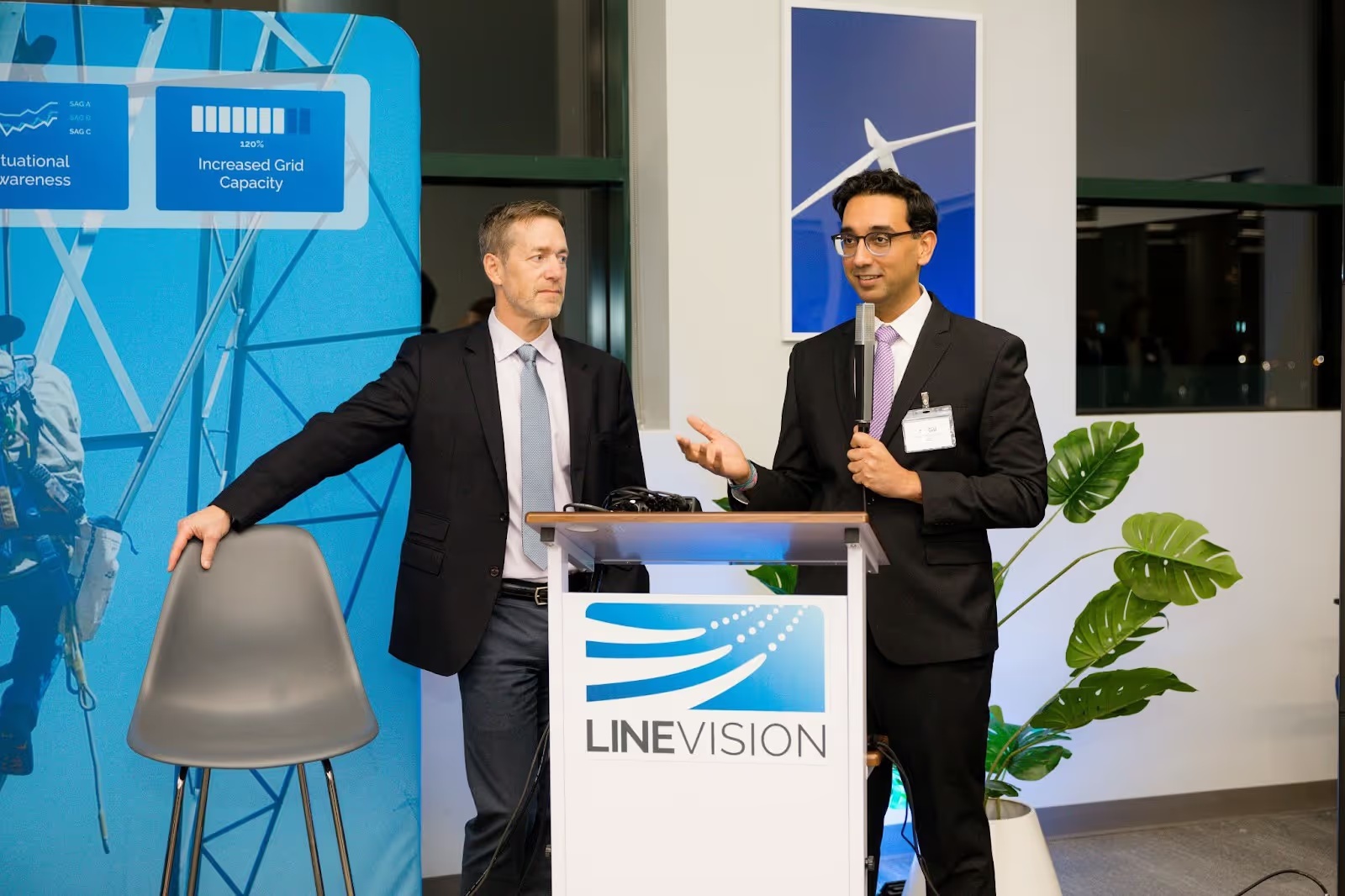
At LineVision’s new-office celebration in 2022, Gilmer and GE’s Sal Gill announced a partnership around Dynamic System Rating. The project brought together line ratings, power ratings and power-flow controllers. It placed LineVision’s work alongside other tools for making existing infrastructure more useful. A transmission network has several constraints; a single instrument cannot conduct the whole orchestra.
Seven years, then a different chair
In October 2022, LineVision announced a $33 million Series C, led by Climate Innovation Capital and co-led by S2G Ventures. Microsoft’s Climate Innovation Fund and Marubeni participated. The financing backed expansion of a business that was already working with utilities in North America, Europe, Japan and Oceania. The scale of the conversation had changed considerably since the first million dollars.
In June 2025, Gilmer moved from CEO to chair of the board. Vishal Kapadia, who had led energy strategy at Walmart, became chief executive. Gilmer remained involved through the board as the company moved into its next stage of deployment.
Five days before the leadership announcement, National Grid had described a British installation covering more than 275 kilometers of overhead conductor. It projected potential consumer savings of around £20 million a year. Those were projections for that deployment, rather than a promise attached to every sensor. They nevertheless showed the kind of customer problem Gilmer’s company was now being asked to address.
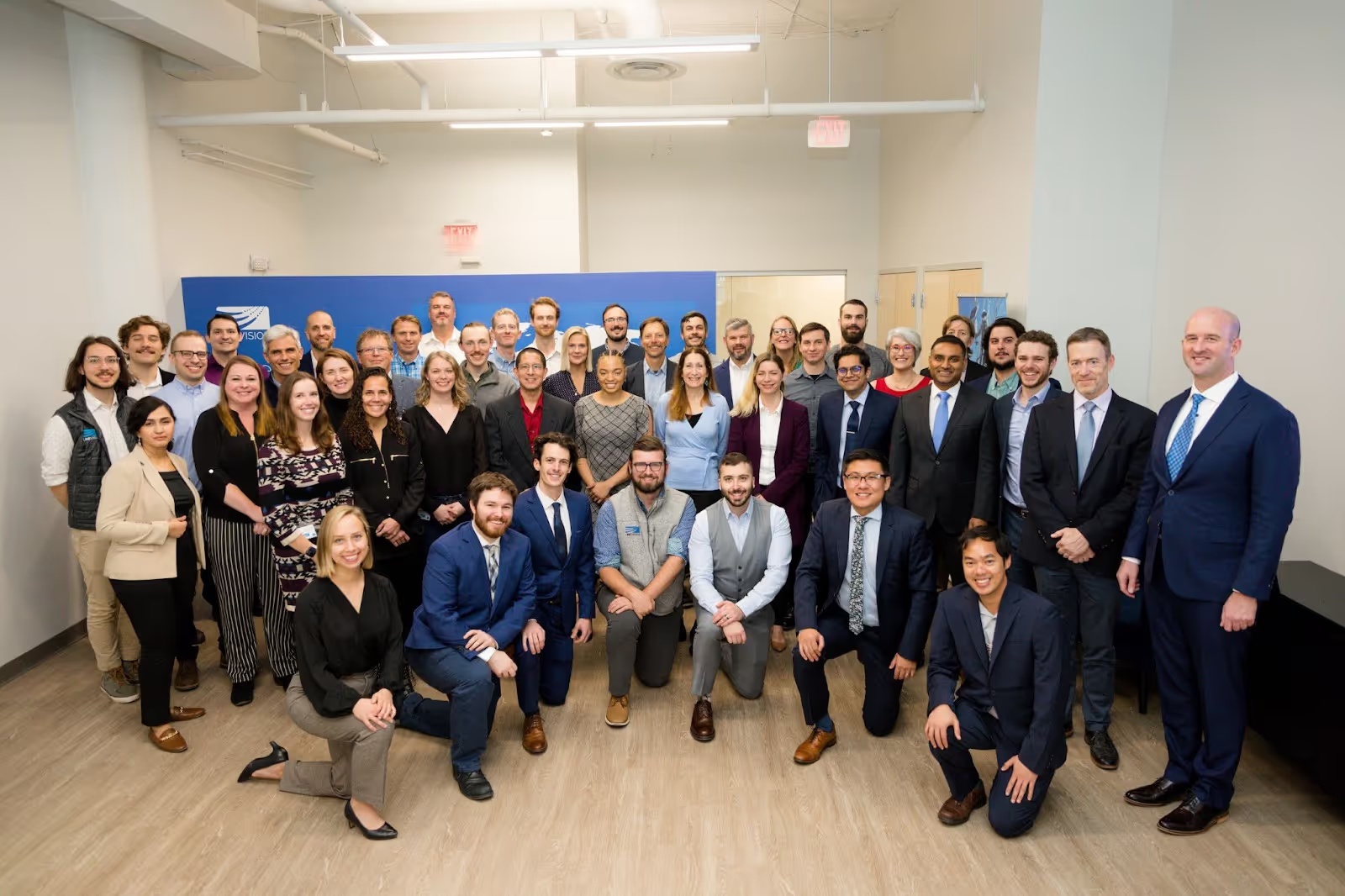
In September 2026, with Gilmer serving as chair, LineVision announced Series D financing totaling up to $37.5 million. Centaurus Capital and New System Ventures led the round, with participation from National Grid Partners and other existing investors. The company’s continuing expansion now belongs to a wider leadership group.
Gilmer lives in Winchester, Massachusetts. Away from work, his official biography puts him on local trails, on foot, bicycle or skis. The teenager who incorporated a ski club has kept at least one early interest. His professional project has also retained its original shape: look carefully at a network, understand what it can do, and make that understanding useful to the people responsible for it.