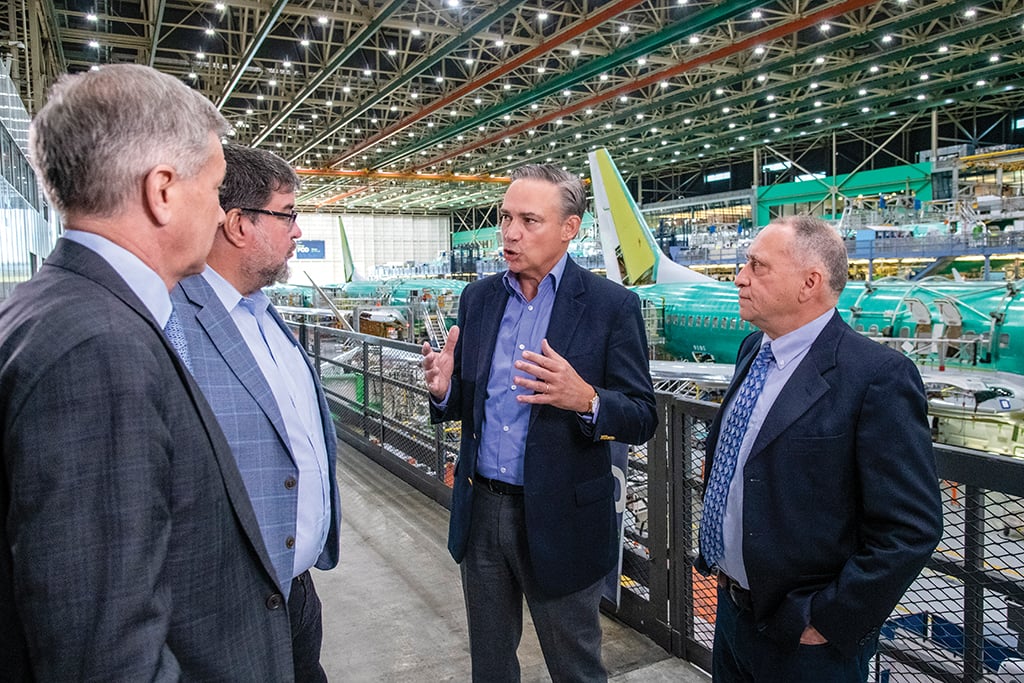
On his first day as Boeing’s chief executive, August 8, 2024, Kelly Ortberg went to Renton, Washington, where workers assemble the 737. An incoming boss has plenty of choices about where to make an entrance. Ortberg chose the factory. He also chose to base himself in Seattle, bringing his office closer to the commercial airplanes whose manufacture he now had to help straighten out.
The geography mattered. Boeing’s corporate headquarters were in Arlington, Virginia. Ortberg would work on the other side of the country. A change of address could hardly repair an airplane company, but it did establish where he intended to look for answers. The distance between a decision and its consequences was about to become a recurring subject of his leadership.
At a Senate hearing the following April, he explained that he wanted Boeing’s leadership nearer the employees who design and build its aircraft. For an executive taking on a company under intense scrutiny, it was a remarkably physical description of the job. Get nearer. See more. Make it harder for problems to remain somebody else’s business.
“…get closer to the people designing and building the aircraftKelly Ortberg · Senate testimony · April 2025
Before Seattle, there was Iowa
Ortberg is a native of Dubuque, Iowa, and graduated from the University of Iowa in 1982 with a bachelor’s degree in mechanical engineering. His first engineering job was at Texas Instruments in 1983. In 1987 he joined Rockwell Collins as a program manager, beginning the long apprenticeship that would eventually put him across the table from Boeing as a supplier.
His route to the top passed through both sides of aerospace: the commercial aircraft that airlines buy and the government systems that military customers require. He became chief operating officer of Rockwell Collins’ Commercial Systems business in 2006, then moved into the corresponding Government Systems role in 2010. He was learning the industry through its working parts.
Those parts gave him a view across competing aircraft makers. His commercial responsibilities included development programs for Boeing’s 787, Airbus’ A350 and Bombardier’s CSeries. He also led the launch of Pro Line Fusion, an integrated avionics system introduced in 2007 and selected for more than 15 aircraft platforms by the time he became CEO. It was a career spent inside other companies’ ambitions.
That background helps explain what Boeing bought when it hired him. Ortberg arrived with experience of the promises an aircraft manufacturer makes to its suppliers, and the promises a supplier must keep in return. A delivery schedule passes through both sets of hands. He had spent years on the side of the relationship where the airplane maker is the customer.
- 1982Mechanical engineering degree
University of Iowa - 1987Program manager
Rockwell Collins - 2013Chief executive
Rockwell Collins - 2018Chief executive
Collins Aerospace - 2024President & CEO
Boeing
A supplier learns to think in whole airplanes
Rockwell Collins named Ortberg president in September 2012 and CEO in August 2013, succeeding Clay Jones. He added the chairman’s role in 2015. These promotions followed years in operating positions, including military avionics contracts for aircraft such as the KC-46A and Embraer KC-390. The new chief executive already knew the products behind the business presentations.
He also knew how to make the business larger. During his leadership, Rockwell Collins bought ARINC in 2013 and B/E Aerospace in 2017, the two largest acquisitions in its history. The deals broadened a supplier associated with cockpit electronics into a company with a wider presence in aviation information and aircraft interiors. Growth meant bringing different businesses into the same organization.
Then Ortberg became part of a much larger combination himself. After United Technologies acquired Rockwell Collins, he led the newly formed Collins Aerospace from December 2018 until February 2020. He subsequently advised the office of RTX’s chief executive until March 2021 and served on its board from 2019 to 2024. By the time Boeing came calling, he had already retired.
His record included a small but relevant distinction: a 2017 Glassdoor Employees’ Choice Award recognizing him among the 100 highest-rated CEOs at large American companies. The recognition came from anonymous, voluntary employee reviews. Such a result describes the people who chose to answer; it cannot stand in for every worker’s opinion. Still, it added an employee perspective to the familiar résumé of contracts and acquisitions.
The uncomfortable part of showing up
Boeing announced his appointment on July 31, 2024. He would succeed Dave Calhoun and join the board as well as take the CEO’s office. It was an outside appointment in the corporate sense, though scarcely an introduction to aerospace. Ortberg had spent much of his working life dealing with the same industry, aircraft programs and institutional customers.
The job demanded more than approachable visits. On October 11, just over two months into his tenure, he told employees Boeing planned to reduce its workforce by roughly 10 percent. Executives and managers would be included. He also described problems on fixed-price defense development programs and promised more direct oversight of that business.
The tension was plain. Ortberg wanted employees to trust the leadership while announcing decisions that would remove jobs. He acknowledged the difficulty those decisions would cause families and colleagues. Being present on a factory floor did not exempt him from the financial choices above it. His employees would have reason to judge both the listening and the decisions that followed.
In his first annual letter at Boeing, he pressed the same point about proximity beyond commercial assembly: leaders needed to spend time in engineering laboratories and other workplaces, understand obstacles and remove them. He also called for barriers between parts of the company to come down. The intended audience included managers accustomed to measuring their own patch of territory.
By April 2025, his Senate testimony put that effort in a public setting. He acknowledged Boeing’s serious mistakes and described changes to its processes and structure. He pointed to employee training, simpler procedures, fewer defects and a stronger safety culture as the work ahead. Those are demanding subjects precisely because they depend on repeated behavior after the visitor has left.
Forty people and an awkward word: culture
Boeing assembled a group of 40 employees from different locations, functions and levels to work directly with Ortberg on the company’s culture. The group helped redefine its values and expected behaviors. Forty people cannot speak for an entire global workforce, but the design put employees inside a task often reserved for senior management and its presentation slides.
The resulting language included safety and quality, trust, a focus on people, ownership and innovation. Some of the instructions were unusually blunt for a corporate values page: “Give a damn!” sat under ownership. Elsewhere, workers were asked to speak up, ask for help and follow through. The vocabulary at least had the virtue of sounding like something a colleague might actually say.
The practical question was whether those instructions would survive a missed target or an inconvenient concern. If an employee raises a problem and a manager welcomes it, the words acquire meaning. If the response is irritation, the words become office decoration. Ortberg’s program made leadership behavior part of the test, exposing the people at the top to the standards being advertised below them.
In April 2026, Boeing reported that 79 percent of employees in its latest survey were proud to work at the company, a rise of 12 percentage points from the previous survey. It was an internal measure, published by Boeing, and it spoke to sentiment. It offered a useful sign of movement while leaving the separate questions of product quality and delivery performance to be answered on their own terms.
of surveyed employees proud to work at Boeing
Bringing the supplier back inside
The supplier’s perspective became especially relevant when Boeing completed its acquisition of Spirit AeroSystems on December 8, 2025. The transaction brought Boeing-related commercial operations, including 737 fuselage production and major structures for other aircraft, into the company. About 15,000 employees across five sites were joining Boeing through the commercial and aftermarket integration.
Ortberg was completing a transaction agreed before he became CEO. The merger agreement dated to June 30, 2024, so the original decision belonged to the company he inherited. Execution now belonged to his team. Boeing described the acquisition as a way to align production systems, quality management, priorities and incentives. A corporate boundary was being redrawn around a manufacturing relationship.
For somebody whose career had developed on the supplier’s side, the task carried a familiar problem in a new form: how to make organizations answerable to the same result. Ownership gives management more authority. Turning that authority into consistent workmanship requires the less photogenic business of procedures, training and daily follow-through. An acquisition announcement is a short document compared with an aircraft’s production history.
The scorecard keeps its own counsel
The second quarter of 2026 supplied a measurable view of the recovery. Boeing delivered 171 commercial airplanes, compared with 150 in the same quarter of 2025. Company revenue reached approximately $24.6 billion. Yet Boeing still reported a $428 million net loss for the quarter. The figures allowed progress and unfinished work to occupy the same page.
More airplanes delivered
That distinction suits the job Ortberg has described. Higher output matters to customers waiting for aircraft and to the finances of the manufacturer. It also creates a continuing obligation to keep the production system stable. Reading delivery numbers alongside the remaining loss is a useful discipline: it prevents a single encouraging statistic from doing the work of a whole assessment.
The phone goes off on the golf course
There is a less corporate Ortberg in the account he gave his university in 2013. He enjoys golf, describing it as “a game that keeps you very humble.” He liked switching off his phone and playing with friends, pursuing the elusive good round. Golf offers a particularly efficient way to remind an executive that a title has no influence over a small white ball.
His connection to Iowa also extends beyond nostalgia. He has served on the university’s Engineering Advisory Board and supported STEM education, including FIRST robotics. In 2018, the university honored him with a Distinguished Alumni Achievement Award, recognizing both his business career and his efforts to encourage women and underrepresented students to enter technical fields.
These commitments place another timescale beside the quarterly results. A future engineer needs encouragement and an education long before an employer needs that person’s work. Ortberg’s involvement with students belongs to the same career as his contracts and acquisitions, but its returns arrive on a different calendar. It is a useful detail in a life spent inside an impatient industry.
The Seattle move remains the clearest expression of his Boeing assignment. He could bring decades of experience, reorganize the reporting lines and put new words on the walls. The people building the airplanes would still have to see what happened when they asked for help. Ortberg placed himself close enough to hear them. What follows that conversation is the work.